Franchisee Collective Bargaining Rights Bills Follow One After Another
Franchisee Groups Visit National Assembly to Request Re-legislation
Included in Democratic Party's 'Top 10 Party Platform Legislation'
Since the early days of the 22nd National Assembly, franchise business law amendment bills granting collective bargaining rights to franchisees have been continuously introduced. The ruling party, the Democratic Party of Korea, which failed to pass the bill in the 21st National Assembly, is determined to push it through as a party line once the parliamentary organization is completed.
According to the National Assembly Legislative Information System on the 21st, Min Hyung-bae, a member of the Democratic Party of Korea, officially proposed an amendment to the Fair Franchise Transactions Act on the 10th. The amendment includes provisions that if a franchisee group requests negotiations on transaction conditions, the franchisor cannot refuse to negotiate without justifiable reasons, and corrective measures along with fines will be imposed. The Fair Trade Commission will impose fines on franchisors violating this law up to 2% of their business revenue.
Considering that leading convenience store companies BGF Retail and GS Retail earn around 240 billion KRW in annual operating profit, fines of up to approximately 5 billion KRW could be imposed.
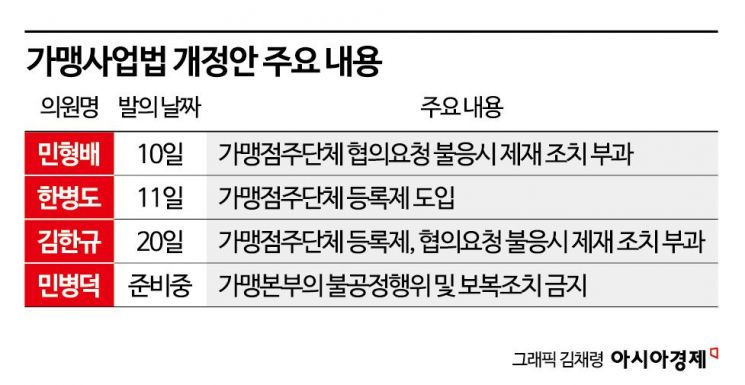
Democratic Party members Han Byung-do and Kim Han-gyu also proposed similar amendments on the 11th and the previous day, respectively. In particular, Han’s amendment includes much stricter regulations, such as excluding items purchasable in the market from mandatory supplies when franchisors supply raw materials to franchisees, and prohibiting franchisees from bearing more than 50% of promotional event costs. Min Byung-duk, another Democratic Party member, is preparing an amendment to prohibit unfair practices and retaliatory measures by franchisors. Min’s office stated, "Since the franchise law is a party line legislation, we are prioritizing and preparing the bill."
These amendments were bills that the Democratic Party and opposition parties pushed until the end of the 21st National Assembly. The amendments included ▲introduction of a registration system for franchisee groups ▲imposition of sanctions for refusal to negotiate upon franchisee group requests ▲prohibition of unfair practices and retaliatory measures by franchisors. The National Assembly’s Political Affairs Committee, which reviewed these amendments, passed them last year solely by the opposition party. When the Legislative and Judiciary Committee delayed the bill’s passage, the Political Affairs Committee even passed a direct submission to the plenary session earlier this year.
In the 22nd National Assembly, the Democratic Party is accelerating the processing of these amendments from the beginning. Recently, Democratic Party members of the Political Affairs Committee included the franchise business law amendment bill among the 'Top 10 Party Line Bills and 6 Household Debt Support Laws.'
At a forum held the previous day at the National Assembly hosted by Democratic Party members titled 'Seeking Solutions to Structural Problems in the Franchise Industry,' members of the National Franchisee Association condemned the franchisors’ abuse of power and urged the amendment of the franchise business law. They argued that franchisors hold various pricing and control rights over sales price, supply price, contract renewal, and operational policies, forming a foundation for unreasonable and unfair relationships. They also criticized some franchisors for designating general commercial products such as cooking oil, powder, napkins, and disposable items as mandatory purchases by relabeling or printing logos through OEM (Original Equipment Manufacturer) or ODM (Original Design Manufacturer) companies to make excessive profits. In particular, recent conflicts between Theborn Korea, led by CEO Baek Jong-won, and franchise brand ‘Yeondon Bolkatsu’ franchisees have intensified, increasing legislative pressure from franchisee groups. A distribution industry official said, "In the 21st National Assembly, the ruling party opposed the bill during the review process, preventing bipartisan agreement and blocking the bill’s passage. Currently, there is concern that regulatory bills could pass without much resistance."
© The Asia Business Daily(www.asiae.co.kr). All rights reserved.

















