Professor Joo Kyungdon's Team at UNIST Develops Precision 3D Technology Combining Point Cloud and Grid Methods
Capable of Reproducing Thin and Complex Structures, Raising High Expectations in Metaverse and Industrial Fields
The 3D reconstruction technology, which has become deeply embedded in our daily lives and across various industries, has now advanced even further.
The precision 3D modeling technology developed by a research team at UNIST is expected to open new possibilities for the restoration of cultural heritage.

The team led by Professor Joo Kyungdon at the Graduate School of Artificial Intelligence at UNIST (President Lee Yonghoon) has developed DITTO (Dual and Integrated Latent Topologies), a technology that reconstructs the shape of objects in detail. This method combines the point cloud approach, which draws shapes by connecting dots, and the voxel approach, which depicts objects within a box-shaped grid.
DITTO converts point cloud data into a grid format and extracts important information by utilizing both types of data simultaneously. Using the DSPT (Dynamic Sparse Point Transformer) analysis tool, it precisely analyzes point cloud data and extracts key features that allow for the accurate modeling of complex and thin objects.
This technology shows the potential to significantly improve the accuracy of 3D modeling in various industries, including medicine, robotics, and virtual reality.
Based on the extracted data, IID (Integrated Implicit Decoder) predicts whether a specific location in 3D space is inside or outside the object. This enables more accurate and detailed 3D reconstruction than existing technologies.
With its improved accuracy, this 3D modeling technology can also be used to precisely restore damaged or broken cultural heritage. By accurately expressing intricate shapes and textures, it is expected to become an important tool for reproducing original forms.
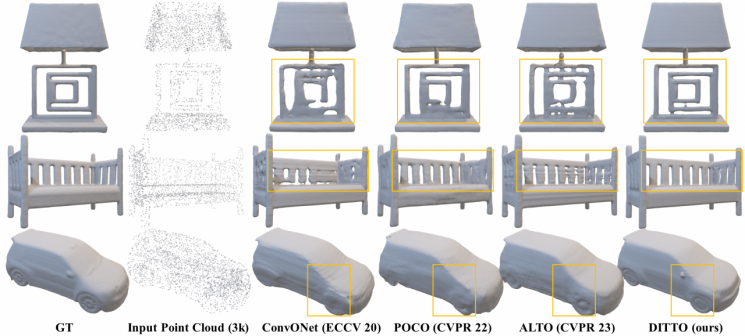
Professor Joo Kyungdon stated, "This research not only enhances the accuracy of 3D reconstruction, but also introduces new approaches for various technologies that use 3D data," adding, "It will be highly beneficial for content and industries such as the metaverse and CAD/CAE."
Shim Jaehyuk, the first author and researcher, added, "This technology could become a new way to represent 3D data and has great potential for technological advancement," emphasizing, "Collaboration with various academic and industrial sectors will play a crucial role in further developing this technology."
© The Asia Business Daily(www.asiae.co.kr). All rights reserved.


















