South Korea was removed from the United States' currency watchlist again in the first half of this year, following the second half of last year.
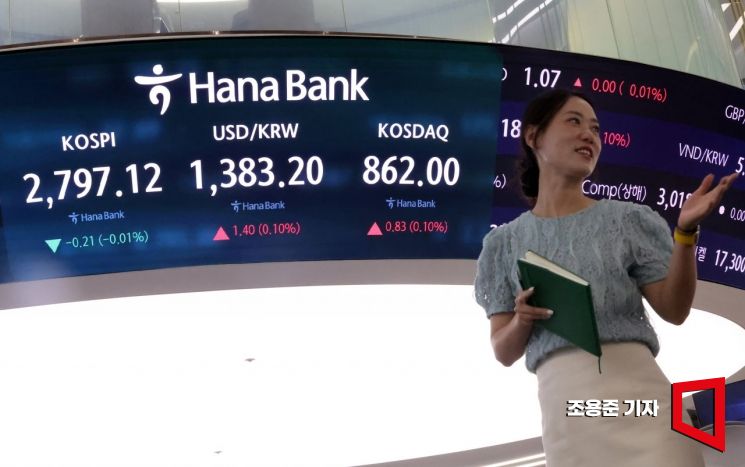 The KOSPI index approached the 2800 mark during the trading session on the 20th, with employees bustling around the dealing room at the Hana Bank headquarters in Jung-gu, Seoul. The KOSPI fluctuated at 2,797.12, down 0.21 points (0.01%) from the previous day. Photo by Jo Yongjun jun21@
On the 20th (local time), the U.S. Department of the Treasury released the "2024 Mid-Year Currency Report," designating seven countries including China, Japan, Malaysia, Singapore, Taiwan, Vietnam, and Germany as currency watchlist countries.
South Korea was excluded from the U.S. currency watchlist again this time, following November last year, marking the first time in over seven years since 2016. Japan, which was removed from the watchlist last year, was added back after one year. Vietnam, China, Germany, Malaysia, Singapore, and Taiwan remained on the list as they were last year.
The United States evaluates the macroeconomic and currency policies of the top 20 trading partners based on trade volume under the Trade Facilitation and Trade Enforcement Act enacted in 2015, and designates countries as either "comprehensive analysis" or "watchlist" if they meet certain criteria.
The criteria mainly include three factors: a trade surplus with the U.S. of $15 billion or more in goods and services, a current account surplus exceeding 3% of Gross Domestic Product (GDP), and net dollar purchases exceeding 2% of GDP for at least 8 out of 12 months. Countries meeting all three criteria are subject to comprehensive analysis, while those meeting two are placed on the watchlist.
South Korea being excluded from the U.S. watchlist for two consecutive times can be seen as recognition of its transparent foreign exchange policy externally. However, government sources explain that even if removed from the currency watchlist, South Korea does not directly gain any benefits or advantages, as watchlist status only means monitoring and does not imply sanctions.
Regarding this report, the Treasury Department stated, "The Biden administration strongly opposes attempts by U.S. trading partners to artificially manipulate currency values to gain unfair advantages over American workers."
The Treasury Department particularly demanded increased transparency from China, stating, "Due to China's failure to publicly disclose foreign exchange interventions and the broad lack of transparency surrounding key features of its currency policy, China has become an 'outlier' among major economies," and emphasized that "close monitoring by the Treasury Department is necessary."
© The Asia Business Daily(www.asiae.co.kr). All rights reserved.
![Clutching a Stolen Dior Bag, Saying "I Hate Being Poor but Real"... The Grotesque Con of a "Human Knockoff" [Slate]](https://cwcontent.asiae.co.kr/asiaresize/183/2026021902243444107_1771435474.jpg)
















