Xi Visits Tibet After 'Tibet Law' Passed on 12th
US Congressional Delegation Meets Dalai Lama in India
Dalai Lama Has Had No Dialogue with China Since 2010
As tensions between the U.S. and China continue over whether Tibet is Chinese territory, Chinese President Xi Jinping visited Tibet to emphasize integration.
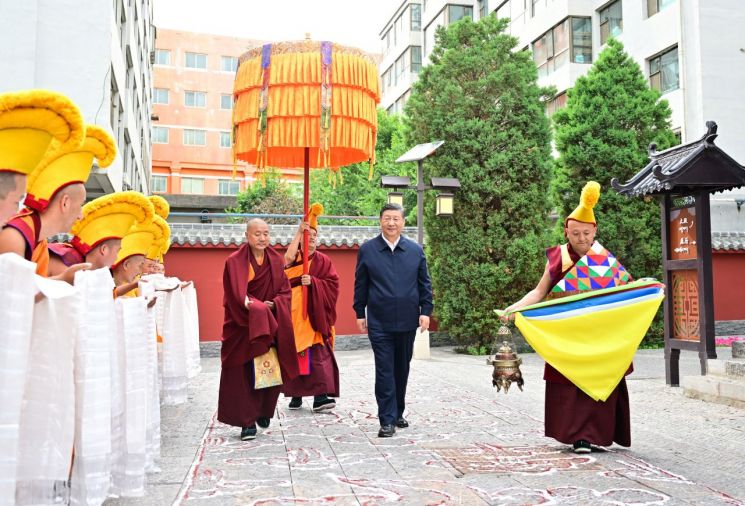 Chinese President Xi Jinping visited a Tibetan temple on the 18th (local time).
 [Photo by Xinhua News Agency]
According to the South China Morning Post (SCMP), President Xi visited the Golok Tibetan Middle School and the Hongjue Tibetan Buddhist Temple in Xining, the capital of Qinghai Province, on the 18th. Xi's visit took place ahead of the 3rd Plenary Session of the 20th Central Committee of the Communist Party of China, which will determine China's major economic directions.
On the 12th (local time), the U.S. House of Representatives passed the "Tibet-China Dispute Act." The bill questions the claim that Tibet is Chinese territory. It also specifies funding to counter false and distorted claims and information by Chinese authorities regarding Tibetan people, history, and institutions.
Following this bill, on the 19th, a bipartisan delegation from the U.S. Congress met with the 14th Dalai Lama, Tibet's spiritual leader, in Dharamsala, India, despite China's objections. The delegation stated, "We visited the Dalai Lama to raise awareness of the importance of the 'Tibet-China Dispute Act' and to encourage dialogue between the Dalai Lama and Chinese officials."
The 14th Dalai Lama went into exile in India in 1959 and resisted China. In 1950, China forcibly annexed Tibet by deploying the People's Liberation Army. At that time, a large-scale uprising demanding independence occurred in Tibet, resulting in many casualties during the suppression. In 1965, China reduced the Tibetan region and incorporated it as the Tibet Autonomous Region (Xizang), one of the 31 provinces, municipalities, and autonomous regions.
During his visit to Qinghai Province for the first time in three years, President Xi emphasized that it is a "strategically key region for maintaining stability in Xinjiang and Tibet." The Hongjue Temple he visited is the site where the Communist Party leadership and Tibetan Buddhist leaders met in 1951.
Xi's father, Xi Zhongxun, then Vice Chairman of the Northwest Bureau, met with the 10th Panchen Lama, Erdini, at Hongjue Temple on December 15, 1951, under Mao Zedong's orders, facilitating his return from exile in India to China. Unlike the 14th Dalai Lama, who resisted China, the Panchen Lama chose a cooperative path with China. He is Tibet's second spiritual leader, succeeding the Dalai Lama.
At a regular briefing that day, Chinese Foreign Ministry spokesperson Lin Zhen said that the Dalai Lama must completely change his political views to resume contact with the Chinese government. Official dialogue between the Dalai Lama and China has been halted since 2010.
According to major foreign media, spokesperson Lin stated, "Our policy regarding contact and negotiations between the central Chinese government and the 14th Dalai Lama is consistent and clear," adding, "The core is that the 14th Dalai Lama must fundamentally reflect and completely correct his political views." He further urged, "We call on the United States to fully recognize the importance and sensitivity of Tibet-related issues and genuinely respect China's core interests."
© The Asia Business Daily(www.asiae.co.kr). All rights reserved.

















