Operation of the 'Water System Replenishment Expert Committee' and 'Policy Decision-Making Body'
Discussion on Establishing Separate Support Systems for Special Accounts and Funds
The government will establish a plan for forecasting and adjusting the supply and demand of medical personnel by September this year.
On the morning of the 20th, the government held the 4th Medical Reform Special Committee (Medical Reform Special Committee) at the Government Seoul Office in Jongno-gu, Seoul, to discuss directions for establishing a forecasting and adjustment system for medical personnel supply and demand to meet future medical demand.
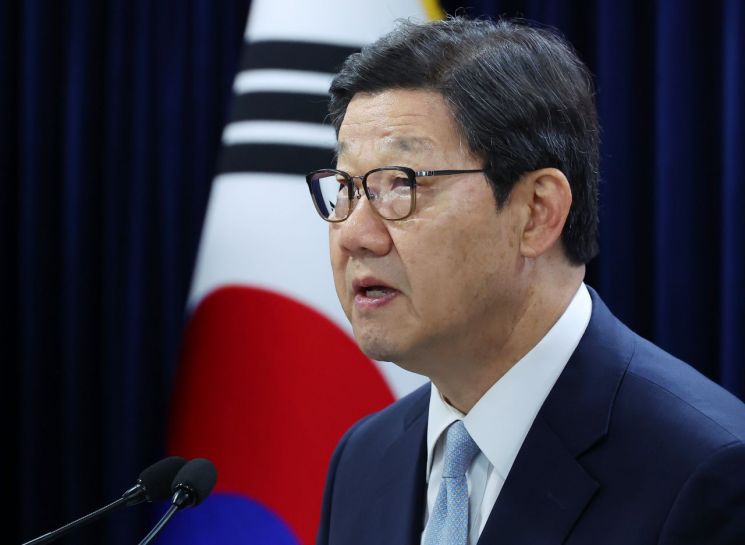 Noh Yeon-hong, Chairman of the Special Committee on Medical Reform, is announcing the results of the 4th Special Committee on Medical Reform meeting held on the afternoon of the 20th at the Government Seoul Office.
 [Image source=Yonhap News]
At the meeting, a plan was reviewed to enhance the scientific expertise and social acceptability of the supply and demand forecast by forming an expert-centered 'Supply and Demand Forecasting Expert Committee' (Expert Committee) and a policy decision-making body separately. Both bodies are characterized by reflecting the voices of patients.
The Expert Committee includes experts in medicine, nursing, public health, economics, demography, and statistics. Members are recommended by providers, consumers, and expert organizations. The committee is responsible for deriving forecasts of medical personnel supply and demand and reporting policy proposals based on these forecasts to the policy decision-making body. It was agreed that external factors such as medical technology advancements, institutional changes, and demand for non-clinical medical personnel like physician-scientists should also be reflected in the forecasting process.
The policy decision-making body discusses workforce policies, including adjusting university quotas for medical schools, based on the supply and demand forecasts from the Expert Committee. The Minister of Health and Welfare serves as the chairperson, and members are composed mainly of representatives from the medical community, consumer representatives, and government ministries.
Later, when establishing policies, the plan to set up advisory committees such as the 'Physician Workforce Advisory Committee' or the 'Nursing Workforce Advisory Committee,' where representatives of professions like doctors and nurses participate in the majority, was also considered to actively gather stakeholders' opinions. Additionally, there was a proposal to newly establish an organization responsible for the practical work of supply and demand forecasting within a national research institute or, in the mid-to-long term, to establish a specialized institution that comprehensively supports health and medical workforce policies.
Based on the discussions held that day, the Medical Reform Special Committee plans to specify the legal status, composition methods, authority, and roles of the supply and demand forecasting and adjustment discussion bodies.
Measures to invest and support essential and regional medical care by combining health insurance finances and national finances were also discussed. The basic policy is to focus health insurance finances on improving fees for essential medical care, while national finances will be invested in workforce training and infrastructure expansion. A plan to invest more than 10 trillion won in essential and regional medical care by 2028 will be detailed, and reforms of payment systems, non-reimbursable services, and indemnity insurance will also be pursued together.
In particular, priority will be given to high-difficulty, severe, and emergency fields, and since appropriate compensation for essential medical care is difficult under the current fee-for-service system, a principle was established to concurrently reform the fee system.
Investments will be made to train personnel in essential medical fields, expand nationwide infrastructure, and strengthen the capabilities of regional base hospitals. The establishment of a separate support system such as a special account or fund to back medical reform was also discussed. The government plans to include specific financial investment plans for medical reform in the government budget proposal, reflecting the discussions of the special committee.
Ways to activate participation in medical reform by the public and the medical community were also discussed. The Medical Reform Special Committee plans to receive health and medical policy proposals from the public to discover reform tasks and officially agenda them in the future.
Additionally, meetings and forums will be held with frontline medical staff, medical school professors, academic societies, and hospital sectors to gather opinions on innovations in education and training systems and the establishment of fair compensation.
There was also a suggestion to launch a campaign to improve the medical delivery system. It will emphasize appropriate medical use according to severity, with mild patients visiting local clinics and severe patients going to tertiary hospitals, and actively inform that emergency rooms prioritize medical staff judgment rather than first-come, first-served. To revitalize regional medical care, people will be urged to prioritize using medical institutions in their regions.
No Yeon-hong, chairperson of the Medical Reform Special Committee, said, "The direction for establishing a medical personnel supply and demand forecasting and adjustment system is the first step to innovate workforce supply and demand policies to ensure rationality and reliability." He added, "It is significant that social discussions on the decision-making structure have begun."
He continued, "Based on the collection of opinions from various sectors and discussions within the special committee, we plan to prepare a plan for establishing a medical personnel supply and demand forecasting and adjustment system to meet future medical demand by September this year."
© The Asia Business Daily(www.asiae.co.kr). All rights reserved.
![User Who Sold Erroneously Deposited Bitcoins to Repay Debt and Fund Entertainment... What Did the Supreme Court Decide in 2021? [Legal Issue Check]](https://cwcontent.asiae.co.kr/asiaresize/183/2026020910431234020_1770601391.png)
















