This summer, which is expected to be hotter and more humid than usual, the maximum power demand is projected to be recorded in the second week of August. The government anticipates a stable power supply and demand situation with a secured supply capacity of up to 104.2GW and emergency reserve resources.
The Ministry of Trade, Industry and Energy announced on the 20th that the maximum power demand this summer is expected to be 92.3GW, similar to last summer's level (93.6GW).
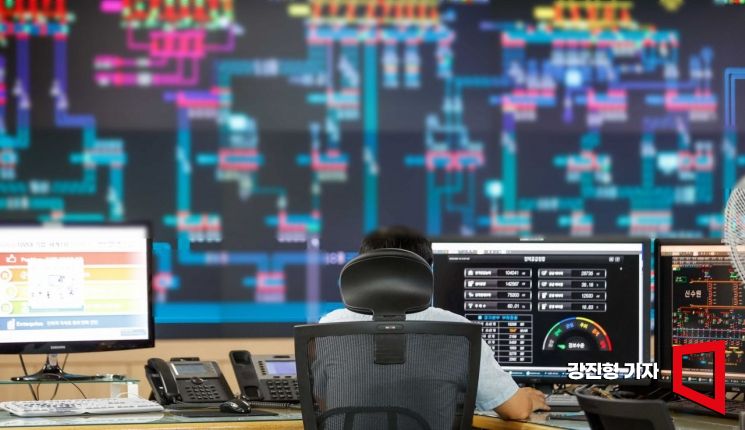 An official is checking the power supply and demand situation at the Grid Operation Center of the Power Management Department, Gyeonggi Regional Headquarters, Korea Electric Power Corporation. Photo by Jinhyung Kang aymsdream@
The maximum power demand is expected to occur on a weekday in the second week of August, when industrial operation rates recover after the industry vacation period. However, the ministry diagnosed that in an exceptional situation where cooling demand is high due to heatwaves in the Seoul metropolitan area while clouds flow into the southern regions lowering solar power utilization, power demand could rise up to 97.2GW.
The power authorities have secured a supply capacity of up to 104.2GW this summer. They plan to operate a total of 21 nuclear power plants, including Shin Hanul Unit 2, which began commercial operation last April. Solar power facilities have also increased by 2.7GW compared to last year, contributing to power supply and demand.
To prepare for unexpected crises such as generator failures and early heatwaves, the power authorities have prepared various supply and demand management measures. First, if reserve capacity becomes insufficient, newly constructed power plants such as Ulsan GPS combined cycle and Tongyeong natural gas plants will be put into trial operation. If reserve capacity is still insufficient despite these measures, emergency reserve resources of up to 7.2GW will be activated, including demand response (DR), increased output of coal power plants, and voltage reduction.
Demand management for rational energy use will also be implemented concurrently. From the third week of July to the third week of August, when intensive management is required, public institutions will sequentially suspend air conditioners for 30 minutes during peak hours (4:30 PM to 5:30 PM). If reserve capacity is expected to fall below 5.5GW, additional measures such as raising indoor temperature standards will be implemented.
As discussed at the high-level government-party meeting held on the 16th, support policies to alleviate cooling costs will also be promoted, including raising the energy voucher amount for vulnerable groups during summer (from an average of 43,000 KRW per household to 53,000 KRW) and expanding the distribution of high-efficiency devices. A system allowing residential electricity consumers who pay more than 100,000 KRW per month and small business owners and root companies with certain documentation to pay their electricity bills for July to September in installments over 2 to 6 months will also be implemented.
The power authorities have designated the period from the 24th to September 6 as the "Summer Power Supply and Demand Countermeasure Period." They will operate a situation room with related organizations to monitor real-time supply and demand status and promptly deploy reserve resources in case of emergencies to manage supply and demand stably.
© The Asia Business Daily(www.asiae.co.kr). All rights reserved.

















