Citigroup AI Report
Insurance, Energy, and Capital Markets Also Expected to Automate 40%
Amid growing concerns that artificial intelligence (AI) will threaten human jobs, it is projected that more than half of banking tasks will be replaced by AI, making the banking sector the most affected industry.
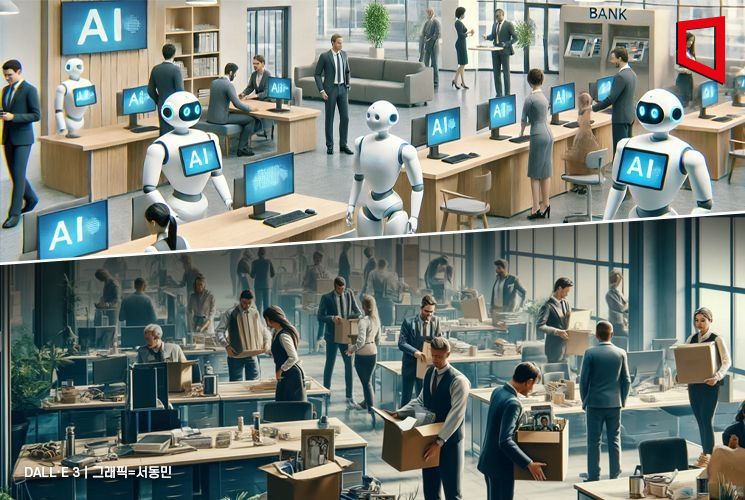
On the 19th (local time), Citigroup analyzed in a report titled "AI in Finance" that approximately 54% of banking tasks will be automated through AI adoption.
The forecast for AI-driven automation rates by industry showed insurance at 48%, second only to banking, followed by energy (43%), capital markets (40%), travel (38%), and software/platforms (36%). Retail (34%), communication/media (33%), public services (30%), and automotive (30%) sectors are also expected to be significantly automated by AI.
The banking industry anticipates that AI will enhance productivity and reduce costs, and is already conducting experiments to increase AI utilization across various operations. Bank of America (BoA), JP Morgan Chase, and Deutsche Bank have introduced AI-based customer asset management services. BoA launched 'Erica,' a financial advisory application, while JP Morgan released 'Index GPT,' an investment product recommendation service using OpenAI models. Deutsche Bank is using AI to review investment portfolios of wealthy clients.
Additionally, Goldman Sachs employs AI in drafting financial contracts to automatically incorporate financial regulations, and ING Group uses AI to identify potential defaults.
Wall Street CEOs expect AI to significantly boost banking productivity. Jamie Dimon, Chairman of JP Morgan, predicted that AI use will reduce the average workweek to 3.5 days. Ted Pick, CEO of Morgan Stanley, also forecasted that asset managers could cut their weekly working hours by 10 to 15 hours through AI utilization.
Recently, the International Monetary Fund (IMF) warned that AI adoption will drastically reduce office jobs in sectors such as law, finance, and healthcare. The IMF projects that 60% of jobs in advanced countries like the United States and the United Kingdom are exposed to AI risks, with half of those expected to experience negative impacts.
However, Citigroup does not see AI adoption as necessarily leading to job losses. It cited the significant increase in bank teller employment from the 1970s to the mid-2000s following the introduction of automated teller machines (ATMs). Citigroup anticipates that as AI technology expands across financial companies’ operations, there will likely be a need to hire additional staff to ensure compliance with related regulations.
David Griffith, Chief Technology Officer (CTO) of Citigroup, stated, "Generative AI has the potential to revolutionize banking operations and improve productivity," adding, "Citigroup is focused on leveraging AI in a safe and responsible manner to empower both the company and its employees."
© The Asia Business Daily(www.asiae.co.kr). All rights reserved.
![Clutching a Stolen Dior Bag, Saying "I Hate Being Poor but Real"... The Grotesque Con of a "Human Knockoff" [Slate]](https://cwcontent.asiae.co.kr/asiaresize/183/2026021902243444107_1771435474.jpg)











