'4th Mobile Carrier' Policy Denied 7 Times Under Licensing System
Main Reason for Rejection: "Lack of Financial Capability"
Changed to 8th Registration System... Concerns Persist
The government's 'Creating the 4th Mobile Carrier' project has already experienced seven failures. Under the licensing system where the government reviews the qualifications of applicant corporations, the companies that expressed their intention to proceed with the project repeatedly failed to overcome the hurdle of 'financial capability.'
Under the licensing system, the government denied the telecommunications business licenses of applicant corporations a total of seven times, including the first applicant, Korea Mobile Internet Consortium (KMI), in November 2010. KMI included not only small and medium-sized enterprises but also large corporations such as Samsung Electronics. Until the seventh attempt, the evaluation criteria for creating the 4th mobile carrier were based on the licensing system. The government assessed the applicant companies' service provision capability, financial capability, technical capability, and adequacy of user protection plans, scoring each item and calculating a total score. The selection criteria required a score of 60 or above in each category and a total score of 70 or above, but no company surpassed these thresholds.
In particular, when examining the reasons for denial for each applicant corporation, financial capability was often a decisive factor. This is because telecommunications businesses require substantial costs for network construction and marketing in the early stages. In fact, in the case of StageX this time, an average expenditure of 150 billion to 180 billion KRW was expected for base station installation.
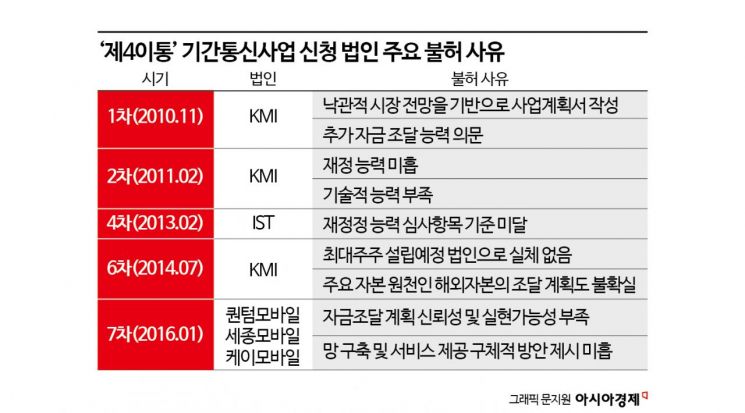
For KMI, which applied in the first and second rounds, doubts about funding ability were the reason for denial. The Internet Space Time Consortium (IST), which applied in the fourth round, was denied due to failure to meet financial capability standards. IST was a consortium centered around the Korea Federation of SMEs. KMI challenged again in the sixth round but was rejected once more because the major shareholder was a planned corporation and the overseas capital procurement plan, the main source of capital under contractual relationships, was uncertain. In the seventh round (Quantum Mobile, Sejong Mobile, K Mobile), the capital procurement plan was deemed unreliable and unfeasible, resulting in failure to meet the licensing eligibility criteria in January 2016.
As financial capability continued to be a stumbling block, the government eventually amended the Enforcement Decree of the Telecommunications Business Act in 2019, changing the registration criteria for telecommunications business from a licensing system to a registration system where companies only need to meet government-designated requirements. The eighth recruitment was the first to be conducted after this transition to the registration system. However, due to the absence of government pre-screening, the financial capability of participating companies became more prominent. This was because small and medium-sized enterprises and mid-sized companies with relatively weaker financial power compared to large corporations such as Sejong Telecom, StageX, and My Mobile applied. The controversy intensified when StageX was selected as the allocated corporation by proposing the highest bid of 430.1 billion KRW. At that time, the Ministry of Science and ICT responded by stating, "Efforts to secure competitiveness and financial capability of new operators depend on each individual operator."
© The Asia Business Daily(www.asiae.co.kr). All rights reserved.
![Clutching a Stolen Dior Bag, Saying "I Hate Being Poor but Real"... The Grotesque Con of a "Human Knockoff" [Slate]](https://cwcontent.asiae.co.kr/asiaresize/183/2026021902243444107_1771435474.jpg)

















