All but one died from heat-related illnesses
At least 550 deaths have been reported during the regular pilgrimage (Hajj) period to Mecca, the holiest site in Islam located in Saudi Arabia.
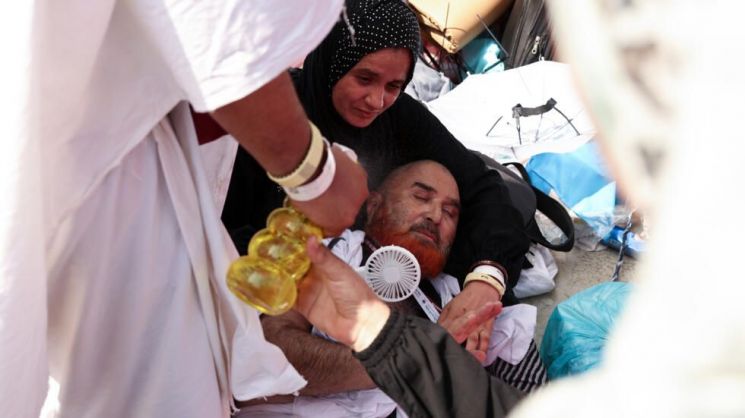
On the 18th (local time), AFP cited several Arab diplomats reporting that since the start of Hajj on the 14th, at least 323 Egyptians and 60 Jordanians were among the minimum 550 people who died. This figure was compiled from the morgue status at a hospital located in Al-Mu'aisim near Mecca. Except for one pilgrim who died in a crowd crush, all the deceased pilgrims reportedly died from heat-related illnesses.
This year's Hajj coincided with summer and was compounded by extreme abnormal weather conditions, which is believed to have caused this tragedy. The Saudi National Meteorological Center reported on the 17th that the temperature at Masjid al-Haram, the Grand Mosque in Mecca, reached 51.8 degrees Celsius. Additionally, a Saudi study released last month pointed out that the temperature in the pilgrimage area has been rising by 0.4 degrees Celsius every decade, indicating the growing impact of climate change.
In fact, scenes were captured locally in Mecca where pilgrims poured water over their heads to cool down, and volunteers distributed cold drinks and chocolates. However, despite these efforts, some pilgrims reportedly witnessed bodies of people lying motionless by the roadside. Saudi authorities announced that they treated more than 2,000 pilgrims suffering from heat-related illnesses but have not updated these figures since the 16th and have not provided information about the deceased, according to media reports.
To participate in Hajj, one must obtain an official Hajj visa issued by Saudi Arabia. However, due to the high cost, many pilgrims attend Hajj through other routes without obtaining a visa. Pilgrims attending via these alternative routes cannot access air-conditioned facilities provided by Saudi authorities, leading to deaths from heat-related illnesses. The reason for the high number of Egyptian deaths this year is attributed to the unusually large number of visa-free Egyptian pilgrims. These visa-free pilgrims caused significant disruption in the Egyptian pilgrim camps, resulting in people enduring long periods without food, water, or air conditioning, which is cited as a reason for the high death toll.
Meanwhile, Hajj is one of the five pillars of Islam that Muslims must perform and is the most sacred religious ritual, held annually from the 7th to the 12th of Dhu al-Hijjah in the Islamic calendar. This year, Hajj lasted up to six days from the 14th to the 19th. Saudi authorities stated that about 1.8 million pilgrims have visited the holy site so far, with 1.6 million of them being international arrivals. Last year, at least 240 pilgrims from various countries were reported dead, most of whom were Indonesians.
© The Asia Business Daily(www.asiae.co.kr). All rights reserved.

![Clutching a Stolen Dior Bag, Saying "I Hate Being Poor but Real"... The Grotesque Con of a "Human Knockoff" [Slate]](https://cwcontent.asiae.co.kr/asiaresize/183/2026021902243444107_1771435474.jpg)














