The Most Common Salary Increase Rate After Job Change Is 1~10%

A survey revealed that 70% of office workers in their 20s to 40s are considering changing jobs. The main reason for considering a job change was dissatisfaction with financial compensation.
According to a survey conducted by the Korea Employers Federation of 1,500 full-time workers nationwide aged 20 to 40, 69.5% responded that they are considering changing jobs from their current workplace to another. By age group, 83.2% of those in their 20s and 72.6% of those in their 30s said they are considering changing jobs. The proportion of those who have already experienced job changes also approached 70%. Those who answered that they had job change experience accounted for 67.8%, with an average number of job changes of 2.8 times.
The reason for considering a job change was overwhelmingly 'salary.' The response of 'dissatisfaction with financial compensation' was the highest at 61.5% (multiple responses allowed). This was followed by ▲excessive workload (32.7%) ▲lower-than-expected evaluation (27.4%) ▲anxiety about the future such as poor company performance (26.6%) ▲for personal growth (25.7%), in that order.
Regarding the meaning of changing jobs, the response 'means to increase annual salary' was the highest at 49.5%. This was followed by ▲opportunity for personal growth 31.8% ▲means to verify capabilities 12.3%.
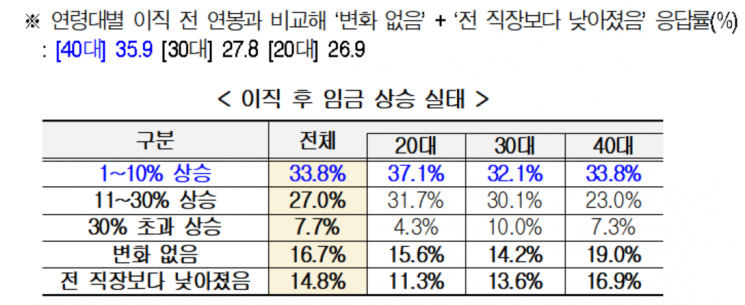
The rate of salary increase after changing jobs was most commonly 1?10% at 33.8%. Those who said their salary rose by 11?30% accounted for 27.0%. The response indicating an increase of more than 30% was only 7.7%. Those who said there was no difference or that their salary was actually cut compared to their previous job accounted for 31.5%.
Kim Seon-ae, head of the Employment Policy Team at the Korea Employers Federation, said, "From a company’s perspective, frequent job changes by employees can cause negative effects such as work gaps or deterioration of organizational atmosphere, and considering the costs invested in employees, it becomes a factor that lowers corporate competitiveness." She emphasized, "Since the biggest motivation for office workers to change jobs is related to financial compensation, companies need to establish fair evaluation and compensation systems, such as introducing job- and performance-based wage systems, to prevent the loss of talented personnel."
© The Asia Business Daily(www.asiae.co.kr). All rights reserved.
![User Who Sold Erroneously Deposited Bitcoins to Repay Debt and Fund Entertainment... What Did the Supreme Court Decide in 2021? [Legal Issue Check]](https://cwcontent.asiae.co.kr/asiaresize/183/2026020910431234020_1770601391.png)
















