Both Forecast and Previous Month Figures Fall Short
S&P 500 and Nasdaq Hit New All-Time Highs Again
Increased Rate Cut Bets... Fed's Kugler Signals "Cut Within the Year"
U.S. retail sales increased last month at a slower pace than expected. It is analyzed that Americans' finances are under pressure due to high inflation and high interest rates. Following recent inflation data, retail sales also fell short of forecasts, confirming signals of a slowdown in the U.S. economy and raising expectations for interest rate cuts.
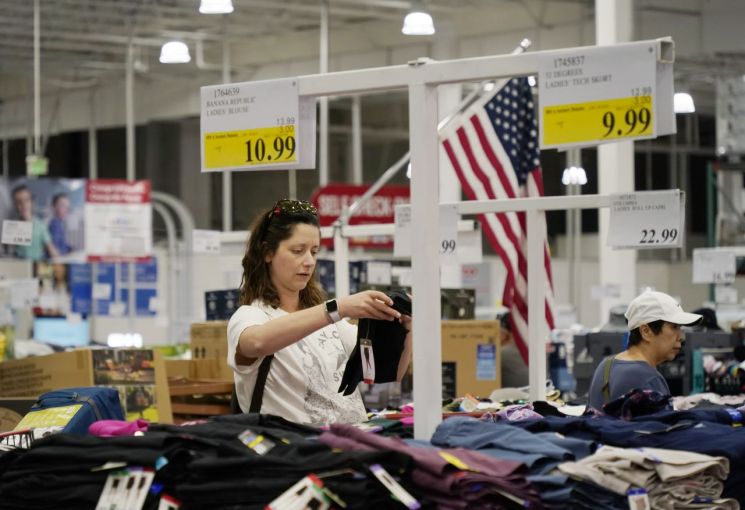
According to the U.S. Department of Commerce on the 18th (local time), retail sales in May rose by 0.1% compared to the previous month. Consumption increased at a pace below market expectations (0.3%). The growth rate was higher than April's figure (-0.2%). The April retail sales growth rate was revised downward from 0% to -0.2%.
Retail sales excluding automobiles and gasoline increased by 0.1%. Although this was lower than experts' expectations (0.4%), it was higher than April's decline of 0.3%.
Among the 13 retail sales categories, five showed a decline. Consumption decreased in gas stations (-2.2%), furniture (-1.1%), building materials, garden equipment, and supplies dealers (-0.8%), and restaurants and bars (-0.4%). On the other hand, consumption increased in sporting goods, music, and bookstores (2.8%), automobile and parts dealers (0.8%), and e-commerce (0.8%).
The retail sales indicator is considered a pillar accounting for two-thirds of the U.S. real economy and is used to assess the overall economic trend. Last month's slower-than-expected consumer spending growth is expected to contribute to the recent slowdown in inflation indicators such as the Consumer Price Index (CPI) and Producer Price Index (PPI).
Within the Fed, there were remarks suggesting that the slowdown in U.S. consumer spending increases the likelihood of interest rate cuts. Fed Governor Adriana Kugler attended an event hosted by the Peterson Institute for International Economics (PIIE), a U.S. think tank, and said, "The long-anticipated slowdown in consumer spending is another signal that (interest rate cuts) may finally be upon us," adding, "If the economy progresses as expected, it would be appropriate to adopt a (monetary) easing policy at some point in the second half of this year."
After the retail sales data release, investors have increased their bets on interest rate cuts this year. According to the Chicago Mercantile Exchange (CME) FedWatch, the federal funds futures market on that day reflected a 67.7% chance that the Federal Reserve (Fed) will cut rates by at least 0.25 percentage points at the September Federal Open Market Committee (FOMC) meeting, up from 61.5% the previous day. The probability of a 0.25 percentage point or greater cut in November rose from 75.6% to 79.8%.
U.S. Treasury yields also declined. The 2-year U.S. Treasury yield, sensitive to monetary policy, fell 4 basis points (1bp = 0.01 percentage points) from the previous trading day to 4.71%, while the 10-year U.S. Treasury yield, a global bond yield benchmark, dropped 3 basis points to around 4.24%.
As the retail sales growth rate fell short of expectations, confirming signals of an economic slowdown, the New York stock market rose across the board. On the New York Stock Exchange (NYSE), the Dow Jones Industrial Average closed at 38,834.86, up 0.15% from the previous trading day. The S&P 500 index rose 0.25% to 5,487.03, and the Nasdaq index increased 0.03% to 17,862.23, marking the 31st and 20th all-time highs this year, respectively.
© The Asia Business Daily(www.asiae.co.kr). All rights reserved.
![Clutching a Stolen Dior Bag, Saying "I Hate Being Poor but Real"... The Grotesque Con of a "Human Knockoff" [Slate]](https://cwcontent.asiae.co.kr/asiaresize/183/2026021902243444107_1771435474.jpg)
















