Deputy Secretary of Commerce Visits Netherlands and Japan
Demands Export Controls on HBM Production Equipment to ASML and Others
Completely Blocks China's AI Semiconductor Technology Development
The U.S. government is reportedly set to request its allies, the Netherlands and Japan, to impose export controls on semiconductor equipment related to China’s artificial intelligence (AI) semiconductor production.
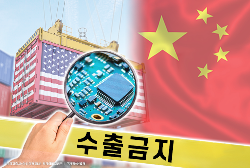
On the 18th (local time), Bloomberg News cited sources reporting that Allen Estevez, Deputy Assistant Secretary for Industry and Security at the U.S. Department of Commerce, will visit the Netherlands and Japan to demand measures to block exports of equipment necessary for producing high-bandwidth memory (HBM) semiconductors, a key technology in AI semiconductor manufacturing, to China.
The U.S. is currently pushing for additional semiconductor regulations aimed at completely blocking China’s access to AI semiconductors. While China has secured competitiveness in general-purpose semiconductors, its technological capabilities lag behind in AI semiconductor fields such as HBM. Accordingly, the U.S. plans to regulate China’s technological development in the AI semiconductor sector, a core area of the U.S.-China advanced technology hegemony competition, from the early stages before China commercializes initial technologies.
In China, companies such as Yangtze Memory Technologies Co. (YMTC), Huawei, and CXMT (Changxin Memory) are currently developing HBM. The U.S. intends to control China’s AI semiconductor development by restricting exports of essential equipment from ASML and Tokyo Electron for HBM semiconductor production. HBM is a high-performance memory created by stacking multiple DRAM chips vertically. It is a core element supporting AI semiconductor operation, with SK Hynix and Samsung Electronics as leading players.
Currently, ASML and Tokyo Electron limit semiconductor equipment exports to China at the U.S. government’s request, but they continue to provide services for equipment already exported. The U.S. has also demanded that ASML and Tokyo Electron restrict maintenance and repair services for advanced semiconductor equipment already sold in China. Deputy Assistant Secretary Estevez is expected to reiterate this demand during his visits to the Netherlands and Japan.
However, the governments of the Netherlands and Japan are reportedly negative toward restricting services for equipment already sold. They argue that the impact of the semiconductor export controls imposed on China by the Biden administration in October 2022 must be evaluated first and have not accepted demands for additional measures. Both countries are expected to decide their stance after observing U.S. semiconductor export control policies toward China following the U.S. presidential election in November.
Meanwhile, China plans to seek breakthroughs by cooperating with countries that have not joined the U.S. semiconductor export controls. Earlier, on the 12th, China’s Ministry of Foreign Affairs strongly criticized the U.S., stating, "The U.S. claims to want dialogue with China regarding AI but is preparing to pressure China’s AI technological development," calling this a "false face of the U.S. whose words and actions do not match."
© The Asia Business Daily(www.asiae.co.kr). All rights reserved.
![Clutching a Stolen Dior Bag, Saying "I Hate Being Poor but Real"... The Grotesque Con of a "Human Knockoff" [Slate]](https://cwcontent.asiae.co.kr/asiaresize/183/2026021902243444107_1771435474.jpg)















