Speed Race Targeting July Plenary Session Approval
Adoption of Minister of Science and ICT and Chairman of the Korea Communications Commission as Witnesses for July 25 Current Issues Inquiry
The National Assembly's Science, Technology, Information and Broadcasting and Communications Committee on the 18th unilaterally passed the so-called "Broadcasting 3 Acts" and the amendment to the Act on the Establishment and Operation of the Korea Communications Commission, which the Democratic Party of Korea is pushing as party policy. The bills have been forwarded to the National Assembly's Legislation and Judiciary Committee.
When a bill is submitted to the relevant standing committee in the National Assembly, it is usually sent to the Subcommittee on Bill Examination for review and resolution. However, the Science and Technology Information and Broadcasting and Communications Committee (STIBC) decided at its plenary session on the 14th to conduct the review and resolution directly, thereby bypassing the subcommittee review stage. The Broadcasting 3 Acts refer to amendments to the Broadcasting Act, the Korea Broadcasting Culture Promotion Foundation Act, and the Korea Educational Broadcasting System Act. These bills had passed the plenary session in the 21st National Assembly but were discarded due to President Yoon Seok-yeol's exercise of the veto power. The legislation includes provisions to increase the number of directors of KBS, MBC, and EBS, granting seats to external groups such as press organizations and civic groups, thereby fundamentally changing the governance structure. Alongside the Broadcasting 3 Acts, the newly processed Korea Communications Commission Act in the 22nd National Assembly includes provisions to increase the quorum for the KCC's resolutions from the current two standing members to four.
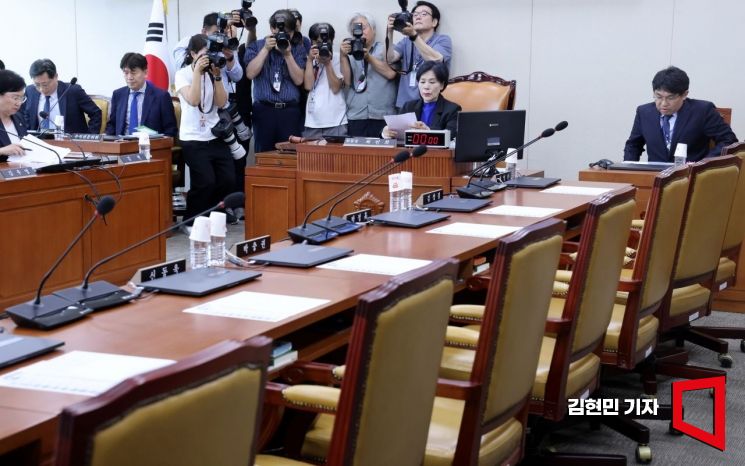 On the 11th, the Science, Technology, Information and Broadcasting and Communications Committee held a plenary meeting at the National Assembly without the participation of ruling party members. Photo by Hyunmin Kim kimhyun81@
The opposition parties refer to these four laws as the Broadcasting Normalization Acts and are eager to process them first, while the ruling party calls them laws for permanent left-wing control of broadcasting and opposes them.
Lee Jun-seok, a member of the Reform New Party, commented on the bill's processing, saying, "Even if these bills are swiftly brought to the plenary session and passed, it seems obvious that the president will exercise the veto power," adding, "I think negotiations should be held to minimize the possibility of veto so that the appointment procedures for the boards and presidents of public broadcasters starting in August can be effective." He further stated, "I hope the legislative schedule proceeds with consideration of how to reduce the impact of the veto power."
Kim Hyun, the Democratic Party's STIBC secretary, said, "We expect the bills to be processed within July," and added, "The opposition is willing to negotiate with the ruling party, so if they want to negotiate, members of the People Power Party should come to the standing committee."
The STIBC had planned to summon Minister of Science and ICT Lee Jong-ho and KCC Chairman Kim Hong-il for a current affairs inquiry on the day, but they did not attend. Accordingly, the committee has requested their attendance as witnesses for the inquiry scheduled on the 25th.
© The Asia Business Daily(www.asiae.co.kr). All rights reserved.
!["The Woman Who Threw Herself into the Water Clutching a Stolen Dior Bag"...A Grotesque Success Story That Shakes the Korean Psyche [Slate]](https://cwcontent.asiae.co.kr/asiaresize/183/2026021902243444107_1771435474.jpg)
















