If Medical Treatment Is Refused or Neglected, Exclusion from 'Health Insurance Medical Expense Advance Payment' Applies
On the 18th, the government stated regarding the Korean Medical Association's (KMA) collective strike, "We will do our best to minimize patient damage caused by illegal collective refusal of medical treatment and to bring it to a swift conclusion." The government plans to strengthen the emergency medical system, and if the collective strike prolongs causing hospital losses, it will consider claiming damages and excluding hospitals that tolerate collective refusal of medical treatment from the advance payment system for health insurance medical fees.
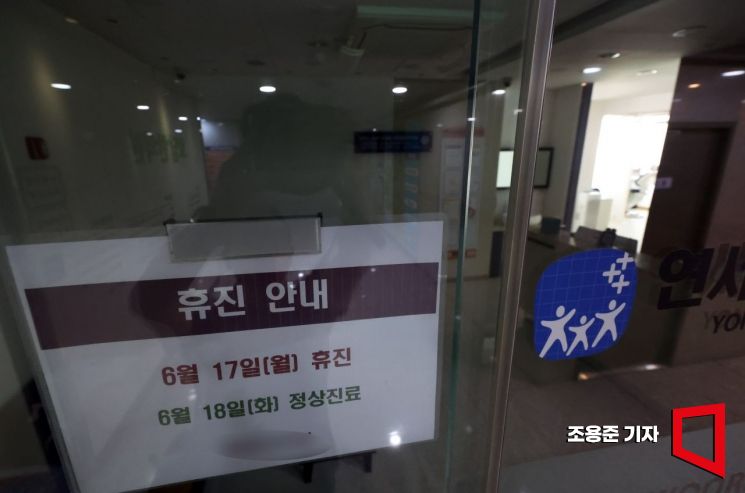 Following the indefinite closure of Seoul National University Hospital, on the 18th, hospitals and clinics nationwide decided to close under the leadership of the Korean Medical Association. A notice indicating closure on the 17th and normal operation on the 18th is posted at a hospital in Seoul. Photo by Jo Yongjun jun21@
On the 18th, Jeon Byeong-wang, Director of Health and Medical Policy at the Ministry of Health and Welfare, said at the Central Disaster and Safety Countermeasures Headquarters (CDSCH) briefing on doctors' collective action, "We will strictly respond to illegal acts while doing our utmost to engage in dialogue and persuasion with the medical community."
Director Jeon stated, "Collective refusal of medical treatment violates the purpose and intent of the KMA's establishment," adding, "The government may restrict certain freedoms as prescribed by the Constitution and laws when necessary to protect the public welfare and maintain social order, including protecting the life rights of citizens." He further added, "Doctors are granted benefits such as supply restrictions through licensing systems and exclusive authority, so they must fulfill their professional and ethical duties to protect citizens' lives and comply with legal obligations under the Medical Service Act."
He also said to the medical community, "The government is ready to engage in dialogue at any time, regardless of the form."
The KMA, in a public appeal the previous day, expressed, "The medical community tried to avoid collective action by proposing three major demands on the 16th, including reconsideration of the increase in medical school quotas, but since the government ruthlessly rejected them, we decided to inform the public that the government's misguided medical policies pose a tremendous threat to the lives and health of the people."
In response, Director Jeon urged, "We call on them to stop attempting to enforce policy demands on the premise of illegal collective refusal of medical treatment and to resolve issues through dialogue."
The government plans to respond firmly to this collective refusal of medical treatment. Following a request on the 13th to university hospital directors to prohibit some professors from participating in the collective strike, the government will request consideration of damage claims if the collective refusal by some professors prolongs causing hospital losses, and will also consider excluding hospitals that tolerate collective refusal from the advance payment system for health insurance medical fees.
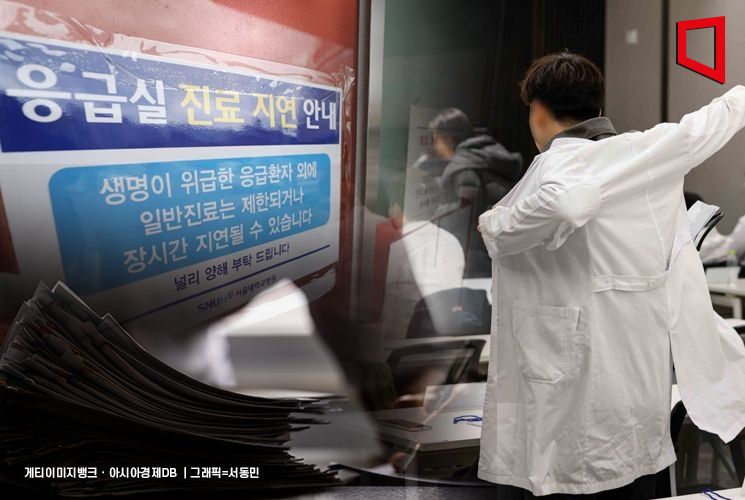
The government has also set a strong response policy against the scheduled collective refusal of medical treatment by the KMA on this day. On the 14th, it sent orders prohibiting collective action and incitement to the KMA executive board, and the previous day, it reported the KMA to the Fair Trade Commission for violating the Fair Trade Act by encouraging illegal refusal of medical treatment.
Director Jeon said, "If hospitals unilaterally cancel medical treatment without prior notice to patients causing harm, they will be reported for refusal of medical treatment under Article 15 of the Medical Service Act."
On the 10th, the government issued medical treatment orders and strike reporting orders to about 36,000 medical institutions nationwide. Although the pre-identified strike reporting rate is about 4%, the government and local governments issued work commencement orders at 9 a.m. to minimize medical service gaps. They explained that they will closely monitor strike status going forward. Director Jeon said, "We will also request investigations and take strong measures against social network service (SNS) posts that encourage illegal collective refusal of medical treatment while claiming voluntary participation."
At the same time, the government plans to concentrate all efforts on a seamless emergency medical system.
Since the previous day, the government has been operating a nationwide rotation duty system for severe emergency diseases to minimize disruption in emergency patient care, and is operating National Cancer Center beds at maximum capacity to ensure timely treatment for cancer patients. The number of Physician Assistant (PA) nurses will gradually increase through payment of allowances in July and August and support for education in the second half of the year. Since establishing the emergency medical countermeasures in February, the government has invested 1 trillion won in health insurance finances and contingency funds, deployed 547 public health doctors and military doctors, supported 1,627 newly hired doctors and nurses, and supported 11,395 PA nurses, strengthening both material and human resources.
To ensure patients do not experience inconvenience in using medical institutions, the government will actively provide information on hospitals and clinics that are open and medical institutions capable of telemedicine. Related information can be confirmed by calling the Health and Welfare Call Center at 129 (no area code), the 119 Emergency Situation Management Center, the National Health Insurance Service, or the Health Insurance Review and Assessment Service by phone.
© The Asia Business Daily(www.asiae.co.kr). All rights reserved.


















