Yeo "Must push through plenary session and conclude"
Ruling party "Request Constitutional Court jurisdiction dispute trial"
As conflicts between the ruling and opposition parties over the organization of the 22nd National Assembly continue into the third week of its opening, a "half-assembled parliament" is becoming prolonged. On the 18th, the Democratic Party of Korea held standing committee meetings unilaterally and began reviewing key bills, while the People Power Party also strengthened policy cooperation with the government through activities of its special committees.
On the same day in the morning, the Democratic Party held separate meetings of the Science, Technology, Information and Broadcasting and Communications Committee and the Land, Infrastructure and Transport Committee to conduct urgent inquiries. The Science, Technology, Information and Broadcasting and Communications Committee is reviewing amendments to the three broadcasting laws solely by the opposition party. The National Assembly Steering Committee also held its first plenary meeting, processing the agenda to appoint Park Seong-jun, the Democratic Party’s senior deputy floor leader, as the opposition party’s secretary. The Education Committee and the Culture, Sports and Tourism Committee also plan to pass the agenda for appointing secretaries through plenary meetings held solely by the opposition party. It is highly likely that neither the ruling People Power Party nor government ministers will attend the urgent inquiries.
The People Power Party is boycotting standing committees under the slogan of "complete nullification of the organization" and expanding the scope of activities of its special committees. First, it held the inaugural meeting of the "Special Committee to Prevent Judicial Destruction by Lee Jae-myung" and discussed ways to block the Democratic Party’s efforts, including the "Special Prosecutor Act on North Korea Remittances," related to the Ssangbangwool North Korea remittance case, the "impeachment of prosecutors and judges and the judge election system," and the "forced passage of the Chae Sang-byeong Special Prosecutor Act." In particular, amid the disclosure of testimony that former Gyeonggi Province Peace Deputy Governor Lee Hwa-young, who was convicted in the first trial regarding the North Korea remittance allegations, reported to Lee Jae-myung, then governor of Gyeonggi Province and party leader, the intention is also to block the Democratic Party’s backlash against the prosecution and judiciary that investigated and tried the case.
The Medical Reform Special Committee visited Boramae Hospital in Dongjak-gu, Seoul, in the morning to meet with Director Lee Jae-hyeop and check the status of medical suspensions. The meeting was attended not only by Rep. In Yo-han, chair of the Medical Reform Special Committee, but also by floor leader Choo Kyung-ho. In the afternoon, the Labor Special Committee and the Energy Special Committee - AI and Semiconductor Special Committee held meetings at the Seoul Southern Employment Center and SK Yongin General Industrial Complex, respectively, continuing their on-site schedules.
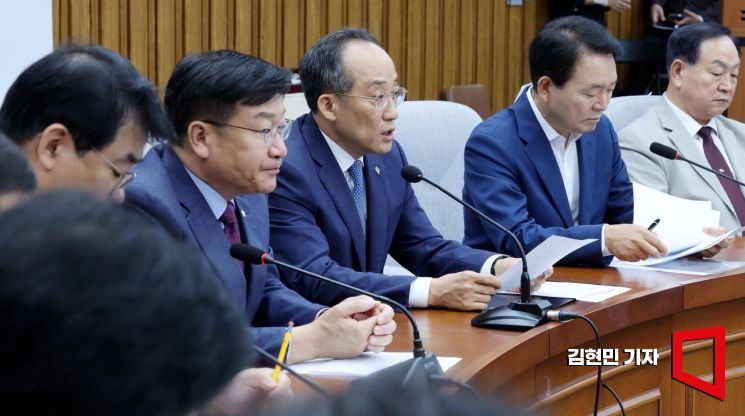 Chu Kyung-ho, floor leader of the People Power Party, is speaking at the party's strategy meeting held at the National Assembly on the 18th. Photo by Hyunmin Kim kimhyun81@
Solutions Differ... Opposition "Push for Plenary Session" vs Ruling Party "Request Constitutional Court Ruling"
The solutions for organizing the National Assembly are also sharply divided between the ruling and opposition parties. The People Power Party judged the opposition party’s unilateral election of standing committee chairs to be invalid and decided to file a constitutional dispute adjudication with the Constitutional Court. They argue that the unilateral election of the National Assembly Speaker’s group, the forced election of standing committee chairs, and the forced assignment of standing committee members all violate the Constitution.
The People Power Party plans to submit the petition under the names of all 108 of its members. Previously, during the first half of the 21st National Assembly, the Democratic Party filed a constitutional dispute adjudication in response to their monopolization of all 18 standing committees. However, the petition was rejected because the then floor leader’s representative filing was not considered a party to the dispute. This time, all members are filing together.
The Democratic Party has pressured Speaker Woo Won-shik to hold a plenary session. The Democratic Party plans to request Speaker Woo’s decision to conclude the organization by holding a plenary session on the 20th. According to the National Assembly Act, since government questioning and speeches by negotiation group representatives are scheduled within the June extraordinary session, the formation of standing committees cannot be delayed any longer. In response, Speaker Woo maintains the position that it is reasonable to divide the standing committees 11 to 7 between the ruling and opposition parties and repeatedly urges for an agreement.
© The Asia Business Daily(www.asiae.co.kr). All rights reserved.


















