Arrival Tonight... First Visit to North Korea Since Kim Jong-il Era
Kremlin "Possibility of Comprehensive Strategic Partnership Agreement"
'Close Ties Amid Isolation' North Korea-Russia... Exchanging Shells and Technology?
Russian President Vladimir Putin's visit to North Korea after 24 years marks the beginning of a 'Korean Peninsula diplomatic campaign.' North Korea and Russia are expected to sign a 'comprehensive strategic partnership' agreement. Attention is focused on how closely the two sides, isolated in the international community, will align their interests.
According to the Kremlin on the 18th, President Putin will arrive in Pyongyang that evening. This is his first visit to North Korea in 24 years since July 2000 during the rule of Kim Jong-il, Chairman of the National Defense Commission. It is a quick reunion just nine months after the summit with Kim Jong-un, Chairman of the State Affairs Commission, held in Russia last September. Putin’s decision for a swift return visit signifies the growing need to publicly demonstrate close ties with North Korea.
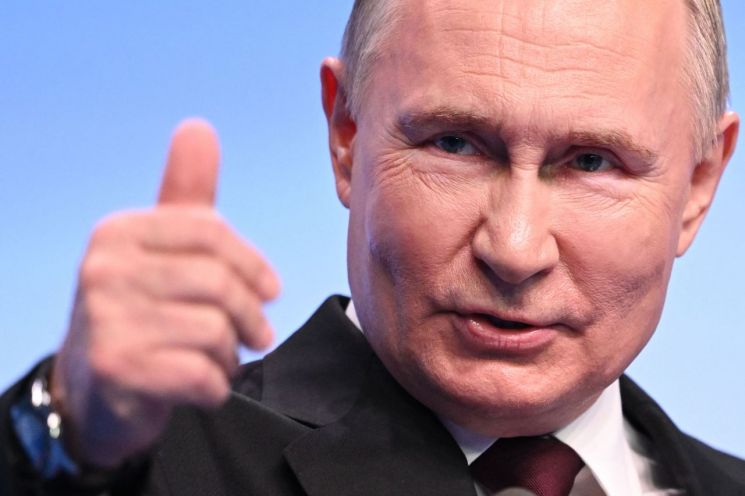
Yuri Ushakov, a Kremlin aide, said at a briefing the day before, "The substantive schedule will take place on the 19th," adding, "The document to be signed is being prepared, and it includes the possibility of concluding a 'comprehensive strategic partnership' agreement." He explained, "President Putin will discuss sensitive issues through informal talks with Chairman Kim." The comprehensive strategic partnership is a level above the strategic cooperation partnership that South Korea and Russia have established.
What does President Putin aim to gain? At the summit held last September at the Vostochny Cosmodrome in Russia's Far East, Putin indicated his willingness to support North Korea with satellite technology. Although North Korea failed again to launch a military reconnaissance satellite at the end of last month, South Korean intelligence agencies assess that actual technical support from Russia has been provided since the summit. Russia is expected to offer economic support such as food and oil, as well as assistance in military technology to North Korea. There is also speculation that Russia will demand more artillery shells or military supplies from North Korea for its so-called 'special military operation' in Ukraine.
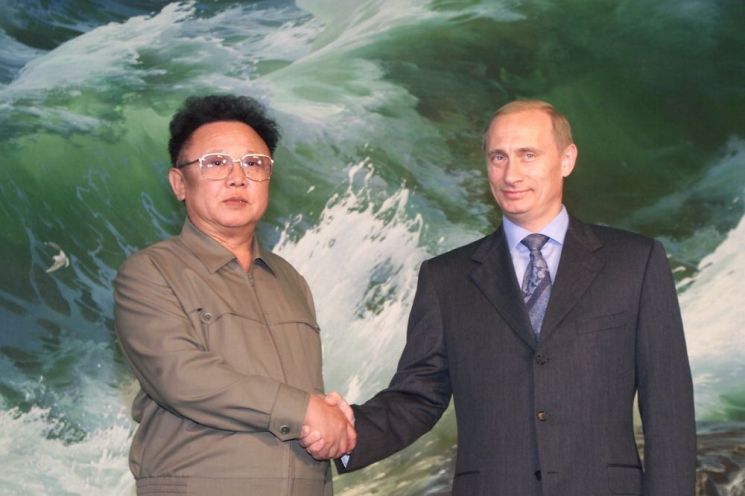 In July 2000, Russian President Vladimir Putin met with North Korean National Defense Commission Chairman Kim Jong-il in Pyongyang. [Image source=Yonhap News]
What North Korea desires is weapons technology. There is also a strong possibility that North Korea will send workers to Russia to earn foreign currency as Russia undertakes battlefield restoration. Although all of these actions violate the United Nations (UN) Security Council sanctions against North Korea, Russia made a 'clear gesture' by blocking the expert panel monitoring sanctions enforcement in March this year.
Victor Cha, a U.S. expert on North Korea and Korea Chair at the Center for Strategic and International Studies (CSIS), analyzed, "Putin is asserting his presence in Asia and demonstrating that he has the capability to complicate U.S. President Joe Biden’s security plans not only in Europe but also in Asia." He pointed out that if military and economic support is provided to North Korea, the U.S. efforts to check Russia’s invasion of Ukraine will inevitably be diluted.
Meanwhile, South Korea and China will hold a 'Diplomatic and Security Dialogue' in Seoul on the afternoon of the same day. This is to maintain high-level exchanges and has been upgraded to the vice-ministerial level for the first time in nine years. China, which seeks to increase its influence against the U.S., has recently stepped back somewhat from the North Korea-China-Russia alliance. Analysts say this week is a time for South Korea to exercise diplomatic power to draw China closer, ensuring that the 'Korean Peninsula diplomatic campaign' does not proceed according to North Korea’s wishes.
© The Asia Business Daily(www.asiae.co.kr). All rights reserved.
![Clutching a Stolen Dior Bag, Saying "I Hate Being Poor but Real"... The Grotesque Con of a "Human Knockoff" [Slate]](https://cwcontent.asiae.co.kr/asiaresize/183/2026021902243444107_1771435474.jpg)

















