Conservative Corporate Culture Spreads 4-Day Workweek in Japan
Major Corporations and Transport Companies Adopt 4-Day Workweek
Advantage in Talent Acquisition Amid Low Birthrate and Aging Population
Benchmarking Europe Begins
Following Europe, more places in Japan are also paying attention to the four-day workweek. Although Japan is known for its conservative corporate culture, it is suffering from severe labor shortages due to low birth rates and an aging population, leading to analyses that companies have no choice but to change their working methods to secure talent.
Recently, Nihon Keizai Shimbun (Nikkei) reported that the four-day workweek is spreading not only in Europe but also in Japan, introducing various cases. Iyo Tetsu Group, a transportation company headquartered in Matsuyama City, introduced a four-day workweek at its holding company starting in October last year. Iyo Tetsu Group designated every Wednesday as a holiday and has been steadily working on reforming work styles, including introducing flexible working hours three years ago to prepare for the four-day workweek. With the implementation of the four-day workweek, the company's annual holidays increased from about 120 days to around 170 days.
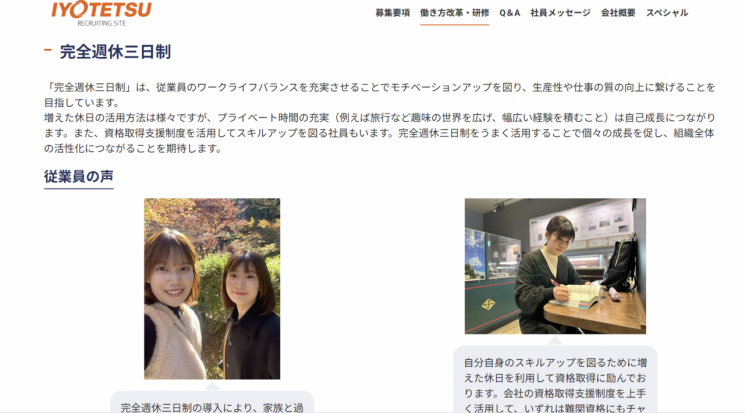 Iyotetsu promotes the full three-day weekend system (four-day workweek) on its recruitment website. Positive evaluations from employees are also included. (Photo by Iyotetsu website)
Instead, the company decided to maintain a 40-hour workweek, increasing working hours on the other four days except Wednesday. Employees gave positive feedback in interviews, saying, "I can now visit hospitals for regular checkups without time constraints," "I have time to study other subjects for self-development," and "I can pay more attention to childcare." Ichiro Shimizu, president of Iyo Tetsu, told Nikkei, "We want to change the image of the transportation industry, which is considered to have relatively low wages compared to other industries and no days off."
Hitachi Manufacturing, an electronics company, also established a system last year allowing employees to choose a four-day workweek by abolishing the minimum working hours lower limit for 30,000 employees. Currently, about 100 to 150 people are using the four-day workweek. Audio equipment company JVC Kenwood introduced the same option starting this year.
Online clothing sales platform ZOZOTOWN introduced a four-day workweek for some departments starting in 2021, and currently, 25-40% of employees in each department choose to work a four-day week. A ZOZOTOWN representative said, "The advantage of being able to choose a flexible working style has increased the number of new college graduate applicants and job changers, which is also beneficial for securing talent." In fact, a survey conducted last year by recruitment company Mynavi targeting 900 workers in Japan found that 52% responded that a four-day workweek should be introduced in the workplace.
In Europe, discussions on the four-day workweek are already underway in earnest. Since February, 50 companies in Germany have started a large-scale pilot experiment implementing a four-day workweek for six months. Salaries will be paid the same as under the existing five-day workweek. The transportation industry, which has irregular working systems, is also keeping pace. German Railways reached a labor-management agreement at the end of March to implement a 35-hour workweek with a four-day workweek by 2029. It attracted attention because, despite reducing working hours from the previous 38 hours to 35 hours, wages will be maintained. Lamborghini in Italy has also been implementing a four-day workweek since the end of last year.

Nikkei analyzed, "The reason Europe has moved like this is because the balance of power between labor and management has changed," adding that "the combination of COVID-19 and low birth rates has accelerated labor shortages." In addition, various empirical experiments showing that reducing working hours does not affect productivity have accelerated the introduction of the four-day workweek. According to a 2022 experiment conducted by the UK on 60 companies, sales from June to December increased by 1.4% compared to the same period the previous year, and 70% of employees at participating companies reported reduced stress in the survey.
However, in Japan, it is pointed out that it is still difficult to adopt the idea of maintaining wages even if working hours are reduced, as in Europe. Hiromi Murata, Global Center Director at Recruit Works Institute, said, "To introduce a European-style four-day workweek in Japan, it is unavoidable to consider productivity improvement using the latest technologies such as digital transformation," adding, "It is also important to have sufficient dialogue between labor and management."
© The Asia Business Daily(www.asiae.co.kr). All rights reserved.


















