Fierce Competition Among US, Europe, and China
"Safety Not Verified" Sparks Backlash
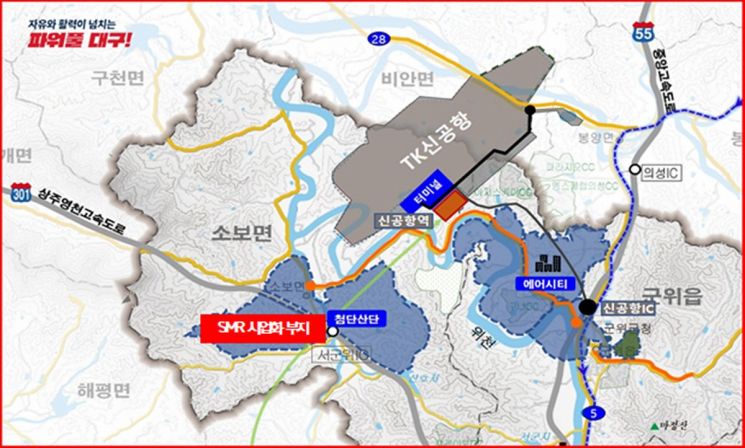
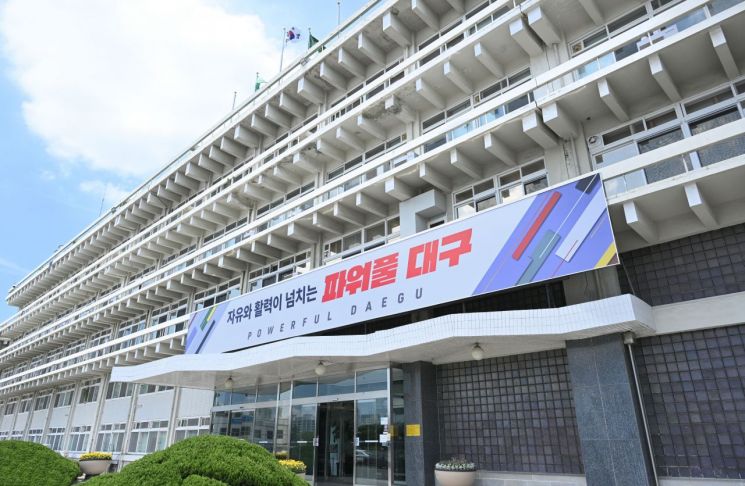
On the 17th at 11 a.m., Daegu City signed a business agreement with Korea Hydro & Nuclear Power at the Sanggyeok office of Daegu City Hall for the commercialization of the nation’s first 680MW Small Modular Reactor (SMR) within the TK New Airport Advanced Industrial Complex.
A Small Modular Reactor (SMR) refers to a nuclear reactor with an electric output of 300MW or less, where major equipment is modularized and can be manufactured in a factory.
This agreement is the first to be promoted since the announcement of the introduction of one SMR in the 11th Basic Electricity Plan last May, and it is particularly notable as the first case where a metropolitan government is directly participating in SMR construction.
Since two years ago, Daegu City has been in discussions with the Ministry of Trade, Industry and Energy, Korea Atomic Energy Research Institute, and the I-SMR Technology Development Project Group to build the nation’s first SMR in the Gunwi New Airport Advanced Industrial Complex.
In particular, by comprehensively considering safety, economic feasibility, and sustainability, Daegu chose to pursue our own innovative SMR (i-SMR) model rather than a foreign-developed one, and after several working-level consultations with Korea Hydro & Nuclear Power, the agreement was signed.
The agreement includes cooperation on matters such as ‘feasibility studies including site suitability and economic viability for SMR commercialization and construction within the TK New Airport Advanced Industrial Complex,’ ‘efforts for SMR commercialization and collaboration to create a SSNC-based carbon-neutral city,’ ‘enhancing local acceptance,’ and ‘joint efforts to promote the CF100 policy.’ SSNC (SMR Smart Net-zero City) refers to an eco-friendly, carbon-free energy city combining smart city concepts and SMR, while CF100 (Carbon Free 100) means supplying 100% of power with carbon-free energy sources such as solar and nuclear power.
Small Modular Reactors (SMRs) are attracting attention as they offer higher safety and efficiency compared to conventional large reactors, can complement the intermittency of renewable energy and provide flexible output, and can be used not only for electricity but also for heat production and supply, hydrogen production, and as an alternative energy source to coal-fired power plants.
Globally, more than 80 SMR models are under development, with Korea, the United States, Europe, and China fiercely competing to achieve commercial operation in the 2030s.
Going forward, Daegu City, together with Korea Hydro & Nuclear Power and private construction companies, will conduct a ‘pre-feasibility study’ by 2026, obtain standard design approval in 2028 in accordance with government procedures, begin construction, and start commercial operation in 2033.
For this, a new SPC (Special Purpose Company) for SMR construction will purchase 160,000 square meters (48,000 pyeong) of land within the 500,000 square meter energy production site at the Gunwi Advanced Industrial Complex, and the total project cost of 4 trillion won will be fully financed by the SPC.
Daegu City plans to attract power-intensive industries such as AI semiconductors and data centers to the New Airport Advanced Industrial Complex to establish an ‘SMR industrial ecosystem,’ supply district heating to Gunwi New Airport Air City and old downtown areas, and prepare various support measures such as increasing local income, enhancing resident welfare, and subsidizing electricity bills.
The Gunwi SMR aims to strengthen the logistics base of TK New Airport, attract companies to the Gunwi Industrial Complex, which covers up to 9.3 million pyeong, and reduce energy costs for resident companies.
In particular, the New Airport Advanced Industrial Complex, with TK New Airport, SMR providing cheap electricity, and affordable, abundant industrial land, offers optimal conditions for dispersing semiconductor clusters currently concentrated in the Seoul metropolitan area such as Yongin and Icheon. In fact, Taiwan’s TSMC thoroughly disperses its production bases across the country by performance and type, including Hsinchu Science Park (north), Taichung Science Park (central), and Tainan Science Park (south).
Hong Joonpyo, Mayor of Daegu, emphasized, “Future semiconductor campuses must be distributed from the perspective of national security and industrial infrastructure, and the Gunwi Advanced Industrial Complex, with its airport and SMR, can be the optimal rear base. We will closely cooperate with the government and private companies for the construction of the Gunwi SMR, and also strive to communicate with local residents and enhance their interests.”
© The Asia Business Daily(www.asiae.co.kr). All rights reserved.
![Clutching a Stolen Dior Bag, Saying "I Hate Being Poor but Real"... The Grotesque Con of a "Human Knockoff" [Slate]](https://cwcontent.asiae.co.kr/asiaresize/183/2026021902243444107_1771435474.jpg)

















