2023 Academic Achievement Assessment Results
Ministry of Education: "Will Expand Curriculum Supplementation"
English Proficiency Rates Rise in Both Middle and High Schools
More Females at Level 3 or Above, More Males at Level 1
The academic achievement level in mathematics among middle school students has been found to remain significantly lower compared to other subjects such as Korean and English. Additionally, the achievement level in Korean has continuously declined over the past three years among middle school students.
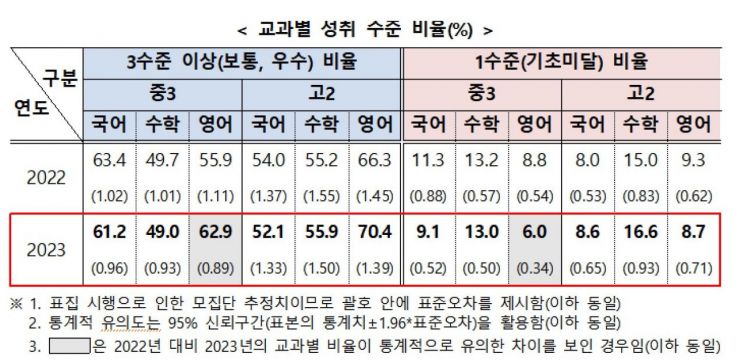
According to the "2023 National-Level Academic Achievement Assessment Results" announced on the 17th by the Ministry of Education and the Korea Institute for Curriculum and Evaluation, the proportion of middle school 3rd graders achieving 'Level 3 or above' last year was 61.2% in Korean and 62.9% in English, but only 49.0% in mathematics. Mathematics also showed lower academic achievement rates compared to Korean and English in previous years, recording 49.7% last year and 55.6% in 2021.
Regarding this, a Ministry of Education official stated, "We consider the issue of 'Supoja' (students who have given up on mathematics) very important," and added, "We will expand support in areas such as supplementary classes, after-school guidance, and basic academic skills improvement."
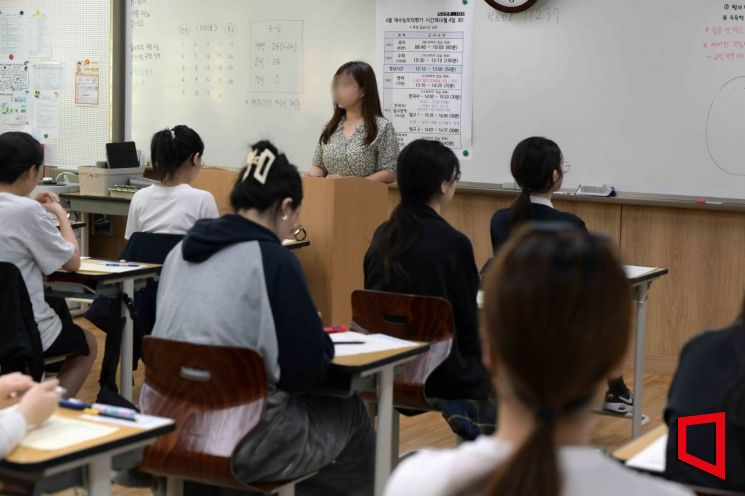 On the 4th, at Yeouido Girls' High School in Seoul, third-year high school students are waiting for the start of the first period Korean language test during the June mock exam for the 2025 College Scholastic Ability Test. Photo by Joint Press Corps
In Korean, the proportion of middle school 3rd graders achieving 'Level 3 or above' has declined for three consecutive years following 2021. The rates were 74.4% in 2021, 63.4% in 2022, and 61.2% in 2023. The official noted, "Teachers in the field still observe literacy issues among some students during classes," and said, "We will consider opinions emphasizing the need for focused support when implementing policies."
On the other hand, English achievement levels increased by approximately 7.0 percentage points for middle school 3rd graders and 4.1 percentage points for high school 2nd graders compared to the previous year. The official explained, "There is an analysis suggesting that the face-to-face speaking classes in English may have influenced the academic achievement levels," and added, "We will conduct a systematic analysis in the future."
By gender, the proportion of female students was higher than male students in Korean and English subjects in both middle and high schools. For middle school 3rd graders, the Korean achievement rate at 'Level 3 or above' was 17.9 percentage points higher for females than males, and the English achievement rate was 11.0 percentage points higher. For high school 2nd graders, the Korean achievement rate was 15.0 percentage points and 14.7 percentage points higher for females. Conversely, in the 'Level 1' category, male students showed higher achievement rates than female students across all subjects in both middle and high schools.
By region, the 'Level 3 or above' achievement rates were higher in metropolitan areas compared to eup/myeon (township/rural) areas for both middle and high schools. However, in the 'Level 1' category, regional disparities varied; for example, the mathematics achievement rate at 'Level 1' for middle school 3rd graders was 7.3 percentage points higher in eup/myeon areas.
The national-level academic achievement assessment is conducted annually to systematically analyze the current status and trends of academic achievement among students in Korea. Approximately 3% of all middle school 3rd graders and high school 2nd graders are sampled to diagnose academic achievement levels by subject, school life satisfaction, and non-cognitive characteristics such as social and emotional competencies.
This assessment was conducted in September last year, targeting 24,706 students (from 476 schools), representing about 3% of all middle school 3rd graders and high school 2nd graders.
© The Asia Business Daily(www.asiae.co.kr). All rights reserved.
![From Bar Hostess to Organ Seller to High Society... The Grotesque Con of a "Human Counterfeit" [Slate]](https://cwcontent.asiae.co.kr/asiaresize/183/2026021902243444107_1771435474.jpg)

















