Seoul National University College of Medicine Emergency Committee Begins Strike and Holds Rally
Government Strengthens Emergency Medical System
"Requesting Hospitals to Review Claims for Compensation"
Professors at Seoul National University College of Medicine began an indefinite strike on the morning of the 17th, demanding the government cancel the administrative order for resident doctors and reconsider the expansion of medical school admissions.
The Emergency Response Committee (ERC) of Seoul National University College of Medicine and Seoul National University Hospital announced that 529 out of 967 clinical professors, accounting for 54%, participated in the strike. As a result, significant disruptions occurred in the medical services at four hospitals affiliated with Seoul National University College of Medicine, including Seoul National University Hospital, Bundang Seoul National University Hospital, Boramae Hospital, and Gangnam Center.
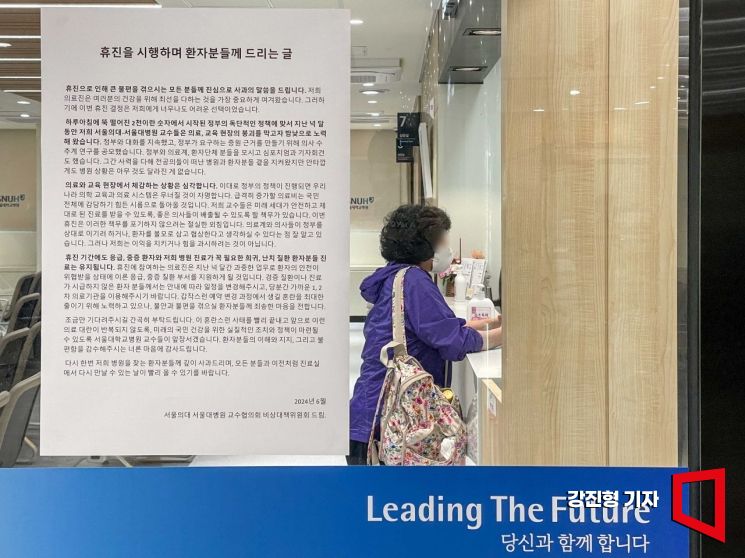 On the 17th, when Seoul National University Hospital professors began an indefinite strike demanding the resolution of the resident doctors' crisis, a notice titled "A Letter to Patients Regarding the Strike" written by the Emergency Response Committee of the Seoul National University Hospital Professors' Council was posted at Seoul National University Hospital in Jongno-gu, Seoul. Photo by Jinhyung Kang aymsdream@
As of 10 a.m. that day, a hospital official reported that outpatient services across all 20 departments at Seoul National University Hospital were operating at about 50% of normal capacity. Surgeries were also significantly reduced. Seoul National University Hospital anticipates that if the strike continues, the overall operating rate of all surgical rooms in affiliated hospitals will drop from an average of 62.7% since the medical crisis began to 33.5%.
The emergency room, intensive care unit, delivery room, and dialysis unit at Seoul National University Hospital are operating normally, and the children's hospital, which treats severe pediatric diseases, has relatively fewer professors participating in the strike.
Despite the strike news, about 20 patients were waiting in front of the outpatient reception desk at Seoul National University Hospital that morning. Baek (78), who visited the orthopedic department, sighed, saying, "I came to the hospital and found out that the appointment scheduled for today has been postponed to the 24th." Kim (78), who came from Gunsan, Jeonbuk early that morning for her husband's chemotherapy, said, "It's the first chemotherapy after my husband's surgery, and I couldn't sleep all night worrying about the treatment being delayed from the start."
Bundang Seoul National University Hospital reported that although some professors were on strike, outpatient services and surgeries had not significantly decreased compared to usual as of that morning. Boramae Hospital and Gangnam Center experienced less reduction in medical services than the main Seoul National University Hospital, and health checkups were proceeding normally. Patients currently admitted to wards continue to receive treatment without discharge.
The ERC of Seoul National University College of Medicine held a rally at 10:30 a.m. that day to mark the start of the strike, stating, "We cannot endure a situation where doctors, as experts, are ignored, and after three months of maintaining the situation by professors working themselves to exhaustion following the resignation of resident doctors, we can no longer sustain this."
Following Seoul National University College of Medicine, professors at Yonsei University, Catholic University, Sungkyunkwan University, and Ulsan University medical schools?the remaining members of the 'Big 5'?will simultaneously go on strike starting the 18th. Yonsei University College of Medicine plans to begin an additional indefinite strike from the 27th.
The government has requested university hospitals, including Seoul National University, which announced the strike, to consider claiming compensation from professors participating in the strike if hospitals incur losses due to prolonged refusal of medical services. The government also urged the medical community to unconditionally stop the strike and engage in sincere dialogue.
On the 17th, Jung Tong-ryeong, head of the Central Accident Response Headquarters for Medical Collective Action, Emergency Medical Situation Room, said, "Even during the period of the medical community's collective strike, we will do our best to operate the emergency medical system to minimize harm to public safety," and added, "We encourage non-emergency patients to use other hospitals, clinics, or public health centers that are operating normally or to receive telemedicine."
The government plans to strengthen the emergency medical system. Starting that day, it will implement a 'nationwide rotation duty system by severe emergency disease' with at least one duty institution organized daily in four metropolitan areas?Seoul Metropolitan Area, Chungcheong Region, Jeolla Region, and Gyeongsang Region?to be on 24-hour standby for nighttime and holiday emergencies. Additionally, unilateral cancellation or delay of scheduled appointments without patient consent will be considered 'refusal of medical treatment,' which is prohibited under the Medical Service Act. The government is also considering excluding university hospitals that allow collective refusal of medical treatment by professors from the health insurance advance payment system.
A Ministry of Health and Welfare official stated, "While strengthening responses to collective refusal of medical treatment such as the emergency medical system, we will continuously communicate and persuade the medical community to prevent the realization of collective refusal of medical treatment."
© The Asia Business Daily(www.asiae.co.kr). All rights reserved.
![Clutching a Stolen Dior Bag, Saying "I Hate Being Poor but Real"... The Grotesque Con of a "Human Knockoff" [Slate]](https://cwcontent.asiae.co.kr/asiaresize/183/2026021902243444107_1771435474.jpg)
















