The price of pork, once blamed as the main culprit for the decline in prices in China, is continuing to rise. As China launches an anti-dumping investigation into EU pork amid the European Union's (EU) tariff bomb on electric vehicles, there is also a possibility that local price recovery will accelerate.
According to Chinese consulting firm Zhuochuang Statistics on the 16th, the average transaction price of nationwide three-way crossbred pork reached 18.98 yuan per kg (approximately 3,603 won) on the 11th. This is not only the highest level in 18 months but also a 43.4% increase compared to the unit price of 13.24 yuan recorded at the low point on January 12. The pre-slaughter pig price also recorded 5.74 yuan per kg, showing the same rate of increase.
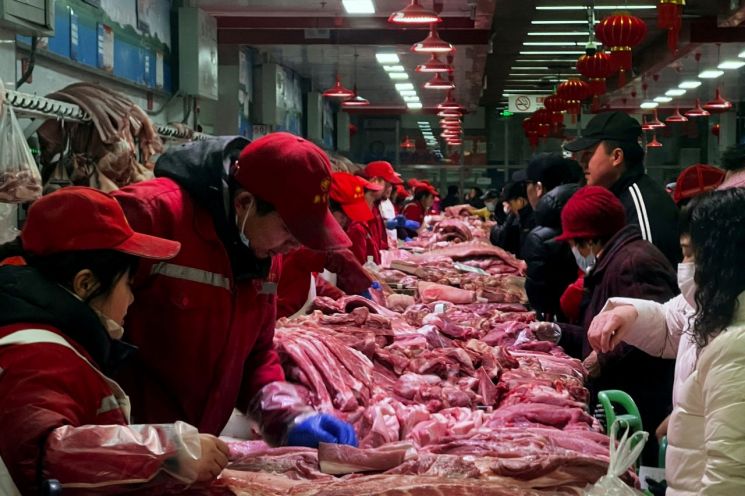
Analysts evaluate that the recent rise in pork prices is related to changes in both supply and demand. In particular, the number of pigs available for slaughter in the market has decreased, causing a current supply shortage, while the increase in demand during the Dragon Boat Festival holiday has coincided to push prices up. They also assessed that as the price rise is observed, consumption is being stimulated, and supply is delayed.
According to data from the Chinese Ministry of Agriculture and Rural Affairs, as of the end of April, the number of breeding sows was 39.86 million, down 6.9% compared to the same period last year. This is a 9.2% decrease compared to the peak of 43.9 million recorded in December 2022.
If the import volume of EU pork distributed in China decreases, there is also a possibility that local prices will rise further. According to China's state-run media Global Times (GT), Chinese companies have reportedly applied for an anti-dumping investigation into EU pork imports. On the 12th (local time), as the EU announced a tariff bomb of up to 48% on Chinese electric vehicles, the dominant analysis is that this is a retaliatory response by the Chinese government.
According to Politico, the EU's meat exports to China sharply declined from 9.898 billion euros (approximately 14.6625 trillion won) in 2020 to 4.993 billion euros last year. In the case of pork, the EU accounted for more than half of the $6 billion worth (approximately 8.2644 trillion won) of pork, including offal, imported by China last year. Spain was the largest exporter of pork to China, with France, Denmark, and the Netherlands also being major suppliers.
© The Asia Business Daily(www.asiae.co.kr). All rights reserved.
![Clutching a Stolen Dior Bag, Saying "I Hate Being Poor but Real"... The Grotesque Con of a "Human Knockoff" [Slate]](https://cwcontent.asiae.co.kr/asiaresize/183/2026021902243444107_1771435474.jpg)
















