Evercore ISI Raises S&P Forecast to 6000
"AI Strength & Inflation Slowdown Drive Market Rally"
Goldman Sachs Also Raises S&P Forecast to 5600
Some Warn of AI Bubble Concerns
As the U.S. stock market continues to hit record highs day after day, Wall Street is repeatedly raising its year-end forecast for the S&P 500 index. Even Wall Street experts who had predicted a bearish market this year have shifted to a bullish stance, with some forecasts suggesting the S&P 500 index will surpass the 6000 mark by year-end. The recent strength in artificial intelligence (AI) and the easing of inflation have been cited as the driving forces behind the stock market. However, some caution remains regarding an AI bubble and concerns about the U.S. stock market rally being led by a few large tech stocks.
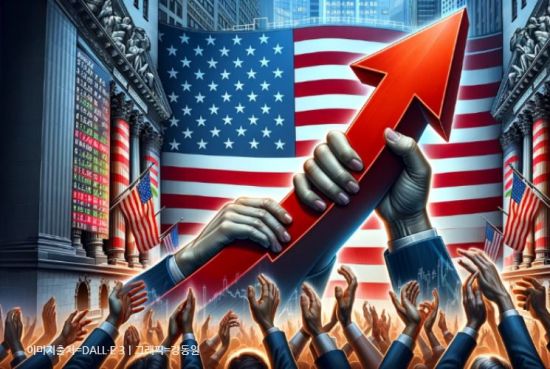
According to Bloomberg and other sources on the 16th (local time), strategists at Evercore ISI, a U.S. investment advisory firm, raised their year-end forecast for the S&P 500 index to 6000. Based on the closing price of 5431.6 on the 14th, they see about a 10% upside potential.
Julian Emanuel, Evercore ISI’s chief equity and quant strategist who raised the S&P target, was previously a notable bearish voice, having set the year-end S&P 500 forecast at 4750. However, as the recent market rally continued, he reversed his bearish outlook and raised the year-end S&P 500 forecast to 6000. This level is higher than the 5600 targets set by Goldman Sachs, UBS Group, and BMO Capital.
The S&P 500 index has risen 14% this year, hitting record highs 29 times, driven by the robust U.S. economy, improved corporate earnings, and expectations that the Federal Reserve’s tightening cycle is ending. Emanuel expects the easing of inflation and AI preference to drive the market rally.
Emanuel stated, "Post-pandemic, record stimulus, increased cash balances, and low leverage supported consumption, and then AI arrived. Today, AI’s potential is being utilized across all jobs and sectors. The vitality of AI has raised the valuation of the S&P 500, and the index’s price-to-earnings ratio (PER) can remain elevated for a long period." He added, "The easing of inflation, the Fed’s inclination toward rate cuts, and growth are supporting a Goldilocks economy (neither too hot nor too cold)."
He predicted the S&P 500 index will surpass 7000 by the end of 2025. The earnings per share (EPS) forecast for companies included in the S&P 500 is $238 for 2024 and $251 for 2025, representing increases of 8% and 5%, respectively, compared to previous estimates.
Earlier, on the 15th, U.S. investment bank Goldman Sachs also raised its year-end forecast for the S&P 500 index. It increased its target from 5200 in February to 5600, anticipating about a 3% additional upside. The strong earnings growth of the top five tech giants?Apple, Microsoft (MS), Amazon, Alphabet (Google’s parent company), and Facebook?was seen as the main driver of the index’s rise. Accordingly, Goldman Sachs raised the S&P 500’s PER from 19.5 times to 20.4 times.
Goldman Sachs projected that in the most optimistic scenario, the S&P 500 index could soar to 6300 by year-end, while if recession concerns intensify, the index could correct down to around 4700.
However, some caution remains regarding the U.S. stock market rally, including concerns about an AI bubble. JP Morgan, for example, has set its year-end S&P 500 target at around 4200 despite the recent market rise, which is more than 20% below the closing price on the 14th.
The fact that a small number of large tech stocks are leading the bull market is also seen as a vulnerability. According to market data provider FactSet, the top 10 stocks included in the S&P 500 account for 36.8% of the total index, the highest since September 2000 during the height of the IT bubble. The "Wall Street fear index" also indicates an excessively low market fear level. According to the Chicago Board Options Exchange (CBOE), the CBOE Volatility Index (VIX), known as the Wall Street fear index, fell below 12 on the 13th. The VIX falling below 12 is the first time in four and a half years since November 2019. The VIX tends to spike when stock prices plunge, but it remained unusually low around 12 during 2005-2007, just before it surged to 80 during the 2008 global financial crisis.
Steve Sosnick, chief strategist at Interactive Brokers, warned, "The current market is driven more by greed than fear. The longer this situation persists, the more vulnerable the market becomes."
© The Asia Business Daily(www.asiae.co.kr). All rights reserved.

















