Korean Monetary Policy Can Be Taken Flexibly
Interest Rate Cuts Would Greatly Help Domestic Demand Recovery
Strengthening 'Pinpoint Support' for Self-Employed and Small Business Owners
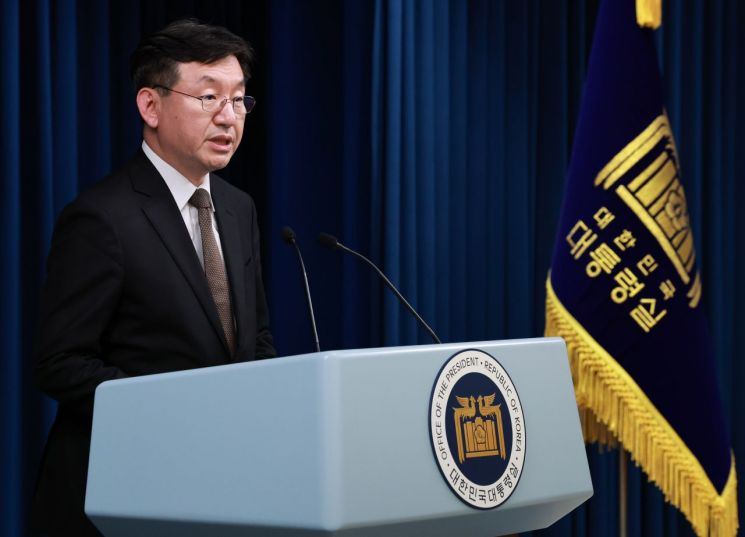
The Presidential Office stated, "The environment for interest rate cuts is developing in our country," adding, "If interest rate cuts are effectively implemented, it could significantly help the recovery of domestic demand, especially among self-employed individuals."
Seong Tae-yoon, the Presidential Office Policy Chief, appeared on KBS's 'Sunday Diagnosis' on the 16th and said, "The core inflation rate has recently stabilized, and other countries are also in a situation of lowering interest rates, so there is room for our country to adopt a more flexible monetary policy."
Seong explained again, "The consumer price inflation rate fell from 3.1% in March to 2.9% in April and 2.7% in May," adding, "The core inflation rate excluding agricultural products dropped to 2.2%, so it is true that the environment for interest rate cuts has changed in terms of monetary policy."
As Seong explained, some countries have recently lowered their benchmark interest rates. The Swiss National Bank cut rates in March, and Sweden and Canada lowered rates last month and this month, respectively. The European Central Bank (ECB) also cut rates earlier this month for the first time in about five years.
Seong said, "A kind of shift in interest rate policy is happening worldwide," adding, "It is hard to say that these countries have better price stability than ours, yet they are confident enough to cut rates now."
He added that even the United States, where interest rate cut prospects are being raised, has a consumer price inflation rate of 3.3%, saying, "I think our country has already shifted to an environment where significant interest rate cuts are possible."
Seong said, "The key to domestic demand recovery is the inflation rate," and expressed hope that if prices stabilize and the Bank of Korea lowers its benchmark interest rate, the domestic economy will revive.
He also viewed the economic outlook for the second half of the year positively. He said, "Overall export recovery is continuing, and exports are generally improving in major trading partners such as the United States and China," adding, "If exports continue to improve and prices stabilize to some extent, the economic trend in the second half of the year will be relatively favorable."
He mentioned that the Presidential Office is operating a Livelihood Price Task Force (TF), emphasizing, "We are working on price stabilization by making the distribution structure, trade structure, and the distribution, storage, and preservation processes of agricultural products more efficient."
He said that 'targeted support' will be strengthened for self-employed individuals who are heavily burdened by high interest rates. He said, "We need to continue expanding debt restructuring through interest refunds, low-interest refinancing, and the New Start Fund," adding, "For those who are in extreme difficulty, we may also need to consider one-stop support for business closure."
Regarding the increase in household loans, he said, "It is not at a level to be concerned about." Seong pointed out, "The ratio compared to Gross Domestic Product (GDP) has recently rather declined," adding, "If household debt is managed too strictly in total volume, vulnerable groups may face even more difficulties."
On whether to extend the fuel tax reduction, he said, "International oil prices have recently fallen significantly," adding, "We need to discuss whether to continue the fuel tax reduction or partially restore it since it is not a complete cut."
Regarding the recent rise in Jeonse prices centered on Seoul apartments, he said, "The important thing is whether additional apartments can be supplied," adding, "Since apartment supply plans are related to reconstruction, it is also necessary to consider facilitating reconstruction more smoothly in terms of regulations."
© The Asia Business Daily(www.asiae.co.kr). All rights reserved.

















