June 16 Central Disaster and Safety Countermeasure Headquarters Meeting Chaired by Head Han Deok-su
"Maximize National Cancer Center Bed Operation and Actively Support Collected Patient Damage Cases"
"Request to Hospital Directors to Review Claims for Compensation if Refusal of Treatment Causes Hospital Losses"
The government announced on the 16th that it will implement a rotating duty system for severe emergency diseases starting from the 17th to minimize disruptions in emergency patient care ahead of the medical community's planned collective strike next week.
The Central Disaster and Safety Countermeasures Headquarters (CDSCH) for the doctors' collective action held a meeting chaired by Head Han Deok-su on the same day to review the response to the medical community's collective refusal to provide care and the status of the emergency medical system operation.
The medical community has announced that it will begin a collective strike next week in opposition to the increase in medical school admissions. Professors at Seoul National University Hospital will enter an indefinite strike starting on the 17th, and the Korea Medical Association (KMA) and other medical groups will strike for one day on the 18th.
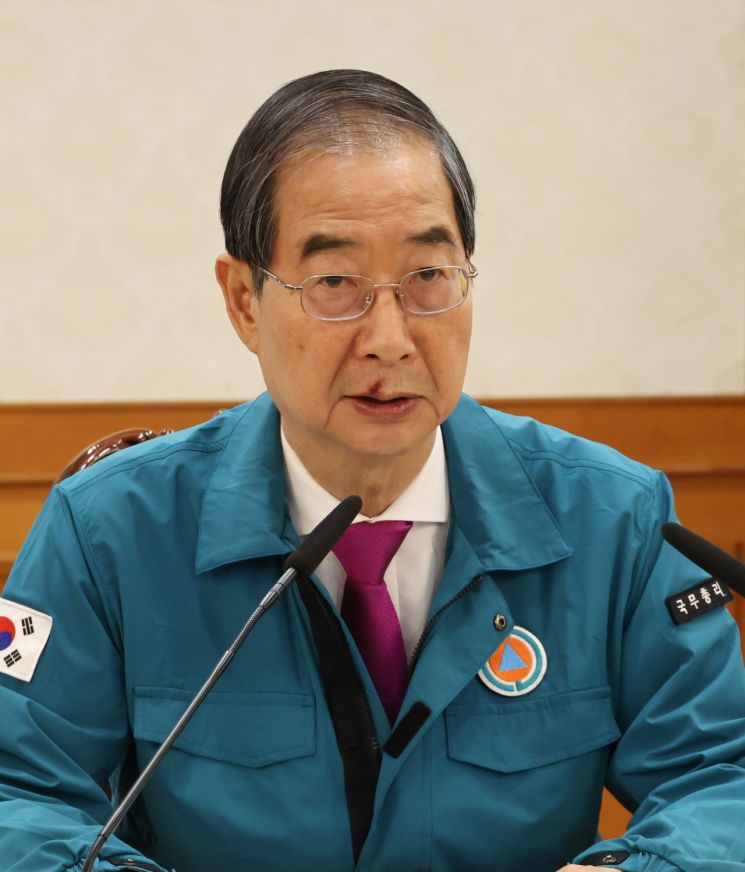 Prime Minister Han Duck-soo is speaking at the Central Disaster and Safety Countermeasures Headquarters meeting on the collective action of medical professionals held at the Government Seoul Office in Jongno-gu, Seoul, on the 16th.
 [Photo by Yonhap News]
The government expressed "deep regret over the Korea Medical Association (KMA) and others pushing forward with the decision to collectively refuse medical care amid ongoing public inconvenience due to the prolonged doctors' collective action," and explained that "it has decided to further strengthen the emergency medical system to minimize gaps in care for severe and emergency patients."
First, to treat patients who require care within the golden time (optimal period), a "nationwide rotating duty system by severe emergency disease" will be implemented starting on the 17th. Institutions that apply for rotating duty will be organized to have at least one duty institution per day in each of the four metropolitan areas: the Seoul metropolitan area, Chungcheong region, Jeolla region, and Gyeongsang region, to be on 24-hour standby for emergency situations during nights and holidays. The target diseases are ▲ acute aortic syndrome ▲ acute abdominal diseases in children under 12 years old ▲ obstetric emergency diseases, with plans to expand to other emergency diseases in the future.
To ensure cancer patients receive timely treatment, the National Cancer Center beds will be operated to the fullest extent, and a hotline will be established with five major hospitals in Seoul.
To support frontline medical staff, separate allowances for physician assistant (PA) nurses will be paid in July and August, and the scope of support for personnel recruitment wages and existing staff duty pay will be expanded from tertiary general hospitals to resident training general hospitals.
To strengthen the emergency medical capacity of local governments, measures include ▲ designating regional coordinators ▲ maximizing bed utilization in public health medical institutions ▲ gradually expanding night and holiday medical services ▲ increasing the designation of pediatric emergency responsible medical institutions.
Medical institution information will be collected in real time and provided to identify medical institutions operating normally even on the days of the medical community's collective strike.
To activate non-face-to-face medical care for patients with mild and chronic diseases, public health medical institutions such as local medical centers, public health centers, and health sub-centers will be actively utilized, and local governments will designate dedicated medical institution coordinators to guide elderly patients and others on non-face-to-face medical care methods.
The government views unilateral cancellation or delay of medical care by medical institutions without patient consent or changes in treatment plans as potentially constituting "refusal of treatment without justifiable reason," which is prohibited under the Medical Service Act, and plans to actively support by collecting cases of patient harm.
The CDSCH emphasized, "Patients who have suffered damages can report their cases by calling '129' (without area code), and the government and local governments will closely cooperate to respond promptly to the reports." It also stated, "The government has requested hospital directors to prohibit collective refusal of care by some professors, and if losses occur due to prolonged refusal of care, it will consider claiming compensation. It is also considering excluding hospitals that neglect collective refusal situations from the health insurance advance payment system."
Furthermore, the government urged hospital directors to maintain emergency medical systems to prepare for care gaps, continuously persuaded residents to return, and designated one-on-one coordinators for 11 patient organizations to collect and resolve grievances and suggestions, thereby strengthening communication with patient groups.
Head Han said, "There will be no disadvantages for residents who return, but it is difficult to accept demands to nullify measures taken according to the Constitution and laws," and added, "We earnestly hope the medical community will withdraw unreasonable demands, participate in medical reform, and become both the main actors and brains of the process."
© The Asia Business Daily(www.asiae.co.kr). All rights reserved.

















