2024 Korean Finance Association Annual Conference Dinner Speech
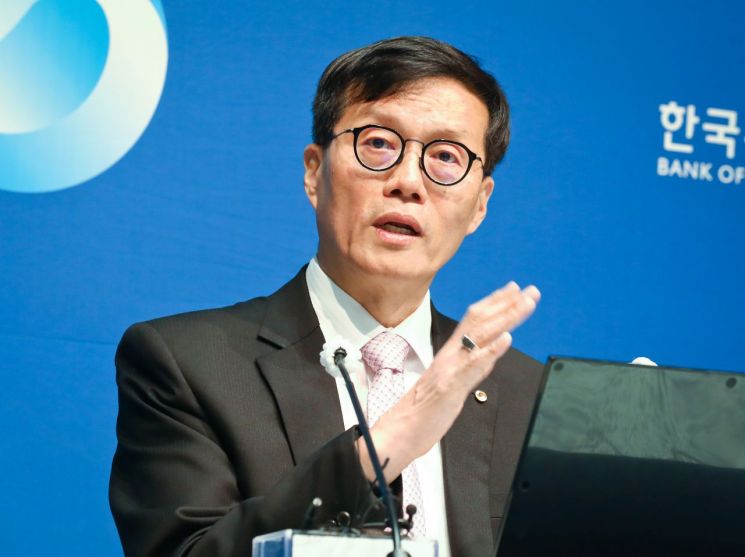
Lee Chang-yong, Governor of the Bank of Korea, proposed five research tasks to academia that require study for better monetary policy management, including improvements to the central bank's lending system and measures to stabilize the household debt ratio downward.
On the 14th, Governor Lee attended the regular general meeting of the Korean Finance Association and presented five research tasks needed by academia through a dinner speech, including improvements to the central bank's lending system, measures to stabilize the household debt ratio downward, and ways to promote green finance.
The first task he presented was how to improve the central bank's lending system. Recently, the Bank of Korea has been expanding the eligible collateral for loans to strengthen the liquidity safety net following last year's Silicon Valley Bank (SVB) incident. In July last year, public institution-issued bonds and bank bonds were included as eligible collateral for loans, and on the 13th, covered bonds with dual recourse rights were newly incorporated.
Currently, the Bank of Korea is considering whether it is appropriate to include non-bank deposit-taking institutions as eligible institutions for liquidity adjustment loans. Governor Lee said, "Under the current Bank of Korea Act, this is only possible with the resolution of the Monetary Policy Committee in situations where significant difficulties in funding may occur, but there are many concerns about the stigma effect on the financial institutions involved." He added, "Discussions are needed on whether it is appropriate to include non-bank deposit-taking institutions, and if so, how the Bank of Korea Act should be amended." He further noted that research is also needed on how to prevent moral hazard that may arise if accessibility for non-bank deposit-taking institutions improves due to the reform of the Bank of Korea's lending system, and how collateral transaction and management practices might change if the scope of collateral is expanded.
He also expressed concerns about ways to stabilize the high household debt ratio downward. Governor Lee said, "The household debt ratio in our country is considerably higher compared to major countries and still poses a latent risk factor in terms of financial stability." He added, "However, Korea's household debt is closely linked to loan-centered real estate finance, making it difficult to reduce." He mentioned, "If a significant portion of housing purchase funds is raised through equity rather than debt by utilizing REITs, it would help stabilize the household debt ratio downward." He added that research is underway to expand REIT investments, which have so far focused on commercial real estate, to residential real estate.
Measures to promote green finance were also mentioned. Recently, global climate regulations to reduce greenhouse gas emissions have increased pressure on small and medium-sized enterprises (SMEs) to make eco-friendly investments, but SMEs have relatively low credit ratings, making it difficult to raise large-scale facility investment funds through green bond issuance. In response, the Bank of Korea is currently reviewing the issuance system of Green CLOs to help SMEs secure the capacity for eco-friendly investments. If banks sell green loans to special purpose vehicles (SPVs), the SPVs can issue loan-backed securities. He said, "If Green CLO issuance is activated, it will not only help SMEs transition to eco-friendly operations but also provide new investment opportunities in the capital market, where the domestic green bond market is still minimal."
He also proposed the activation of KOFR (Korea Overnight Financing Repo Rate), a risk-free benchmark interest rate based on actual transactions. Governor Lee pointed out, "Since the LIBOR manipulation scandal in 2012, major advanced countries have quickly established risk-free benchmark interest rates based on actual transactions as the standard reference rates for derivative transactions. However, in Korea, KOFR-based financial product transactions are still sluggish." Recently, the Bank of Korea has been promoting KOFR activation by encouraging financial product transactions using KOFR as the reference rate in cooperation with the Financial Services Commission. He said, "If the risk-free benchmark interest rate based on actual transactions is established as the reference rate in the short-term financial market, it will contribute not only to the activation of related derivative markets but also to enhancing the effectiveness of monetary policy transmission."
He also called for active responses to digital transformation, including CBDC. Governor Lee mentioned that the Bank of Korea is currently conducting pilot tests focusing on the second phase of institutional CBDC and said that banks could issue deposit tokens digitizing deposits based on this. He also noted, "The Bank of Korea recently joined the Bank for International Settlements (BIS) and seven central banks in an inter-country payment project (known as the 'Agora Project'). This is a good opportunity to position ourselves as early designers setting standards for cross-border payment systems together with major reserve currency countries."
At the end of his dinner speech, Governor Lee said, "If new tasks arise in the future, I will seek your (academia's) help," and added, "I believe that insightful research and policy recommendations from professors and researchers, combined with the Bank of Korea's efforts to reflect these in policies together with the government, will further advance Korea's financial and monetary policies."
© The Asia Business Daily(www.asiae.co.kr). All rights reserved.