High Profit Margins, Production Base Relocation, and Export Diversification Strategies
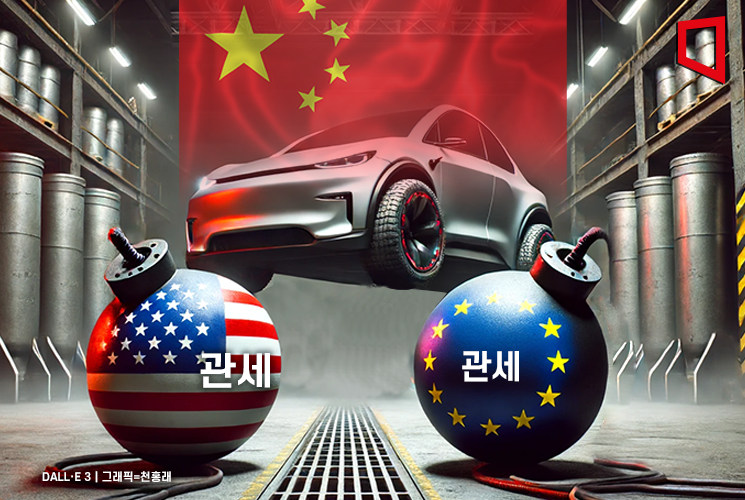
Following the United States, the European Union (EU) has significantly increased tariffs on Chinese electric vehicles, but there are expectations that Chinese EV manufacturers will continue their growth trajectory.
On the 13th (local time), Bloomberg reported that although Chinese EV manufacturers criticized the EU's additional tariffs, they are expected to sustain growth through relocating production bases, large profit margins, and diversifying exports.
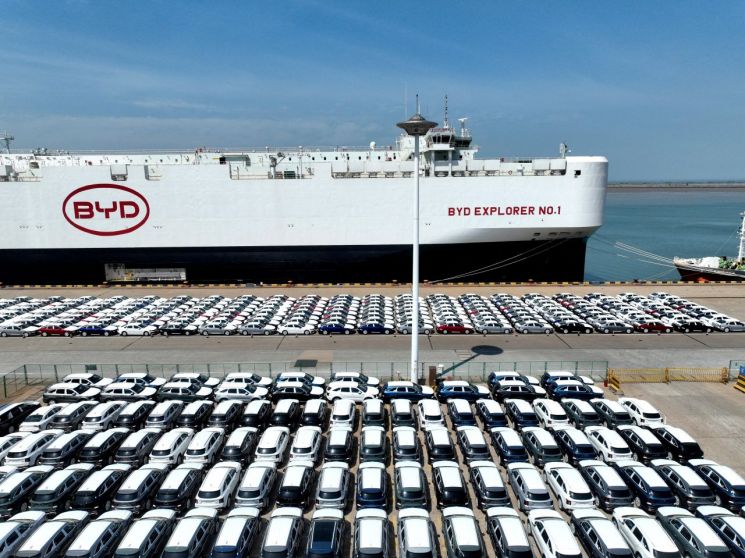 BYD vehicles awaiting export to Brazil at Lianyungang Port, Jiangsu Province, China [Image source=Reuters Yonhap News]
On the 12th, the EU Commission decided to impose provisional additional tariffs ranging from 17.4% to 38.1% based on a preliminary anti-subsidy investigation into Chinese electric vehicles such as BYD, Geely Automobile, and Shanghai Automotive Industry Corporation (SAIC). Since the EU already imposes a 10% tariff on Chinese EVs, the maximum tariff could reach 48.1%. Previously, the United States raised tariffs on Chinese EVs from 25% to 100%.
Although the EU has joined the tariff hike following the US, forecasts suggest that the impact on Chinese manufacturers will not be significant.
Bloomberg noted that the BYD Dolphin compact crossover and MG’s MG4 are sold in Europe at nearly twice the price compared to China, providing a tariff buffer effect. According to Rhodium Group analysis, as of March this year, the BYD Seal is sold in Germany for 40,684 euros, while the price in China is only 21,769 euros.
Nick Lai, an analyst at JPMorgan Chase, stated that even with increased tariffs, BYD’s profit per vehicle in Europe is 1.5 times higher than in China.
Some predict that tariffs could worsen the profitability of Chinese manufacturers. Tim Xiao, a Morgan Stanley analyst, said, "Calculations suggest Chinese companies may need to raise sales prices by 15-30%. I believe the EU’s punitive tariff increase will slow down Chinese EV sales, but the possibility of stopping sales is low. Accelerating localization plans is key."
Chinese manufacturers are relocating production bases to prepare for tariffs. BYD is pushing forward with factory construction in Mexico, Brazil, and Thailand, and is building a plant in Hungary within the EU. SAIC is also exploring production bases in Europe, and Chery Automobile has signed a contract to produce cars in Spain. Lingpao Automobile (Zhejiang Leapmotor) can utilize Stellantis’s overseas factories for production.
Export destinations are also diversifying. Recently, the Middle East has emerged as a new market for Chinese EV manufacturers such as Chery, Xpeng, and Geely’s premium brand Zeekr. William Li, CEO of Nio, announced in a recent earnings report that "products and services will be launched in the United Arab Emirates by the end of this year."
Kevin Lau, an analyst at Daiwa Securities, said, "The EU’s tariff increase will have a minimal impact on Chinese manufacturers because the EU accounts for a small portion of their total sales. From January to April this year, Europe accounted for only 1-3% of total sales for BYD, Geely, and SAIC." He added, "I do not view the EU’s tariff increase negatively. The EU market remains open to Chinese manufacturers."
© The Asia Business Daily(www.asiae.co.kr). All rights reserved.


















