Yongsan-gu Advances Population Change Response Study
Predicting Population Changes Every 5 Years Until 2040 - Identifying Tasks - Presenting Implementation Strategies
Analyzing Re-occupancy Rates After Development, Total Fertility Rate, and Changes in Living Population
Reflecting Characteristics of 80% of Development Sites... Systematic Preparation for Yongsan's Future
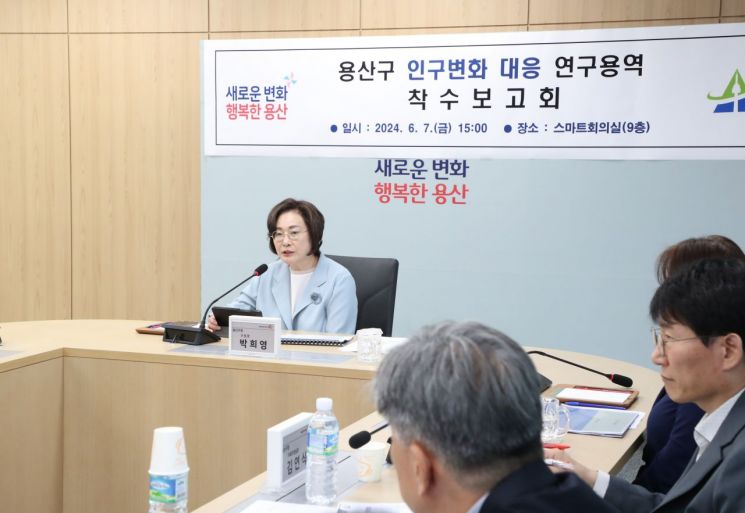
Yongsan-gu, Seoul (Mayor Park Hee-young) is conducting a research project to respond to population changes by the end of the year. This is the first case among Seoul's autonomous districts to carry out a project in preparation for urban restructuring.
On the 7th at 3 p.m., the district held the "Yongsan-gu Population Change Response Research Project Kick-off Meeting" at the district office's smart conference room, attended by the mayor, experts from various fields, and heads of related departments.
The attendees received a report from the executing agency, the Korea Institute for Industrial Relations, on the project overview, execution plan, cooperation with stakeholders, and utilization of experts. Heads of related departments, including experts in urban administration, urban planning, law, and policy, offered various opinions to ensure the project is carried out effectively.
A district official stated, "Rapid changes in the urban structure are expected due to redevelopment, reconstruction, the creation of the international business district, and development linked to Yongsan Electronics Market," adding, "Improvements in transportation systems such as the undergrounding of the Gyeongbu Line and the extension of the Shinbundang Line will particularly affect changes in the resident population."
The population change response research project aims to analyze population change trends across the entire district and its 16 neighborhoods every five years from 2025 to 2040 (a 15-year period).
The main research contents include ▲ securing data through various population analyses ▲ conducting and analyzing resident perception surveys on population changes ▲ designing forecast scenarios for population change response ▲ presenting tasks and implementation strategies for each population policy area.
Population analysis will consider factors such as re-occupancy rates due to regional development, total fertility rates, and changes in the resident population. The resident perception survey and analysis will be conducted through resident questionnaires, in-depth interviews (Focus Group Interview), and expert advisory meetings to identify policy demands. The forecast scenarios for population change response will allow for the prediction of annual population changes.
In particular, based on changes in population structure, tasks will be identified by sector and implementation strategies proposed by comprehensively considering residents' age by neighborhood, family composition (single-person households, elderly households), and nationality (multicultural families).
The district plans to secure population change forecast data reflecting the broad urban development, transportation infrastructure improvements, low birth rates, aging, and other social and natural conditions faced by the region through this project, and to establish a comprehensive basic plan for population change response that encompasses phased policies.
Park Hee-young, Mayor of Yongsan-gu, said, "This project is significant as it is the first among autonomous districts to forecast population changes in response to urban structure changes and prepare for the future," adding, "We will strive to make it a model case for establishing sustainable, regionally tailored population policies."
© The Asia Business Daily(www.asiae.co.kr). All rights reserved.
!["The Woman Who Threw Herself into the Water Clutching a Stolen Dior Bag"...A Grotesque Success Story That Shakes the Korean Psyche [Slate]](https://cwcontent.asiae.co.kr/asiaresize/183/2026021902243444107_1771435474.jpg)
















