"Need for Change in the Attitude of the Government and Ruling Party"
Kim Dong-myeong, Chairman of the Federation of Korean Trade Unions (FKTU), met with the Korean press after the International Labour Organization (ILO) General Assembly and said, "The channel for social dialogue must be maintained under any circumstances."
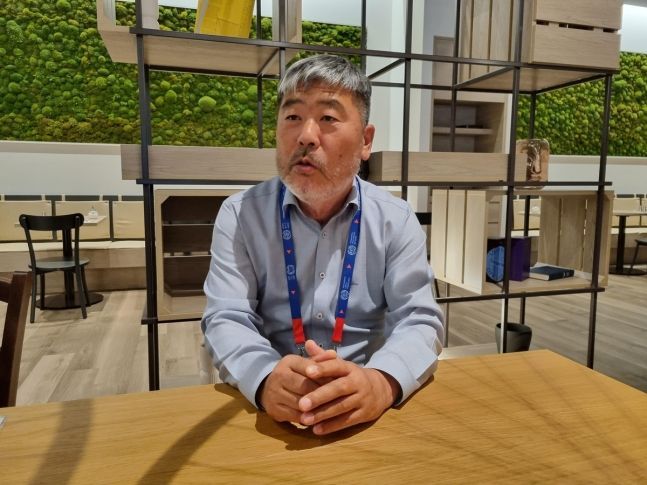 Kim Dong-myeong, Chairman of the Federation of Korean Trade Unions (FKTU), attending the International Labour Organization (ILO) General Assembly, is seen interviewing with the press at a hotel in Geneva, Switzerland, on the 11th (local time).
 [Photo by Ministry of Employment and Labor Press Corps Joint Photography]
On the 11th (local time), Chairman Kim met with the press at a hotel in Geneva, Switzerland, and stated, "The FKTU has a strong belief in tripartite labor-management-government cooperation."
The FKTU had boycotted the Economic, Social and Labor Council (ESLC), a social dialogue body directly under the president, in protest against the government's forced eviction of sit-in protests last June, but returned after five months. The first ESLC plenary session under the current administration was held in February but stalled repeatedly. However, with the ESLC Future Generations Special Committee meeting held at the end of last month, substantive discussions have begun.
Chairman Kim claimed that 'labor repression' has continued through various means under the current government. He said, "For social dialogue to yield results, a change in attitude from the government and ruling party is a prerequisite," adding, "Despite the crushing defeat in the general election, there is no sign of a shift in the ruling party's national policy direction."
Regarding his proposal in April to the Korea Employers Federation (KEF) for labor-management dialogue and joint projects, he explained, "To adapt to changes such as the climate crisis, population decline, and industrial transformation, and to overcome these crises, workers and companies must join forces and pool their wisdom."
He continued, "After proposing to KEF to identify common interests and agendas and to carry out joint projects, practical preparations are underway," adding, "The FKTU, as an economic actor, is committed to taking the lead in overcoming this era of crisis."
On the Minimum Wage Commission starting deliberations on next year's minimum wage, he expressed the position that "it must be significantly increased to compensate for the real income of households and this year's inflation rate."
He emphasized, "The differential application of the minimum wage advocated by employers will directly transfer the burden to vulnerable groups and undermine the purpose of the minimum wage system, so we will block all such attempts."
Regarding the government's stance that minority union participation should be increased and union representation diversified, he said, "We do not only represent organized workers," and added, "We have always included non-regular, youth, and female workers in various committees such as the Minimum Wage Commission." He further mentioned, "Although the unionization rates of the FKTU and the Korean Confederation of Trade Unions (KCTU) cannot be considered high, it is difficult to accept such criticism unless there is an organization with greater representativeness."
© The Asia Business Daily(www.asiae.co.kr). All rights reserved.

















