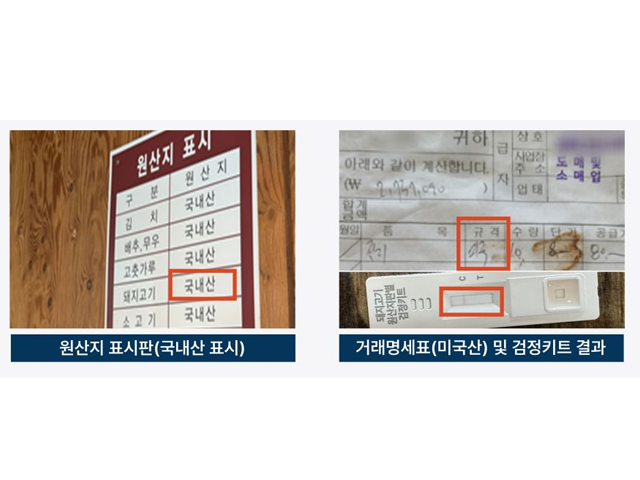
Gyeonggi Province has uncovered a large number of livestock product processing and sales businesses violating related laws, such as falsifying the origin or storing unlabeled livestock products on the floor of frozen storage facilities.
The Gyeonggi Province Special Judicial Police announced on the 13th that, after inspecting 480 livestock product handling businesses in the province from the 7th to the 24th of this month, they found 57 locations (62 cases) violating the Origin Labeling Act, Food Labeling and Advertising Act, Livestock Products Hygiene Control Act, and other regulations.
The main violations include ▲3 cases of false origin labeling ▲11 cases of labeling standard violations ▲22 cases of storing products past their expiration date ▲10 cases of preservation standard violations ▲3 cases of unreported business activities ▲6 cases of failure to perform mandatory self-quality inspections ▲7 cases of failure to prepare transaction records, production work records, and raw material receipt and issue documents, totaling 62 cases.
Among the major violations, Restaurant A located in Icheon City was caught falsely labeling U.S.-origin pork front leg meat as domestic origin. Butcher Shop B in Yeoju City was found storing six types of livestock products, including pork belly, weighing 98.1 kg, with no labeling at all, on the floor of a frozen storage facility.
Butcher Shop C in Gwangju City stored three types of livestock products, including Korean beef leg bones, which were 11 months past their expiration date, in a frozen showcase for sale without marking them as "for disposal."
Meat Sales Shop D in Yangpyeong County operated for a month with a broken freezer and was caught storing Korean beef brisket, which must be frozen at -18°C or below, in a refrigerated storage facility. Meat Processing Facility E in Pocheon City used an additional 16.8㎡ of frozen storage space beyond the approved area for storing finished products and raw materials for 2 years and 4 months without reporting the change.
Under the current Origin Labeling Act, falsifying the origin can result in imprisonment for up to 7 years or a fine of up to 100 million KRW. Under the Food Labeling and Advertising Act, failure to label or violating labeling methods can lead to imprisonment for up to 3 years or a fine of up to 30 million KRW.
Additionally, under the Livestock Products Hygiene Control Act, storing livestock products past their expiration date without marking them as "for disposal" or violating preservation standards can result in imprisonment for up to 3 years or a fine of up to 30 million KRW. Failure to report changes in business premises to the competent authority can lead to imprisonment for up to 1 year or a fine of up to 10 million KRW.
Hong Eun-gi, head of the Gyeonggi Province Special Judicial Police, stated, "As meat consumption increases, illegal activities related to livestock products are also on the rise. We will strictly punish the businesses caught violating regulations and do our best to ensure the safety of residents' food through continuous inspections."
© The Asia Business Daily(www.asiae.co.kr). All rights reserved.

















