35 MOUs Signed During Korea-Kazakhstan Visit
"Discussing to Ensure Positive Outcomes in Nuclear Power Plant Contracts"
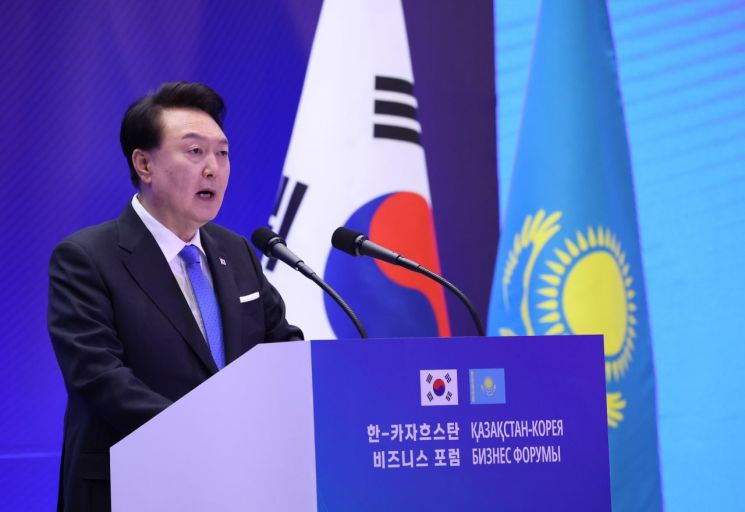 President Yoon Suk-yeol is delivering the keynote speech at the 'Korea-Kazakhstan Business Forum' held at the Hilton Hotel in Astana, Kazakhstan, on the afternoon of the 12th (local time). [Image source=Yonhap News]
President Yoon Suk-yeol is on a state visit to Kazakhstan, during which the two countries signed a total of 35 memorandums of understanding (MOUs), the presidential office announced on the 12th (local time). Of the 35 MOUs, 11 were signed in the presence of the heads of state, and 22 MOUs were signed at the Korea-Kazakhstan Business Forum.
Kim Tae-hyo, the first deputy director of the National Security Office, said at a press briefing held in Astana on the same day that the main achievements of the Korea-Kazakhstan summit included "the significance of producing concrete and practical economic cooperation outcomes" and that "the institutional foundation for continuing substantial cooperation in various fields has been strengthened."
Deputy Director Kim stated, "The two countries have agreed to strengthen support to expand the entry of our companies in the plant and infrastructure sectors," adding, "We have decided to expand opportunities for Korean companies to actively participate in major national projects in Kazakhstan."
Kazakhstan to Hold National Referendum on Nuclear Power Plant Introduction... Possibility of Domestic Company Participation
He continued, "Kazakhstan plans to hold a national referendum on the introduction of nuclear power plants," and said, "We hope that if nuclear power projects proceed in the future, our companies can participate and contribute to energy transition policies." They plan to closely consult to ensure positive outcomes in the nuclear power plant contract sector as well.
In particular, the resource-rich Kazakhstan and Korea agreed to further strengthen their economic security partnership, including securing supply chains. Deputy Director Kim emphasized, "Through the MOU on the supply chain of critical minerals, the two countries will enhance full-cycle cooperation," and "We will closely cooperate to ensure that Korean companies can have priority participation in the development and production of economically viable minerals."
He also said, "Beyond bilateral cooperation, we will closely collaborate on global agendas such as nuclear non-proliferation, international peace, and climate crisis response," adding, "Our relationship has developed to discuss cooperation from a global perspective."
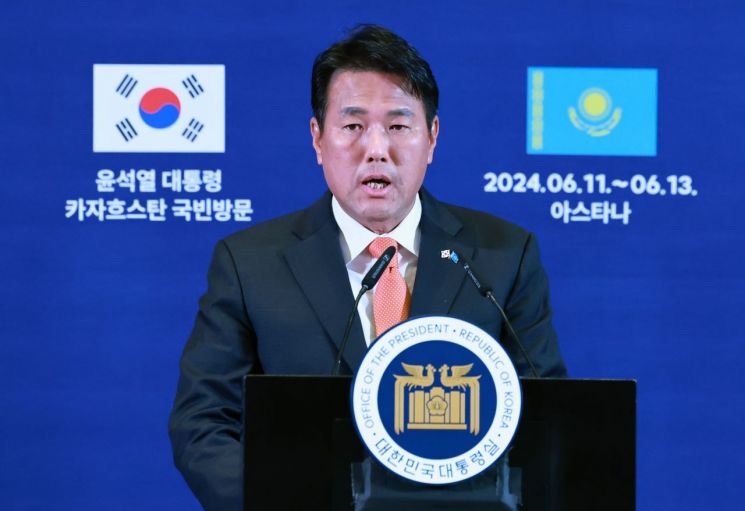 Kim Tae-hyo, the First Deputy Director of the National Security Office, is briefing on President Yoon Seok-yeol's state visit to Kazakhstan at a hotel in downtown Astana, Kazakhstan, on the 12th (local time).
 [Image source=Yonhap News]
Confirming a shared stance and willingness to cooperate on security issues was also highlighted as a major achievement. Deputy Director Kim explained, "Through this state visit, the two countries reaffirmed their firm commitment to nuclear non-proliferation and pledged close cooperation on North Korea's denuclearization," adding, "Kazakhstan expressed full support for the bold initiatives of the Republic of Korea government."
He added, "It is significant that Kazakhstan, which pursues balanced diplomacy in Central Asia where the geopolitical interests of major powers such as Russia, China, and the United States intersect, expressed a clear position on North Korea's denuclearization and shared the same security cooperation will as Korea."
Deputy Director Kim said, "It is meaningful that we secured the active will of the heads of state to launch the Korea-Central Asia Summit next year," and added, "In a private strategic dialogue following the summit, both leaders agreed that Korea and Kazakhstan will jointly exercise leadership in the region and unite to expand peace and prosperity."
Park Chun-seop, the presidential office's chief economic secretary, said in a subsequent briefing regarding mineral cooperation, "We have established a full-cycle cooperation foundation from joint exploration to development, refining, smelting, and processing of critical minerals," emphasizing, "In particular, it was agreed that if economic viability is confirmed through joint exploration of critical minerals, Korean companies will have priority participation."
Along with establishing a government-level cooperation system, specific cooperative projects between private companies and institutions will also be promoted. The Korea Institute of Geoscience and Mineral Resources and SK Ecoplant signed an MOU on 'Lithium Mine Exploration and Development Cooperation' with Kazakhstan's Ministry of Industry and Construction and Tauken Samruk, a subsidiary of Samruk Kazyna.
Secretary Park said, "Kazakhstan's lithium reserves are estimated at about 100,000 tons, and if developed smoothly, it will help secure lithium resources."
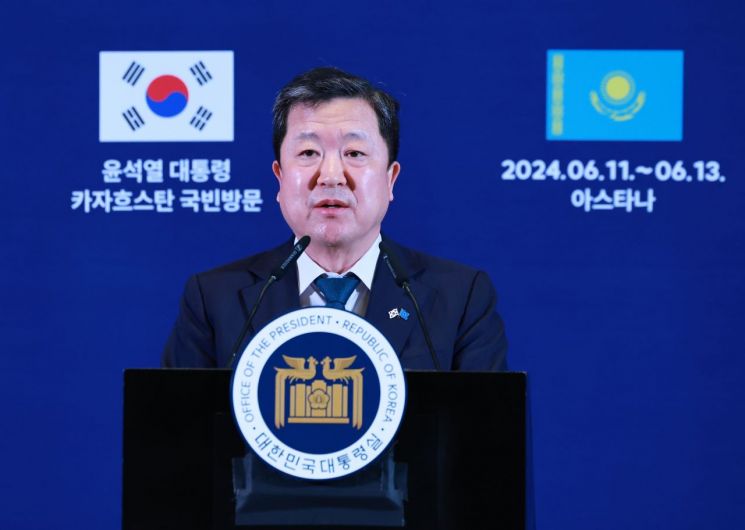 Economic Secretary to the President Park Chun-seop is briefing on President Yoon Suk-yeol's state visit to Kazakhstan at a hotel in downtown Astana, Kazakhstan, on the 12th (local time). [Image source=Yonhap News]
Technology cooperation for the commercialization of rare metals will also be promoted. Secretary Park said, "The Korea Institute for Advancement of Technology and Kazakhstan's National Center for Technology Foresight signed an MOU on 'Technology Cooperation for Commercialization of Rare Metals' for joint research on rare metal extraction and processing, training of experts in flotation, smelting, and recycling, and support for corporate exchanges, and a Rare Metals Center will also be established."
An MOU on 'Automotive Workforce Industry-Academia Cooperation' was also signed between Kia Motors and Nazarbayev University to secure excellent local automotive talent.
Secretary Park emphasized, "Looking at new car sales in Kazakhstan in 2023, Hyundai and Kia sold 72,000 units, accounting for 36.3% of the total," adding, "When the Kia assembly plant with an annual production capacity of 70,000 units is completed in the second half of this year, the market share of Korean cars in Kazakhstan is expected to increase further."
With the expansion of air routes between the two countries, human exchanges are also expected to increase. Secretary Park said, "We have agreed to open direct flights between the two capitals," adding, "Kazakhstan's Air Astana will resume the Astana-Incheon route, which was suspended due to COVID-19, in June, and Korea's T'way Air will operate the Incheon-Astana route, and Eastar Jet will operate the Incheon-Almaty route about 2 to 3 times a week."
Turkic Supreme Leader: "Major Projects Should Be Entrusted to Korean Companies"
Meanwhile, on the 11th (local time), as President Yoon was heading to the airport after a state visit to Turkmenistan, Supreme Leader Gurbanguly Berdimuhamedow reportedly had close talks with President Yoon regarding major projects. Supreme Leader Berdimuhamedow rode in the same car as President Yoon to the airport.
Deputy Director Kim conveyed in the briefing that Supreme Leader Berdimuhamedow said, "We ask Korean companies to take charge of major projects such as the fourth desulfurization facility project at the Galkynysh gas field, which is at the finalization stage, the second phase of the Kiyanly polymer plant project, as well as oil and gas development and futuristic new city construction."
In response, President Yoon replied, "Let us build a mutually beneficial and productive cooperation from a long-term perspective," and added, "We will systematically promote software support such as professional workforce education and training to back this up."
Deputy Director Kim said, "In Central Asian countries, the judgment and determination of the supreme leader have a decisive impact on national economic projects," and expressed hope that "the strong bonds and trust established between the leaders of the two countries this time will be a great force supporting Korea-Central Asia cooperation."
© The Asia Business Daily(www.asiae.co.kr). All rights reserved.



















