Seoul, Gyeonggi, Incheon and Other Major Local Governments Suspend Projects
Taxi Drivers and Passengers Avoid Due to Frustration
Mandatory Implementation Difficult... Voluntary Installation Should Be Encouraged
Recently, concerns over taxi driver safety have grown as incidents of intoxicated passengers assaulting taxi drivers have occurred consecutively. Several years ago, a protective partition installation project, partially funded by local governments to safeguard taxi drivers, was implemented but has mostly been discontinued due to lack of demand and other reasons. Experts advise that active promotion and demand surveys regarding the necessity of protective partitions should be conducted simultaneously.
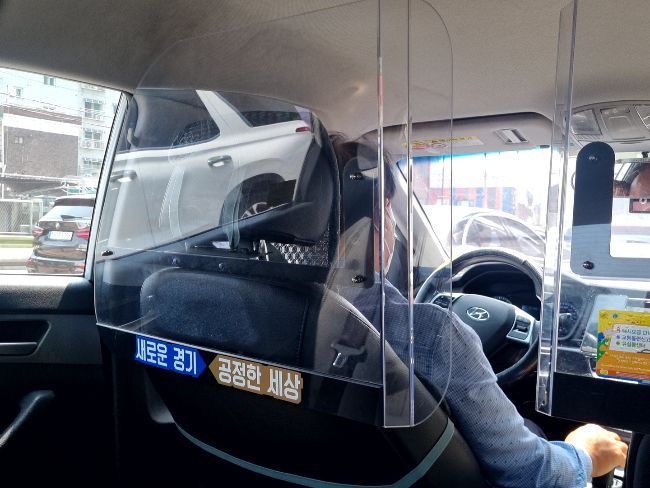
Major Local Governments such as Seoul, Gyeonggi, and Incheon 'Discontinued'
According to a comprehensive report by Asia Economy on the 13th, the 'Taxi Protective Partition Installation Project,' which partially supports the cost of installing protective partitions inside vehicles, has been discontinued in most local governments, including major ones like Seoul, Gyeonggi, and Incheon. Seoul allocated budgets of 25 million KRW and 50 million KRW in 2019 and 2021 respectively, supporting a total of 729 vehicles (236 and 493 vehicles), but the project is currently halted due to budget allocation issues and lack of demand.
Gyeonggi Province also provided subsidies for 1,397 vehicles across 25 cities and counties from 2015 to 2018, spending about 350 million KRW, but the project is no longer ongoing. Incheon City similarly allocated a budget of 38.7 million KRW in 2022 to support 768 vehicles, but the project has been discontinued.
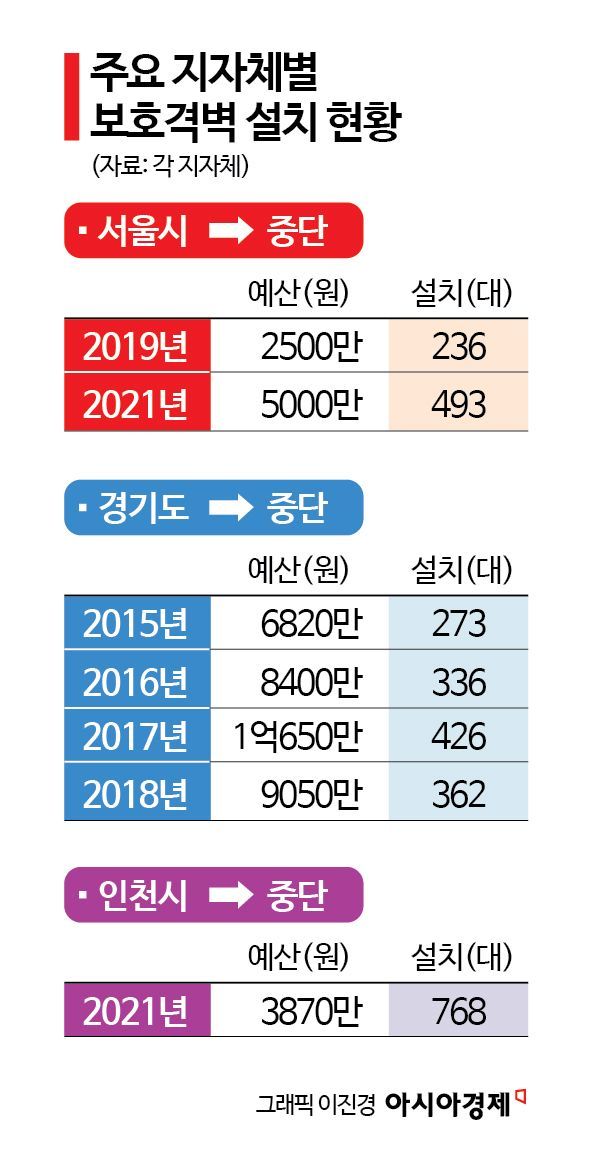
The reasons for the project's discontinuation include low support rates and difficulties in budget allocation. The Taxi Protective Partition Installation Project is designed to support part of the cost for installing transparent protective partitions around the driver's seat to ensure taxi driver safety, with local governments covering between 50% and 80% of the average installation cost of about 200,000 KRW.
However, many taxi drivers avoid installing protective partitions because they feel the partitions make the vehicle interior cramped, and some passengers have expressed dissatisfaction, citing inconvenience during payment. Jeong Mo (56), a taxi driver affiliated with the Taxi Branch of the Korean Confederation of Trade Unions Public Transport Workers' Union, said, "I installed a protective partition three years ago with support from Seoul City, but since it surrounded the driver's seat, it felt stuffy and uncomfortable, so I removed it after about three months." He added, "From what I see around, passengers complain and seem uncomfortable, so the installation rate is not high. I understand that only about one in five taxis have them installed."
Major local governments such as Seoul, Gyeonggi, and Incheon also decided to terminate the project early because the support rate was far below the target during the project's operation. A Seoul city official stated, "We conducted the project in 2019 and 2021, but taxi drivers were reluctant to install the partitions due to discomfort, resulting in low support rates. Because the support rate itself was low, it was difficult to request budget allocation from the budget department."
Different from Buses, Voluntary Installation Should Be Encouraged
There are also calls to mandate the installation of protective partitions inside taxis, similar to buses. According to the National Police Agency, assaults on drivers have been increasing annually, from 2,587 cases in 2019 to 3,947 cases (provisional) last year. On the 5th, in Gwanak-gu, Seoul, an intoxicated passenger assaulted a taxi driver in his 60s while the taxi was driven about 3 km, leading to the passenger's arrest by the police. On the 8th, in Seo-gu, Busan, an intoxicated individual sexually harassed a female taxi driver and strangled her.
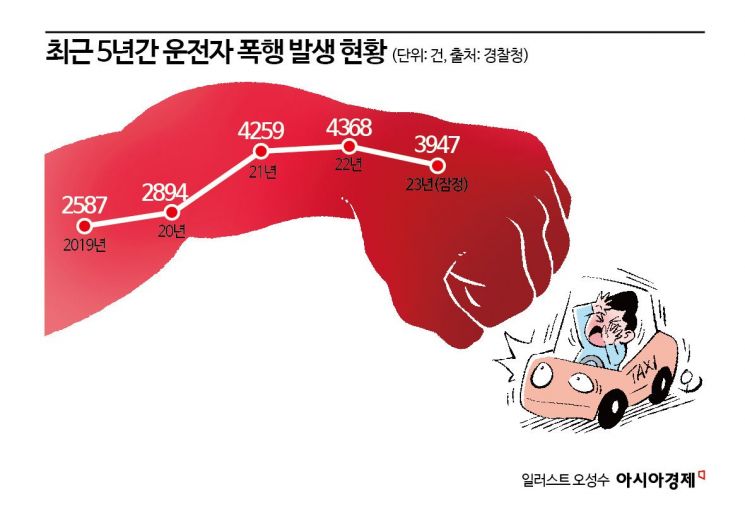
Experts emphasize the need to encourage taxi drivers to voluntarily install protective partitions while also conducting more active promotion at the local government level. Unlike buses, where the necessity and public interest in driver protection are strong and mandatory, it is preferable to leave the decision to taxi drivers' discretion, but sufficient promotion by local governments should be ensured.
Professor Yoo Jeong-hoon of the Department of Transportation Systems Engineering at Ajou University explained, "Since the damage caused by assaults on bus drivers is much greater than that on taxi drivers, it is policy-wise appropriate to mandate protective partition installation for buses, but the situation is different for taxis." He added, "The fact that many taxi drivers avoid installation due to discomfort can be interpreted as a low awareness of the risks involved. Local governments should encourage voluntary installation while emphasizing the necessity of installation more strongly."
© The Asia Business Daily(www.asiae.co.kr). All rights reserved.
![Clutching a Stolen Dior Bag, Saying "I Hate Being Poor but Real"... The Grotesque Con of a "Human Knockoff" [Slate]](https://cwcontent.asiae.co.kr/asiaresize/183/2026021902243444107_1771435474.jpg)


















