Seoul National University Hospital to Begin Group Strike from 17th
"It Hurts to Hear Doctors Called Those Who Leave Patients' Side"
As Seoul National University Hospital has decided to hold a collective strike on the 17th, Kang Hee-kyung, emergency response committee chair of the Seoul National University College of Medicine and Seoul National University Hospital Faculty Council, said, "After the medical school enrollment increase incident broke out, I came to think that the Cargo Solidarity also had a lot of grievances," adding, "Policy is one thing, but the hardest part is not being guaranteed decision-making authority." He saw similarities between the medical crisis issue and the Cargo Solidarity strike at the end of 2022.
On the 12th, on KBS Radio's 'Jeongyeok Sisa,' Kang said, "Honestly, we don't know how the residents will return," but added, "For residents to want to come back to the hospital, they must feel that they are people whose decision-making authority is respected, just like other citizens." He continued, "Many people think that doctors have enjoyed vested interests until now," and said, "The hardest thing in this situation is that policies affecting the medical community are decided and executed without reflecting doctors' opinions."
He pointed out, "I could understand the government issuing orders to start work and maintain medical services, thinking they were worried," but added, "However, the order to prohibit acceptance of resignation letters is a fundamental suppression of the freedom to choose one's occupation." Referring to recent reports that mid-level managers with more than five years of experience are leaving the military, he said, "Shouldn't their resignation letters also be prohibited from acceptance? Is being a doctor the only important job? Are these people less important than doctors?"
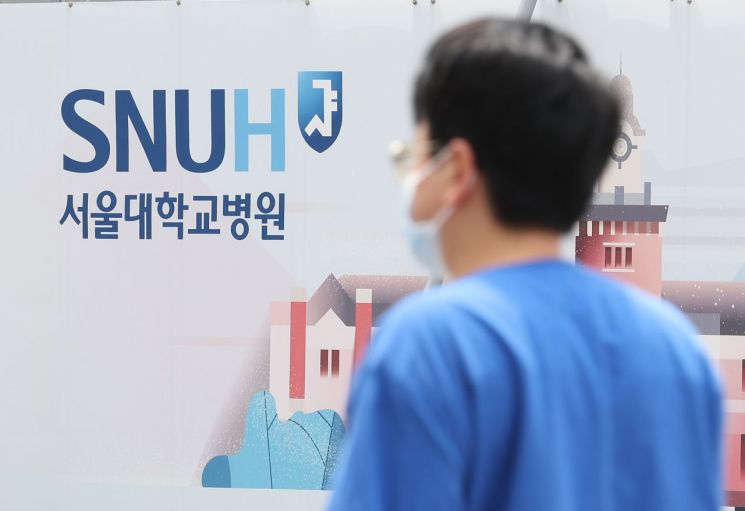 On the morning of the 7th, a medical official was moving at Seoul National University Hospital in Jongno-gu, Seoul. [Image source=Yonhap News]
Kang argued, "Medical work is special in that doctors go home even if their patients are still in the hospital. They make sure to hand over to the on-duty staff properly," and said, "Residents also handed over to professors before leaving, so they have no obligation to see those patients. They did not abandon patients but left the hospital and workplace." He lamented, "Seeing the government's advertisement saying, 'Dear doctors, please return to your patients,' I thought, 'I was on duty that day, so what about me? Am I not a doctor?' It was really heartbreaking to be called a doctor who abandoned patients."
He then clarified that the collective strike does not mean stopping emergency treatment. He explained, "It means closing regular outpatient clinics and scheduled surgeries," adding, "Treatment for those who must receive it now, such as in the emergency room, intensive care unit, inpatient wards, and those who cannot postpone treatment, cannot be stopped. We also have to continue lectures for students."
Kang emphasized, "The medical community's position is that we should first understand what kind of medical system we want, then apply data accordingly to discuss and decide the scale of enrollment increase; it is not too late," and added, "At least, the number should allow for normal education. The number of students to be taught should be increased only after the facilities are properly established."
© The Asia Business Daily(www.asiae.co.kr). All rights reserved.

















