The Supreme Court overturned a guilty verdict for a professor accused of retaliatory threats after sending a text message saying, "I will repay you as you did to me," to a fellow professor who submitted a petition on his behalf to investigative authorities, leading to a trial.
While the lower court had judged the content of the text message as constituting a threat, the Supreme Court found that the harm indicated was not specific and that the prosecution failed to sufficiently prove the 'intent to threaten' or the 'purpose of retaliation.'
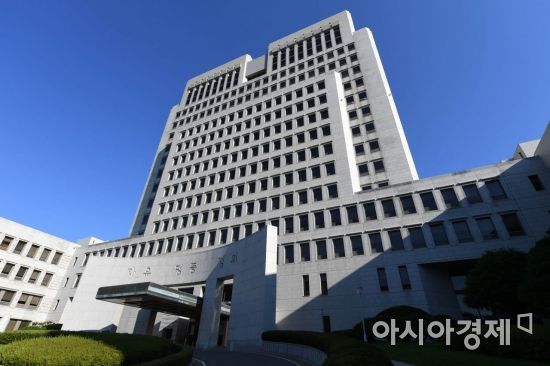
According to the legal community on the 12th, the Supreme Court's Second Division (Presiding Justice Kim Sang-hwan) overturned the original ruling that sentenced Assistant Professor A from a private university in Chungnam to 1 year and 6 months in prison with a 3-year probation and remanded the case to the Daejeon High Court.
The court stated, "It is difficult to evaluate the defendant's act of sending the text message in this case as 'threat' under the crime of threat, and it cannot be considered proven beyond a reasonable doubt that the defendant had the 'intent to threaten' or the 'purpose of retaliation.'" This was the reason for the reversal and remand.
Assistant Professor A was appointed as a professor after serving as a lecturer, introduced by Associate Professor B, who was working at the same university in 2008.
In May 2016, A introduced Mr. C to eight fellow professors, including B, regarding the sale of land located in Geumsan County, Chungnam. C proposed that if they purchased the land, he would develop and sell it at his own expense and share the profits. From April 2016 to June 2017, the professors, including B, deposited a total of 247.05 million KRW into a company account operated by A as payment for the land.
However, when the land was not developed as promised, B and others filed a fraud complaint against C in 2019, claiming that although they purchased the land, the development did not proceed and the payment was embezzled. During the investigation in September 2020 and March 2021, they submitted petitions to investigative authorities requesting severe punishment for A, alleging that A had obtained about 130 million KRW of the embezzled funds. Eventually, in September 2021, the prosecutor indicted both A and C on fraud charges.
Before the trial began, A reviewed the prosecution's evidence and found the petitions submitted by B and others. He believed that B was responsible for his being prosecuted.
On the evening of October 22, 2021, after his first trial, A sent the problematic text message to B expressing resentment.
The message read: "Professor, I apologize, but I have read the petition you and others wrote. I realize I have mishandled my relationships. I am now planning to sort out my relationships. I may leave the school I have grown fond of. Professors O, Dr. O, OOO, OOO, I will repay you as you did to me. Please reply by Tuesday. I will visit your office in the morning on Tuesday."
Eleven hours later, the next morning, A sent a similar message to B again. B did not respond, and A did not actually visit B's office.
Two days later, on October 24, 2021, C called the head of the university's faculty affairs department where B worked to report various school corruption allegations, including B's embezzlement of research funds. Three days later, C sent an email to the same department head detailing B's specific corrupt activities. During the investigation and trial, A testified that he was not involved in C's report of B's misconduct. C also maintained the same position. No evidence emerged that A was involved in the report.
The prosecutor viewed A's act of sending threatening text messages to B, who had provided investigative leads against him, as retaliatory threats under the Act on the Aggravated Punishment of Specific Crimes and indicted A.
Article 5-9(2) of the Act on the Aggravated Punishment of Specific Crimes (Aggravated Punishment for Retaliatory Crimes) states, "A person who commits the crime of threat under Article 283(1) for the purpose of retaliation related to the provision of investigative leads, testimony, or evidence in a criminal case involving oneself or others shall be punished by imprisonment for not less than one year," thereby imposing aggravated punishment for threats.
Meanwhile, the prosecution investigating the case where B and others filed a fraud complaint against C and submitted petitions claiming A was an accomplice argued that C could not obtain development permits for the land and intended to use the funds for other purposes despite receiving payments from victims. They claimed that A conspired with C to deceive victims and embezzle 247.05 million KRW, indicting both A and C.
However, the first trial court handling the fraud charges against A and C acquitted them in March 2022, stating, "Most ownership transfers were completed according to the sales contract, and there is insufficient evidence to conclude that development permits could not be obtained based on the average slope of the land at the time of sale."
The prosecution appealed, but the second trial court dismissed the appeal on October 2, 2023, and the Supreme Court's rejection of the appeal in March 2024 finalized their acquittal.
The first trial court handling A's retaliatory threat case also acquitted A.
In court, A's defense argued, "The defendant sent the text message expressing distress while intoxicated after learning that a victim with whom he had a close relationship petitioned for his punishment, without intending to threaten the victim."
They also claimed, "The text message cannot be seen as a specific threat of harm and is merely an expression of temporary anger, so it does not constitute a threat. It is also difficult to say that it caused fear to the victim, who was the defendant's superior." Since A, who became an assistant professor after being hired as a lecturer with B's help, was not in a position to influence B's professorship, B would not have felt threatened or fearful.
The defense further argued, "Even if the text message is interpreted as a threat to file complaints or accusations against the victim, it is an exercise of legitimate rights and cannot be considered a threat."
The court accepted these arguments.
The court pointed out, "From the content of the text message alone, it is difficult to know what specific legal interest the defendant intended to harm, and it is questionable whether the message was sufficient to generally cause fear."
The court concluded, "Based solely on the evidence submitted by the prosecution, it is difficult to consider the text message as a threat of harm under the crime of threat, and it is also difficult to recognize the defendant's intent to threaten."
However, the second trial court overturned the first trial's acquittal and sentenced A to 1 year and 6 months in prison with a 3-year probation.
The court stated, "The text message can be sufficiently understood as meaning that the defendant, who was prosecuted due to the victim's complaint and suffered status disadvantages and might lose his professorship in the future, would retaliate similarly by causing the victim to lose his professorship through appropriate means such as complaints."
It added, "The defendant specifically threatened to cause status disadvantages to the victim, and the harm indicated was generally sufficient to cause fear."
The court noted that although A was a lower-ranking assistant professor, he could have damaged B's reputation or caused status disadvantages outside the school through complaints without using his position at the school. It criticized the lower court's judgment that A could not cause status disadvantages to the victim, considering that the victim was A's superior and that A did not hold a position to influence the school foundation.
The court also added, "The defendant executed the harm he threatened to the victim through C." Contrary to the first trial's judgment, it found it difficult to believe that A was not involved in C's report of B's corruption.
Finally, regarding A's claim of legitimate conduct, the court stated, "Even assuming the victim's misconduct mentioned by the defendant is true, sending the text message was solely to induce the victim to withdraw the fraud complaint or for retaliation, and cannot be considered a reasonable means for a legitimate purpose."
However, the Supreme Court reversed the ruling again.
Referring to Supreme Court precedents related to the crime of threat, the court stated, "Even if harm is indicated as part of exercising rights, if such harm is socially acceptable under customs or ethics or is a reasonable means for a legitimate purpose and does not violate social norms, the crime of threat does not apply."
The court also noted, "In criminal trials, the prosecution bears the burden of proving the facts constituting the crime charged. Therefore, the prosecution must prove that the perpetrator of the aggravated retaliatory crime under Article 5-9 of the Act on the Aggravated Punishment of Specific Crimes had the purpose of retaliation. Such proof must be strict enough to leave no reasonable doubt to the judge, and if such proof is lacking, the defendant must be judged in favor."
Considering this legal principle, the court judged, "It is difficult to evaluate A's act of sending the text message to B as 'threat' under the crime of threat, and it cannot be considered proven beyond a reasonable doubt that A had the 'intent to threaten' or the 'purpose of retaliation.'"
The court based this judgment on the following: the text message was abstract; assistant professor A was not in a position to cause disadvantages to his superior associate professor B's professorship; B testified that after receiving A's message, reports of misconduct against him were filed at the school, which he suspected were due to A's intention, causing him fear; thus, B's fear likely arose or was concretized after receiving the message and other circumstances; there was no evidence that A was involved in the report; and considering A's acquittal on fraud charges, it was understandable that A felt deeply wronged and hurt by the one-sided suspicion and calls for severe punishment contained in B's petition.
The court concluded, "Considering that A could have actually lost his professorship due to the court's judgment on the fraud charge, that the message was sent on the first trial date for the fraud charge based on C's petition, that the message was written politely and was abstract, it is more plausible that A impulsively expressed his feelings of grievance and hurt to B, with whom he had a long-standing friendship, while intoxicated, rather than that it was a 'threatening intent' or a 'specific threat of harm' for 'retaliation.'"
© The Asia Business Daily(www.asiae.co.kr). All rights reserved.

















