Joo Hyung-hwan, Senior Vice Chairman
"Policy Priorities, Budget Redistribution Based on Performance Needed"
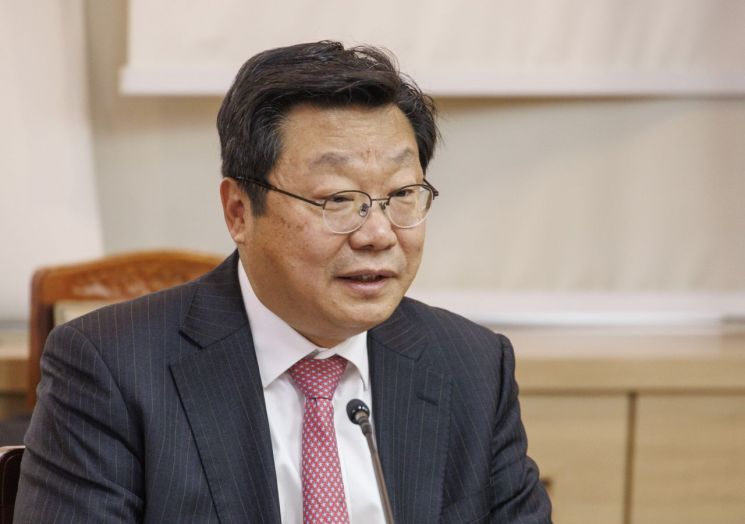
"Going forward, it is necessary to increase financial investment in low birthrate response areas that are needed and have high priority, while reducing it in other sectors."
On the afternoon of the 11th, Joo Hyung-hwan, Vice Chairman of the Low Birthrate and Aging Society Committee, said this at the "Low Birthrate Budget Restructuring Joint Seminar" held at the FKI Tower Conference Center in Yeouido, Seoul. At the seminar, a discussion was held to review the current status of the low birthrate response budget and discuss future improvement measures.
On the same day, Han Sung-min, Director of the Public Investment Policy Office at the Korea Development Institute (KDI), stated in his presentation, "As a result of restructuring the 2023 low birthrate response budget projects, only 23.5 trillion won out of the total 47 trillion won budget is allocated to core tasks directly related to low birthrate response, which is just half."
The housing support budget, which is not included in the OECD family expenditure standard used for international comparison, accounted for 21.4 trillion won, nearly half of the total budget.
Additionally, it was analyzed that 80% (20.5 trillion won) of the total budget was concentrated solely in the childcare sector. Support for work-family balance, which has a significant effect on low birthrate response, accounted for only 8.5% (2 trillion won) of the budget.
Vice Chairman Joo said, "Looking at the analysis result that the budget for core projects directly linked to low birthrate is only half of the total budget, it makes us reconsider whether the government's financial investment so far has truly been sufficient and efficient," adding, "There is a need to redistribute the budget according to policy priorities and outcomes."
He also emphasized, "So far, government policies have lacked selection and concentration, and there has been a tendency to gradually expand existing policies without strict effectiveness evaluation," and "Tasks that are not directly related to low birthrate measures or have insufficient effects should be boldly cut out, and focus should be placed on effective policies."
He continued, "Through the Population Policy Evaluation Center established last May, we plan to conduct in-depth evaluations starting with the care sector, followed by housing support project groups and other sectors, and even cash support projects of local governments."
© The Asia Business Daily(www.asiae.co.kr). All rights reserved.

















