Controversy Over Cadaver Lecture for Fitness Instructors
Some Raise Suspicions of 'Profit from Donated Bodies'
Company Says "Not a Profit Business, Compliance with Regulations"
A company offering paid courses on cadaver dissection practice, using donated bodies for medical training and research purposes, has become embroiled in controversy. The suspicion arose because the course participants are not medical professionals but 'exercise instructors' such as health trainers and Pilates instructors, raising concerns about the commercialization of cadavers. However, the company explained that this controversy stems from a misunderstanding. It is known that there are no specific qualification requirements to observe cadaver anatomy practice.
'600,000 Won Cadaver Class' for Exercise Instructors Under Scrutiny

The controversy began on the 9th across various online communities and social networking services (SNS). The 'Cadaver Class' co-hosted by the private company 'Healience Lab Academy' (Healience) and the Catholic University Applied Anatomy Research Institute came under fire.
On that day, a screenshot of Healience Lab's lecture promotion page was posted on SNS, introducing an anatomy class scheduled for the 23rd. The target audience is 'exercise instructors,' and the tuition fee is 600,000 won. The page also stated, "The class is conducted from start to finish by a current anatomist at the Catholic University St. Mary's Hospital, which has the highest-level cadaver practice facilities in Korea."
Some netizens raised suspicions that Catholic University and Healience Lab might be commercializing cadavers. Currently, cadavers can only be used for medical training and research purposes, and their use requires the explicit consent of the donor during their lifetime.
 Controversy arose over some of the content in the review lectures.
 [Image source=Captured from Healience Lab]
Criticism also poured in regarding the 'reviews' of the course. It was pointed out that this was disrespectful to donors who offered their bodies for the public good. The review section on the website included phrases such as "Essential for trainers," "This is the first time I've seen such a well-preserved cadaver," and "How many trainers and Pilates instructors have experienced hands-on cadaver practice?" Healience Lab also emphasized that they use "fresh cadavers" as practice materials.
"Not a Profit-Making Business, Strict Compliance with Ethical Education in Dissection Practice"
However, there is no indication that Healience Lab violated regulations related to cadaver handling. On the 10th, Yonhap News quoted a Ministry of Health and Welfare official saying, "While dissection acts are strictly regulated by law, there are no restrictions on observation."
Healience Lab also emphasized that the course was not organized for profit and that participants attended as 'observers' of anatomy practice. A Healience Lab representative told Asia Economy, "Healience Lab recruits students, and the lectures are conducted by the Catholic Applied Anatomy Research Institute," adding, "The operation is only at the minimum cost necessary for using the facilities and cadavers in education conducted by the Catholic Medical School."
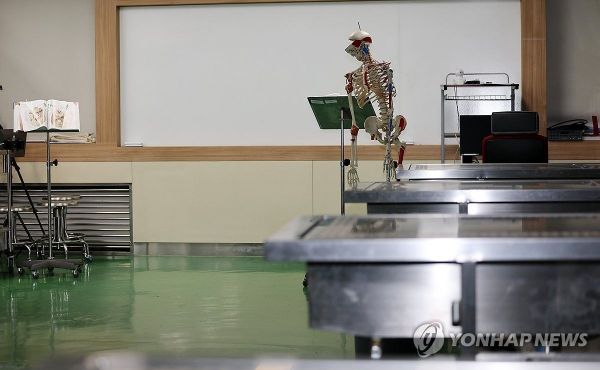 Anatomy laboratory. The photo is not related to any specific expression in the article. [Image source=Yonhap News]
They also added that the anatomy class is conducted under the guidance of an actual anatomy professor, sharing respect for the cadaver as in general dissection practice, and strictly adhering to ethical education applied in dissection settings. The term "fresh cadaver" used in promotional materials is a value-neutral term also used in actual medical settings, and cadaver classes are conducted not only by Healience Lab but also by other domestic institutions.
Donated Bodies, a Sensitive Topic for Bereaved Families
Cadavers donated for research purposes are a very sensitive topic. While they carry the noble meaning of aiding the understanding of anatomy and training medical professionals for the public good, careless handling can insult the deceased and their families.
Earlier in March, when the government proposed revising the system to allow sharing of cadavers among medical schools, criticism arose mainly from bereaved families. On March 21, then-Deputy Minister of Health and Welfare Park Min-su briefed, "About 1,200 cadavers are donated annually in Korea, but only about 800 are actually used in medical schools," adding, "Because donors designate specific institutions for use, other institutions are blocked from access."
Subsequently, families of cadaver donors protested. Six people, including Maeng Ho-young, a Yonsei University Medical School alumnus, stated on Facebook, "We, or our parents, pledged to use our bodies posthumously for research and education at Yonsei University Medical School," and criticized, "It feels inappropriate to use terms like 'surplus' or 'sharing' as if these were items in stock that can be distributed."
They further stated, "Anatomy is an important process where new medical students learn respect and fear for living beings," and criticized that the issue stemmed from misunderstanding of corpse handling and educational preparation, causing public misunderstanding as well.
© The Asia Business Daily(www.asiae.co.kr). All rights reserved.

![A Woman with 50 Million Won Debt Clutches a Stolen Dior Bag and Jumps... A Monster Is Born [Slate]](https://cwcontent.asiae.co.kr/asiaresize/183/2026021902243444107_1771435474.jpg)

















