Sogongyeon Announces Survey on Minimum Wage Increase Impact
87.8% Say "Need Industry-Specific Minimum Wage"
Employers Plan to "Reduce Hiring or Shorten Working Hours" Upon Increase
It was found that 98.5% of small business owners believe that the minimum wage should be lowered or frozen.
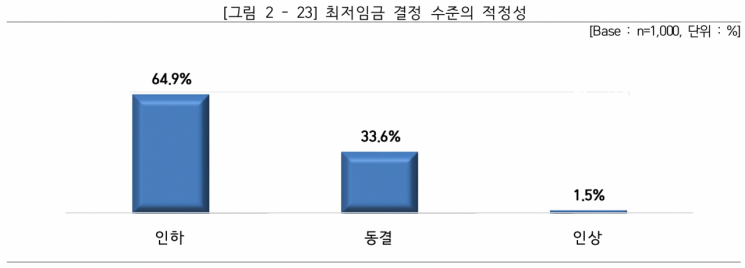
The Korea Federation of Small and Medium Business (KOSME) announced the results of the "Survey on the Impact of Minimum Wage Increase on Small Business Owners" on the 11th. The survey was conducted on 1,000 small business operators nationwide. Regarding next year's minimum wage decision, 64.9% of respondents said a "reduction" was necessary, and 33.6% said it should be "frozen." Only 1.5% responded that it should be "increased."
According to the report, labor costs have risen significantly compared to the recent business conditions of small business owners. The average monthly sales of small business establishments this year is 12,236,000 KRW. Last year it was 12,325,000 KRW, and in 2022 it was 11,903,000 KRW, with an average annual growth rate of 0.9%. The average monthly operating profit also remained at the same 0.9%.
On the other hand, average labor costs grew by an average of 2.2% annually over the past three years, which is 2.44 times higher than the average annual growth rate of sales and operating profit. The average labor cost was 2,769,000 KRW in 2022, 2,927,000 KRW in 2023, and 2,955,000 KRW this year. As a result, employment at small business establishments decreased, with the average number of workers dropping from 2.2 in 2022 to 2.1 this year.
The reduction in employment was also confirmed in the impact of minimum wage increases on business operations. When asked about the impact of next year's minimum wage increase, responses related to employment were high: reduction in new hires (59%), layoffs of existing staff (47.4%), and reduction in working hours of existing staff (42.3%). This was followed by business closures, shortened business hours, and price increases for products and services. In the food and accommodation sector, the proportion citing business closure was 25.2%, more than twice the average.
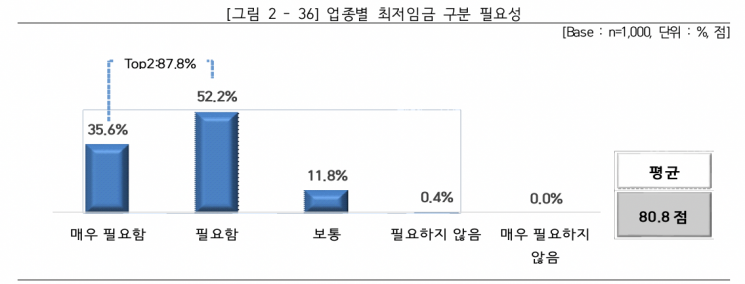
Additionally, 87.8% of small business owners surveyed believed that the minimum wage should be applied differently by industry. Among the methods, "applying to industries with a high proportion of small business owners" accounted for the highest response at 58.2%, followed by "prioritizing industries with a high rate of workers earning below the minimum wage" at 30.5%.
Among these, the voices calling for a reduction in the minimum wage were highest in beauty salons, chain convenience stores and supermarkets, PC rooms, and coffee shops. Looking at responses regarding minimum wage decisions by industry, 73.7%, 72%, and 68% respectively answered that a "minimum wage reduction" was necessary. In particular, chain convenience stores and supermarkets and PC rooms showed the highest responses among all industries regarding the burden of minimum wage, with 91.6% and 90% respectively saying the burden was (very) high. Coffee shops (68.9%), beauty salons (66.7%), and chain convenience stores and supermarkets (65%) had a high proportion of respondents who said the minimum wage was high compared to labor productivity.
Among the respondents in this survey, 44.3% were confirmed to employ workers working less than 15 hours. The main reason for employing workers less than 15 hours was the burden of labor cost payments, accounting for 58%. According to the Labor Standards Act, workers who work 15 hours or more per week must be paid an additional 20% weekly holiday allowance on top of the minimum wage.
Yoo Gi-jun, acting president of KOSME, said, "Small business owners are going through a difficult time due to weakened consumer sentiment, increased labor costs, and rising raw material prices, and the closure rate has surged as they cannot cope with the loans increased during the pandemic," adding, "Minimum wage decisions should be made with differential application, considering the payment capacity and voices of small business owners."
© The Asia Business Daily(www.asiae.co.kr). All rights reserved.


















