Controversy Over the Scope of Criminal Non-Prosecution Privilege
Key Issue: Whether Trials Should Occur During the President's Term
"Privilege Must Be Strict" VS "Duty Must Be Protected"
Following the guilty verdict against former Gyeonggi Province Deputy Governor Lee Hwa-young on charges including illegal remittance to North Korea and bribery, the judicial risk for Lee Jae-myung, leader of the Democratic Party of Korea, has significantly increased. As concerns over the judicial risk of Lee, a leading presidential candidate, grow within political and legal circles, debates have begun over unprecedented scenarios such as whether criminal trials initiated before his presidential term could continue after his inauguration.
On the 10th, legal experts predicted that prosecutors might file additional charges against Lee Jae-myung, prompted by the trial of the former deputy governor. Lee is already undergoing trials related to the Daejang-dong scandal, violations of the Public Official Election Act, and allegations of witness tampering. If prosecutors determine that Lee Hwa-young reported to Lee Jae-myung in advance or during the illegal remittance activities and proceed with charges, the number of trials will increase. Kwak Kyu-taek, senior spokesperson for the People Power Party, stated that "It is a natural step for the investigation to conclude with Lee, who was then the governor of Gyeonggi Province."
For Lee, who is aiming for the next presidential election, this means facing a massive uncertainty in the form of ongoing trials. Consequently, not only the trial outcomes but also their timing have become crucial. If the Supreme Court ruling is finalized before the election, Lee’s eligibility to run will depend on the court’s decision. If all charges result in acquittal, he can run as a presidential candidate; however, if he receives a prison sentence or higher, he will lose both his parliamentary seat and candidacy eligibility. If the verdict is delayed until after the election or beyond, the situation becomes more complicated. Especially since Lee is considered the closest among the next presidential candidates to becoming president, his victory in the election would raise constitutional questions.
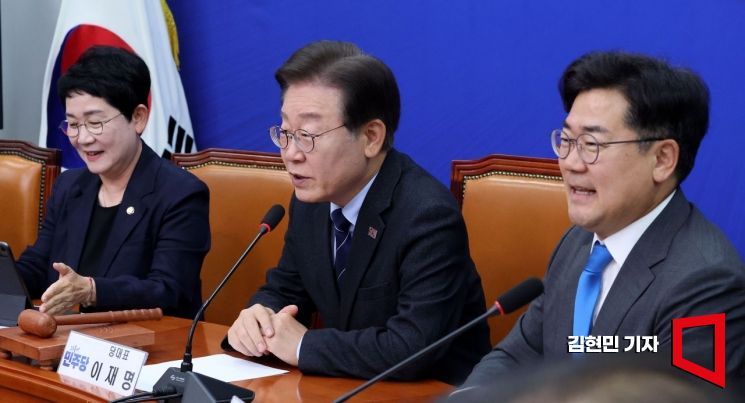 Lee Jae-myung, leader of the Democratic Party of Korea, is speaking at the Supreme Council meeting held at the National Assembly on the 10th. Photo by Kim Hyun-min kimhyun81@
One such question is whether, as a sitting president, the trial should be suspended and resumed after the term, or whether the trial should proceed even during the term.
Article 84 of the current Constitution states, "The President shall not be subject to criminal prosecution during the term of office, except in cases of rebellion or treason." Regarding this provision, known as the President’s privilege against criminal prosecution, Han Dong-hoon, former emergency committee member of the People Power Party, stated on social media that "the criminal trial of the former deputy governor will not be suspended simply because the defendant becomes president." This means that even if Lee becomes president, he must undergo trial, and depending on the outcome, he may have to step down from the presidency.
Experts are divided in their interpretations of Article 84 of the Constitution.
Constitutional law scholar Professor Lim Ji-bong of Sogang University Law School expressed the view that, based solely on the Constitution and grounded in the normative principle of power control, the scope of Article 84 should be limited, allowing trials initiated before the presidential term to proceed during the term. In a phone interview with Asia Economy, Professor Lim said, "Privileges for constitutional and state institutions, including the president, should be interpreted strictly. While constitutional institutions might want to interpret privileges broadly, the Constitution itself embodies the normative principle of power control, so expanding privileges or interpretations contradicts the nature of the Constitution. Article 84, which grants the president immunity from criminal prosecution during the term, should be interpreted strictly." He added, "Prosecution here refers to indictment following investigation," and "From the perspective of the Constitution’s power control normativity, the president is not subject to prosecution or indictment during the term but can still be investigated."
However, Professor Lim noted, "This interpretation pertains to the Constitution itself, but whether the judiciary can proceed with trials while the president is performing duties is a practical issue beyond the Constitution." He said, "This depends on the judiciary’s judgment. There may be arguments for suspending trials during the term, but it is up to the court to decide."
There are opposing views. Former Minister of Government Legislation Lee Seok-yeon told Asia Economy in a phone interview, "Article 84 states that except for rebellion and treason, the president shall not be subject to criminal prosecution during the term," adding, "This means that even crimes committed before the term cannot be prosecuted during the term." He continued, "This provision should be interpreted to mean that the judiciary cannot exercise criminal jurisdiction over the president during the term, except in cases of rebellion or treason." Lee emphasized, "Considering the president’s role as head of state and head of the executive branch, this significant position must be protected to ensure the president’s ability to perform duties," clarifying, "This is not a personal privilege of the president." He stressed, "It is reasonable to view that criminal jurisdiction does not apply to the president during the term."
Regarding the interpretation of the term "prosecution," Lee explained, "It is a broader concept than indictment," including impeachment prosecution, so it should not be limited to indictment as prosecutors claim. He also added, "The statute of limitations is suspended for the president, and regulations requiring trials to conclude within a few years, i.e., trial statutes of limitations, naturally do not apply."
© The Asia Business Daily(www.asiae.co.kr). All rights reserved.
![Clutching a Stolen Dior Bag, Saying "I Hate Being Poor but Real"... The Grotesque Con of a "Human Knockoff" [Slate]](https://cwcontent.asiae.co.kr/asiaresize/183/2026021902243444107_1771435474.jpg)
















