"Running a Private Clinic Is a Livelihood... Not Easy to Close"
"KMA Should Propose Legal Support Measures"
The Korean Medical Association (KMA) has announced a general strike (collective suspension of medical services) scheduled for the 18th, but the anticipated primary medical care gap is expected to be minimal. This is because it is projected that not many private practitioners will participate in the suspension. Some in the private practice community are concerned about potential legal disputes with the government if the suspension takes place.
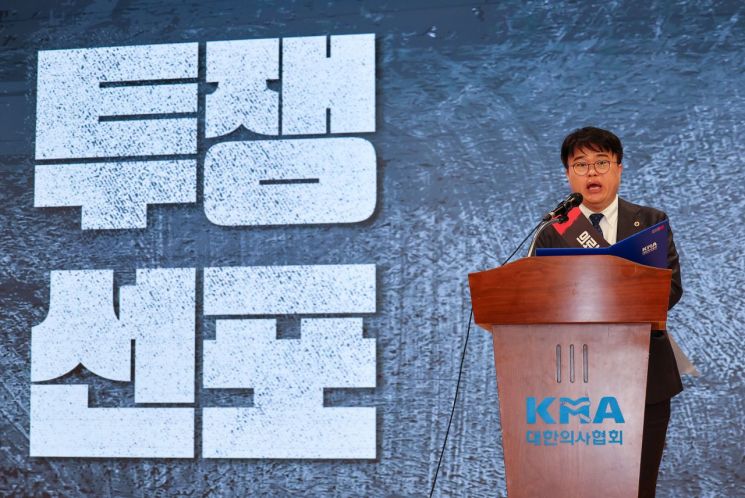 Im Hyun-taek, president of the Korean Medical Association, is declaring a struggle at the National Doctors' Representatives Conference held at the KMA Hall in Yongsan-gu, Seoul, on the afternoon of the 9th. [Image source=Yonhap News]
On the 9th, the KMA held a nationwide doctors' representatives meeting at the KMA headquarters in Yongsan-gu, Seoul, and announced a full suspension of medical services on the 18th along with a mass rally. From the 4th to the 7th, the KMA conducted a survey among all members regarding collective action. Out of 111,861 eligible voters, 70,800 participated, showing a turnout rate of 63.3%. When asked if they would participate in collective action including suspension of services, 73.5% voted in favor.
However, despite nearly half of all eligible doctors supporting the suspension, the primary medical care gap is expected to be small. This is because the suspension rate among private practitioners, whose livelihoods depend on their practice, is expected to be relatively lower than the turnout rate.
Primary medical institutions are defined as medical facilities with fewer than 30 beds that mainly provide outpatient care. Commonly seen 'clinics' and 'public health centers' fall under this category. The majority of private practitioners operate primary medical institutions. One private practitioner said, "Looking back at past strikes, it has not been easy for private practitioners to suspend services," adding, "I think active participation will not be high this time either." He further noted, "If we consider the reality of private practitioners, a realistic and effective form of protest might be strictly limiting consultation hours to 40 hours per week, in line with the OECD average."
A salaried doctor working at a primary medical institution also said, "Realistically, it seems difficult for many private practitioners to participate in the suspension," and predicted, "I expect about 10% of private practitioners will suspend services."
In fact, during the general strike in 2020, the suspension rate among private practitioners was not high. On the first day of the second strike on August 26, 2020, the national average suspension rate was 10.8%, 8.9% on the 27th, and 6.5% on the 28th. More than nine out of ten clinics remained open, so there was no significant primary medical care gap. Earlier that month, the first strike conducted during the vacation season on the 14th had a suspension rate of only 32.6%.
A specialist who participated in the strike at that time said, "Private practitioners were relatively less interested in the issue of increasing medical school admissions. They also talked about the losses incurred due to fixed costs when suspending services," adding, "Some said, 'It is right for residents, who suffer the most, to take the lead.'"
According to the medical community, a suspension rate of 10-30% is unlikely to significantly affect patient inconvenience. A medical official explained, "Even if nearly 30% of private practitioners suspend services, it would only cause some inconvenience such as longer waiting times, but not major discomfort for patients," adding, "Unlike university hospital care, patients visiting private clinics tend to have mild conditions, and similar care can be received at any clinic."
Meanwhile, concerns about potential administrative sanctions following the suspension have been raised among frontline private practitioners. A local medical association president said, "There are certainly some who intend to participate in the suspension for whatever reason," but added, "There is anxiety among members that their licenses might be suspended or revoked if they participate."
He continued, "For private practitioners, their livelihood is at stake, but there has been no explanation from the KMA or others about what risks might arise from suspending services," and added, "I think it is necessary for the KMA to provide guidelines on what risks exist and what legal support will be available when suspending services."
Meanwhile, the KMA stated that it does not plan to encourage private practitioners to participate in the suspension. Anna Choi, a KMA spokesperson, said, "The target participation rate for private practitioners is the same as the turnout rate," but when asked about plans to persuade or encourage private practitioners, she replied, "This is not about persuading members to suspend services, but a collective suspension based on the members' will."
© The Asia Business Daily(www.asiae.co.kr). All rights reserved.

















