In the European Parliament elections that concluded on the 9th (local time), the anticipated surge of far-right forces was confirmed. Meanwhile, centrist parties are expected to barely maintain their position as the largest party in the parliament. French President Emmanuel Macron, anticipating a crushing defeat for the far-right party, dissolved the parliament and abruptly announced an early general election. In Germany, exit polls indicated that the far-right party, which sparked pro-Nazi controversies, is expected to come in second place.
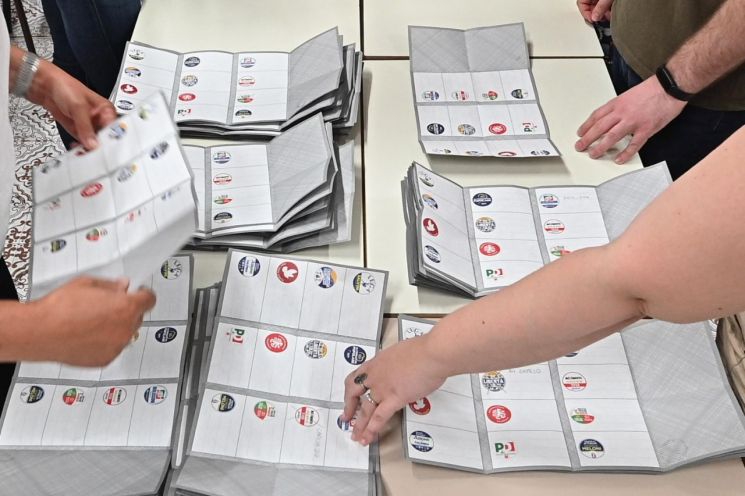
Far-right surge as expected... Centrists barely maintain first place
According to the updated analysis of the expected seat distribution in the European Parliament as of 7 a.m. on the 10th Korean time, the European People's Party (EPP), which is currently the largest party with a center-right orientation, is expected to secure 189 seats (26.2%) out of the total 720 seats, maintaining its position as the largest party in the European Parliament. This is almost the same level as the current 176 seats (25.0%) out of 705 seats. It is an increase of 3 seats compared to the previously released first analysis.
Following that, the second-largest party, the center-left Socialists and Democrats (S&D), is expected to hold onto second place with 135 seats (18.75%). However, the proportion of seats for the center-left has slightly decreased from the previous 19.7%. The third-largest party, the centrist Renew Europe, is expected to drop significantly from the current 102 seats to 80 seats.
On the other hand, hard-right and far-right political groups made gains as expected in this election. The hard-right European Conservatives and Reformists (ECR) are predicted to increase their seats from 69 to 72, and the far-right Identity and Democracy (ID), classified as more extreme than ECR, is expected to rise from 49 to 58 seats. The number of seats held by far-right parties not belonging to existing European Parliament political groups, such as Germany's Alternative for Germany (AfD), which was expelled from ID, also expanded.
Politico Europe also diagnosed that "the political center of Europe is shifting to the right." The Associated Press (AP) reported, "The rise of the far-right is much more surprising than many analysts had predicted," adding, "It dealt a shocking defeat especially to key leaders President Macron and German Chancellor Olaf Scholz." The Wall Street Journal (WSJ) stated, "Mainstream parties supporting the European Union (EPP) will maintain power in Brussels," but also assessed that "this result has shifted European politics to the right."
The official results are scheduled to be announced tonight after all polling stations in the 27 EU member states close. The voter turnout for this European Parliament election is estimated at 51%, the highest level since 1994.

"Macron's gamble?" France dissolves parliament and calls early general election
France and Germany are cited as countries where the surge of far-right forces was particularly prominent. After the election ended on this day, President Macron, seeing that the far-right party National Rally (RN) led by Marine Le Pen suffered a crushing defeat, took the gamble of dissolving the parliament and calling an early general election. The plan is to hold the early general election on the 30th of this month and the 7th of next month.
According to previously released exit poll results, the far-right RN recorded 31.5% of the vote, expected to more than double the anticipated 15.2% for Macron's party, Renaissance. Major foreign media outlets have described this as a "scathing rebuke of President Macron." The Renaissance party has already failed to secure a majority in the French parliament. In this context, President Macron is interpreted as having pulled out the parliament dissolution card, a presidential prerogative, to seek political change.
In his speech on the day, President Macron acknowledged defeat, saying, "We cannot act as if nothing has happened." However, he warned of the rise of far-right forces, stating, "The rise of nationalists and demagogues threatens not only our country but also Europe as a whole, and France's position in Europe and the world."
Le Pen, leader of RN, welcomed the announcement of the early general election. She emphasized, "When the people vote, the people win," adding, "We are ready to rebuild the nation, defend the interests of the French people, and end the war."
The last French president to dissolve parliament using the presidential prerogative was Jacques Chirac in 1997. Before him, Fran?ois Mitterrand and Charles de Gaulle each exercised the power twice. France24 described the early election card as "Macron's gamble." The BBC noted, "Calling an early general election is surprising and a big risk for President Macron," adding, "He must recognize the possibility of another victory for RN."
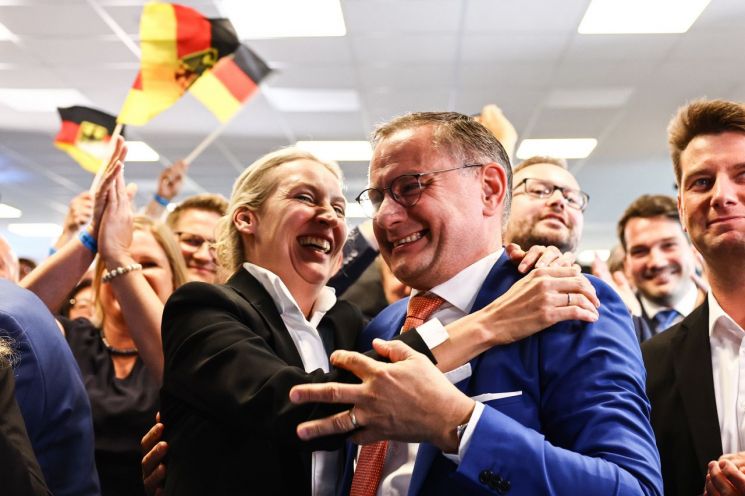 Co-leader Tino Chrupalla and members of the far-right party Alternative for Germany (AfD) are celebrating as they watch the exit poll results on the 9th (local time).
 [Image source=EPA Yonhap News]
Far-right surge in Germany as well... Scholz coalition faces defeat
In Germany, the most populous EU member state, the far-right party AfD rose while the coalition led by Chancellor Scholz suffered a humiliating defeat.
According to the seat analysis data, AfD is expected to come in second place after the conservative Christian Democratic Union (CDU) and Christian Social Union (CSU) alliance in this election. The vote share is expected to rise from 11.0% in 2019 to 16.5%, an increase of 5.5 percentage points. Although it falls short of the first-quarter poll results that suggested it could exceed 20%, the far-right surge was confirmed despite recent controversies such as pro-Nazi remarks and bribery scandals before the election. AfD was even expelled from the European Parliament political group ID due to these controversies.
Meanwhile, the Social Democratic Party (SPD), to which Chancellor Scholz belongs, is expected to secure only 14.0%. The Green Party and Free Democratic Party (FDP), which are in coalition with SPD, are also projected to see their vote shares drop to 12.0% and 5.0%, respectively. The Associated Press described the situation as "humiliating for Chancellor Scholz."
Additionally, far-right parties gained ground in Hungary and Austria. Nationalist parties also won or made gains in Cyprus, Greece, Bulgaria, and the Netherlands. In Italy, the Brothers of Italy (Fdi) led by Prime Minister Giorgia Meloni is leading with an expected vote share of 26-30%.
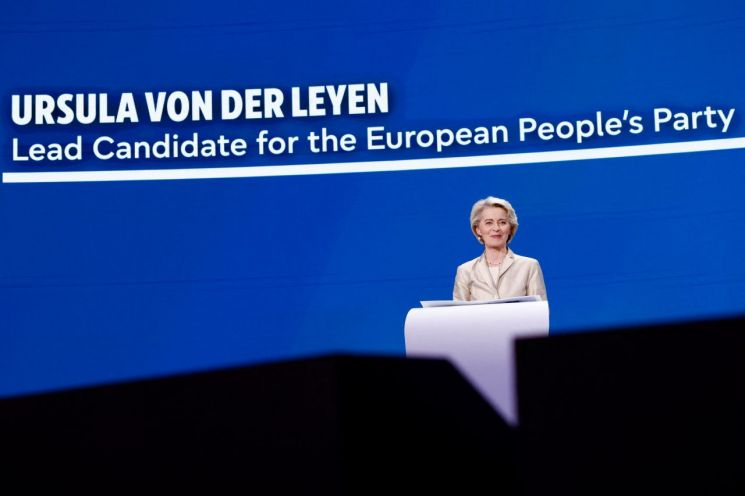
Meanwhile, the leaders of the 27 EU countries will hold an informal summit in Brussels, Belgium, on the 17th to begin discussions on leadership formation based on this election. The candidate for the head of the EU executive, the Commission President, is expected to be confirmed at the EU summit on the 27th-28th. Despite the rise of far-right parties, the EPP is still expected to maintain first place, making it highly likely that the current Commission President Ursula von der Leyen will be nominated as the candidate.
Following the announcement of the exit polls, EPP candidate Commission President von der Leyen said in a speech, "What European citizens expect is a strong Europe. We will build a bulwark against the extremes of left and right," adding, "We will stop them. That is certain." Supporters responded by chanting "Five more years." The candidate agreed upon at the summit must be approved by a vote in the European Parliament. For this, at least 361 of the 720 members of the European Parliament must support the candidate. The new Commission is expected to officially take office on December 1.
© The Asia Business Daily(www.asiae.co.kr). All rights reserved.
![User Who Sold Erroneously Deposited Bitcoins to Repay Debt and Fund Entertainment... What Did the Supreme Court Decide in 2021? [Legal Issue Check]](https://cwcontent.asiae.co.kr/asiaresize/183/2026020910431234020_1770601391.png)


















