2017 UNESCO World Heritage Tentative List Registration
Famous for the Largest Reclining Buddha in Korea and Unique Patterned Pagoda Body
Efforts to register Hwasun Unjusa Temple in Jeollanam-do, known for its "Mystery of a Thousand Buddhas and Thousand Pagodas," as a UNESCO World Heritage site are gaining momentum.
On the 9th, Hwasun County announced that it will hold an international academic conference for two days starting from the 20th to promote the Unjusa Stone Buddha and Stone Pagoda Complex for UNESCO World Heritage inscription. This academic conference aims to clarify the value of Unjusa as a World Heritage site through research presentations and discussions by domestic and international experts.
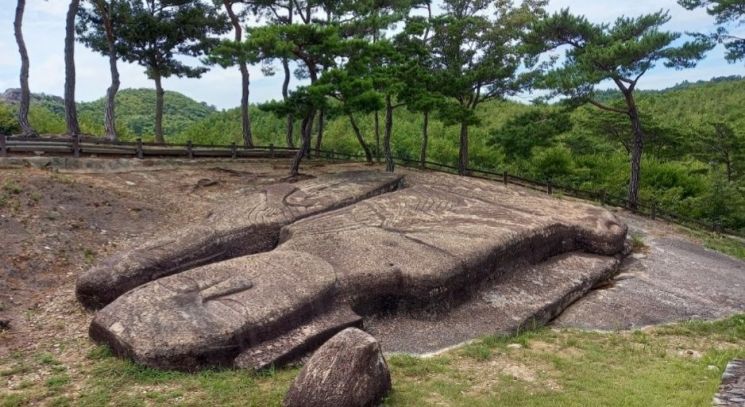 The Reclining Buddha of Unjusa Temple in Hwasun, Jeonnam
[Image source=Captured from Unjusa Temple official website]
The Cultural Heritage Administration registered the Buddha statues and stone pagodas of Unjusa under the name "Hwasun Unjusa Stone Buddha and Stone Pagoda Complex" on the UNESCO World Heritage tentative list in March 2017. The Hwasun Unjusa Stone Buddha and Stone Pagoda Complex includes stone Buddha statues and stone pagodas created from the 10th to the 16th century, as well as Chilseong Stones (七星石) related to Chilseong faith, a constellation belief influenced by Taoism.
The most famous feature here is the Cheonbul Cheontap, consisting of 1,000 Buddha statues and 1,000 pagodas. A legend related to the origin of Cheonbul Cheontap involves Doseon Guksa, a Buddhist monk and master of geomancy from the late Silla period. Doseon Guksa is said to have summoned celestial stonemasons to build the thousand Buddhas and thousand pagodas in a single day and night to open a new world. However, a young attendant, unwilling to run errands back and forth between the stonemasons and Doseon, crowed like a rooster, causing the stonemasons to think dawn had come and ascend to heaven, leaving the reclining Buddha unfinished. It is said that the day this reclining Buddha rises, Maitreya Buddha will appear on this land, or a new world will open. This reclining Buddha is the largest in Korea, measuring 12 meters in length and 10 meters in width. Currently, Unjusa has 108 intact stone Buddhas and 21 stone pagodas remaining.
Another striking feature of Unjusa is the unique patterns on the pagoda bodies. The pagoda bodies at Unjusa feature geometric patterns such as X-shaped intersecting lines and diamond shapes, and the action scenes of director Choi Dong-hoon's film "Alienoid" were filmed here. Additionally, the area around Unjusa is the base of Chilseong faith, with Chilseong Rocks representing the Big Dipper constellation on the ground.
Earlier, on the 31st of last month, Hwasun County held a domestic academic conference at the Hwasun Cultural Center to clarify the World Heritage value of the Unjusa Stone Buddha and Stone Pagoda Complex. Hosted by the Korea Cultural Heritage Conservation Research Institute, this academic conference was the first expert forum held after the Unjusa Stone Buddha and Stone Pagoda Complex was finally registered on the UNESCO World Heritage tentative list. Attendees included Heo Kwon, former Secretary-General of the UNESCO Asia-Pacific Intangible Heritage Center; Lee Gye-pyo, Jeonnam Cultural Heritage Committee member; Oh Ho-seok, curator at Dankook University Seokjuseon Memorial Museum; Lee Kyung-hwa and Lee Sook-hee, cultural heritage appraisal committee members of the National Heritage Agency; and Lee Dong-sik, former director of the Cultural Heritage Conservation Management Center at the National Research Institute of Cultural Heritage. They presented and later engaged in comprehensive expert discussions.
A Hwasun County official said, "More active discussions are expected through the international academic conference scheduled for the 20th and 21st," adding, "We hope this will promote the push for the inscription of the Hwasun Unjusa Stone Buddha and Stone Pagoda Complex as a World Heritage site not only locally but nationwide."
Meanwhile, Korea’s UNESCO World Heritage sites include the Gaya Tumuli, Gyeongju Historic Areas, Gochang, Hwasun, and Ganghwa Dolmen Sites, Namhansanseong Fortress, Baekje Historic Areas, mountain temples, Bulguksa Temple and Seokguram Grotto, Jeju Volcanic Island and Lava Tubes, Joseon Royal Tombs, Jongmyo Shrine, Changdeokgung Palace, tidal flats, Seowon Confucian Academies, Hahoe and Yangdong Villages, Haeinsa Temple Janggyeong Panjeon, and Hwaseong Fortress.
© The Asia Business Daily(www.asiae.co.kr). All rights reserved.
![User Who Sold Erroneously Deposited Bitcoins to Repay Debt and Fund Entertainment... What Did the Supreme Court Decide in 2021? [Legal Issue Check]](https://cwcontent.asiae.co.kr/asiaresize/183/2026020910431234020_1770601391.png)















