Bilateral Diplomatic Relations Commemoration Event
The iconic Christ the Redeemer statue in Rio de Janeiro, Brazil, was elegantly dressed in hanbok. This is the first time the Rio Christ statue has worn traditional clothing from another country.
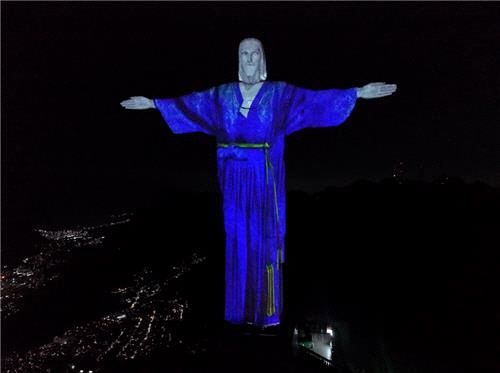 On the night of the 7th (local time), the Christ the Redeemer statue in Rio, Brazil, was dressed in Korea's traditional hanbok.
 [Photo by the management organization of the Christ the Redeemer sanctuary]
On the 8th (local time), Brazilian media such as G1 reported that the Christ statue in Rio de Janeiro wore hanbok the previous night. The event was carried out by projecting the image of hanbok onto the giant Christ statue. It was part of a celebration commemorating the diplomatic relations between Korea and Brazil (established on October 31, 1959). The event was organized by the Korean Cultural Center in Brazil, the Korean Embassy in Brazil, Jinju City, and the Brazilian cultural institution Scuola di Cultura.
The hanbok worn by the Christ statue was designed by designer Lee Jin-hee. The designer explained, "The blue color symbolizes the birth of spring and life, and is one of Korea's five traditional colors (Obangsaek). In the Brazilian flag, green represents the sky and rivers, and the hanbok's belt incorporates the colors of the G20 logo, which will be held in Brazil in November."
Along with the hanbok event, the management organization of the Christ statue released a special video featuring Father Omar, the head of the institution, and Ambassador Im Gi-mo of the Korean Embassy in Brazil singing a Brazilian song together. As an extension of the Christ statue hanbok event, the Taegeukgi (Korean national flag) will be projected onto the statue on the night of the 8th.
The giant Christ statue in Rio, also called the "Savior" or "Christ of Salvation," measures 30 meters wide and 38 meters tall, and stands atop Corcovado Hill at an altitude of 710 meters, overlooking Copacabana Beach. It was planned in 1922, the 100th anniversary of Brazil's independence, and completed on October 12, 1931, after nine years of construction.
In July 2007, the giant Christ statue in Rio was selected as one of the "New Seven Wonders of the World," alongside China's Great Wall, Jordan's ancient city Petra, Peru's Inca ruins Machu Picchu, Mexico's Mayan ruins Chichen Itza, Rome's Colosseum, and India's Taj Mahal.
© The Asia Business Daily(www.asiae.co.kr). All rights reserved.

















