Installation of 'Food Radiological Nuclide Analysis Equipment' at Five Schools This Year
Establishing a Constant and Proactive Radiation Safety Inspection System for School Food Ingredients
Gijang-gun in Busan has recently completed the installation of 'Food Radioactive Nuclide Analysis Equipment' in five local schools and is expanding its 'School Meal Radioactive Safety Inspection Project.'
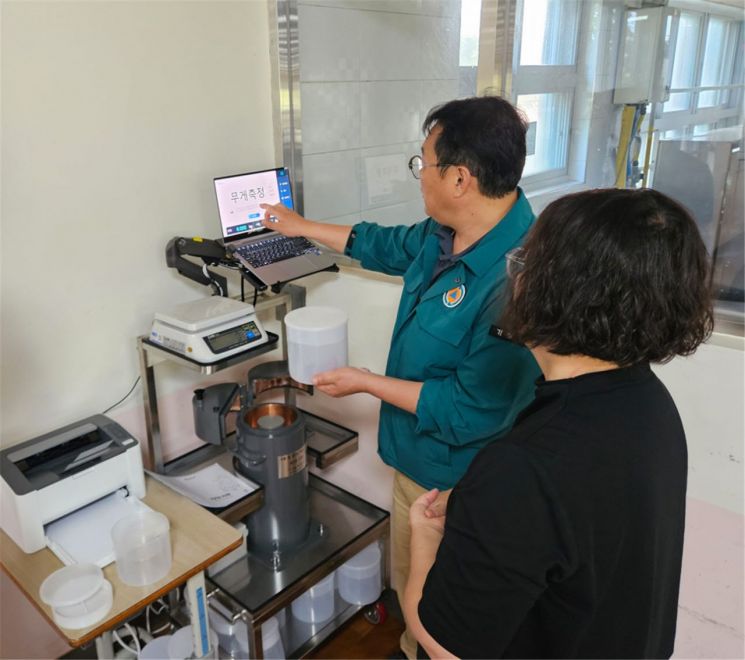 A Gijang County official is installing radioactive nuclide analysis equipment for food at a local school and demonstrating the equipment.
The 'Radioactive Safety Inspection Project for Meal Ingredients' involves Gijang-gun providing schools with 'Food Radioactive Nuclide Analyzers' (free of charge), as well as offering technical support such as ▲equipment operation training ▲performance checks and maintenance ▲verification of measurement and analysis results, thereby supporting each school to conduct its own radioactive safety inspections. This project is uniquely implemented only in Gijang-gun.
This initiative was launched in response to the Japanese government's release of contaminated water from the Fukushima nuclear accident into the ocean in August last year, aiming to secure safe food for young students who are sensitive to radiation exposure and to alleviate parents' concerns.
Last year, the county began a pilot project at two schools (Ilgwang Middle School and Wollae Elementary School). At the beginning of this year, after three rounds of project applications targeting all 38 elementary, middle, and high schools in the area, five schools were finally selected: ▲Ilgwang Elementary School ▲Jwacheon Elementary School ▲Daecheong Middle School ▲Jangan Jeil High School ▲Busan Haemaru School.
After procedures such as bidding for equipment purchase, the installation of 'Food Radioactive Nuclide Analysis Equipment' in the five schools was completed over two days, June 3 and 4.
These schools can now directly conduct radioactive safety inspections on any food ingredients suspected of containing radiation, regardless of type or frequency, before cooking or serving meals.
Additionally, the county has signed a research contract with the National Pukyong University Radiation Science and Technology Research Institute (Director: Nam Seungil), which conducts national environmental radiation monitoring, to perform cross-check analyses two to three times a month on the same food samples that the schools have tested in the first round.
Through this, the county will ▲ensure the reliability of the schools' own radioactive inspection results ▲provide technical support and consultation ▲enable expert response in case of abnormal measurement values. Furthermore, the county plans to establish clear roles and strengthen communication among Gijang-gun, local schools, and university research institutes to secure safe food from radioactive contamination.
County Governor Jeong Jongbok stated, "We will do our utmost to establish a regular and proactive radioactive safety inspection system for school meal ingredients to ensure safe food for young students and to alleviate residents' concerns," and added, "We hope schools will actively participate to ensure the sustainability and continuity of this project."
The county has expressed its intention to expand the project to all 38 elementary, middle, and high schools in the area, as the enactment of the 'Ordinance on Supporting the Use of Safe Food Ingredients Free from Radioactive and Other Hazardous Substances in School Meals in Gijang-gun, Busan' (No. 1425) in January provided justification and institutional support for the project.
© The Asia Business Daily(www.asiae.co.kr). All rights reserved.
![User Who Sold Erroneously Deposited Bitcoins to Repay Debt and Fund Entertainment... What Did the Supreme Court Decide in 2021? [Legal Issue Check]](https://cwcontent.asiae.co.kr/asiaresize/183/2026020910431234020_1770601391.png)















