Eurozone Base Rate Cut by 0.25% Points
Inflation-Unstable Korea Likely to Lower Base Rate in Q4
If the US Cuts in Q3, Korea May Follow Soon After
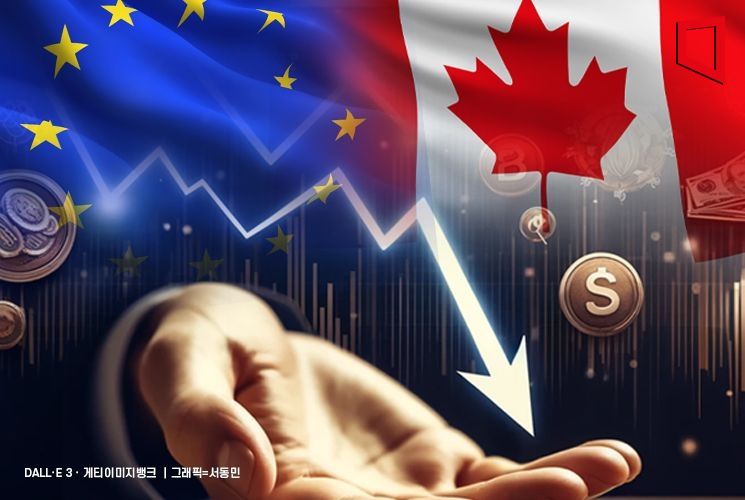
As major countries around the world, including Europe and Canada, begin to lower their benchmark interest rates, interest in the timing of South Korea's rate cuts is growing. Many experts expect the Bank of Korea to lower its benchmark interest rate in the fourth quarter when the inflation stabilization trend becomes clear, but some forecasts suggest that a rate cut could also occur in the third quarter depending on the situation.
ECB Cuts Benchmark Interest Rate by 0.25 Percentage Points as Inflation Stabilizes
On the 6th (local time), the European Central Bank (ECB) announced a 0.25 percentage point cut in its benchmark interest rate from 4.5% to 4.25% per annum. This marks a shift in monetary policy direction for the first time in 1 year and 11 months since it began raising rates in July 2022 due to soaring inflation. The interest rate gap between South Korea (benchmark rate 3.50%) and the Eurozone (20 countries using the euro) has also narrowed to 0.75 percentage points.
The main reasons behind the ECB's rate cut are inflation stabilization and concerns over economic slowdown. In its monetary policy statement, the ECB said, "After nine months of holding rates steady, it was deemed appropriate to ease monetary policy," adding, "Since the September meeting last year, the inflation rate has fallen by more than 2.5 percentage points, and inflation forecasts have greatly improved."
The Eurozone consumer price inflation rate, which exceeded 10% last October, dropped to the mid-2% range earlier this year, and the growth rate fell below 1%, raising concerns about economic slowdown. Ahead of the Eurozone, major countries such as Switzerland, Sweden, and Canada also cut their benchmark interest rates as inflation stabilized. Analysts interpret this as the beginning of monetary policy differentiation from the United States worldwide.
 Lee Chang-yong, Governor of the Bank of Korea, is striking the gavel at the Monetary Policy Committee meeting held at the Bank of Korea headquarters in Jung-gu, Seoul, on the 23rd of last month. Photo by Joint Press Corps
South Korea Expected to Cut Rates by Fourth Quarter at the Latest
Although more countries are cutting benchmark interest rates ahead of the United States, South Korea is expected to be somewhat late. Inflation has not yet stabilized, and the surprise growth of the Korean economy in the first quarter means concerns about economic slowdown are not significant. There is also an argument that since the U.S. has not cut its benchmark rate, South Korea does not need to do so first.
The Bank of Korea's stance is that it can consider lowering the benchmark interest rate only when there is clear evidence of inflation slowing down. Lee Chang-yong, Governor of the Bank of Korea, said at a meeting held after deciding to hold the benchmark rate steady on the 23rd of last month, "If the inflation rate in the second half of the year is confirmed to be trending down to 2.3?2.4%, we can consider a rate cut."
Last month's consumer price inflation rate was 2.7%, slightly down from 2.9% the previous month. Although the downward trend continues compared to 3.1% recorded in February and March, it has not yet fallen to the Bank of Korea's target. However, since the Bank of Korea expects the consumer price inflation rate to fall to around 2.4% in the second half of the year, discussions on cutting the benchmark interest rate are predicted to intensify in the latter half.
Experts' evaluations of recent inflation trends are mixed. The prevailing view is that it will take more time for inflation to stabilize fully, so the benchmark interest rate cut will likely occur in the fourth quarter. However, some argue that inflation stabilization is happening faster than expected, and rates could be cut as early as the third quarter.
Im Jae-kyun, a researcher at KB Securities, said, "Considering the average monthly inflation rate over the past five years, inflation in the high 2% range is expected to continue until July, and core consumer prices are expected to slow down from September," adding, "Since the Bank of Korea Governor mentioned that a rate cut requires confidence that inflation will reach 2%, the benchmark interest rate is expected to be cut around November."
On the other hand, Kim Myung-sil, a researcher at Hi Investment & Securities, said, "Considering the seasonal characteristics of domestic inflation, the inflation rate is expected to slow to 2.4% in the third quarter," and added, "The Bank of Korea could cut the benchmark interest rate in August."
There are also some differences in the expected timing of rate cuts among foreign investment banks (IBs). Among seven IBs that released reports after the Bank of Korea's Monetary Policy Committee meeting on the 23rd of last month, three expect the Bank of Korea to start cutting rates from the third quarter, while four expect cuts from the fourth quarter. Goldman Sachs, Citi, and BNP Paribas expect the Bank of Korea to begin cutting the benchmark interest rate in the third quarter. Nomura, Morgan Stanley, JP Morgan, and Soci?t? G?n?rale see the timing of the rate cut as the fourth quarter.
The Timing of U.S. Rate Cuts Is Also a Key Variable
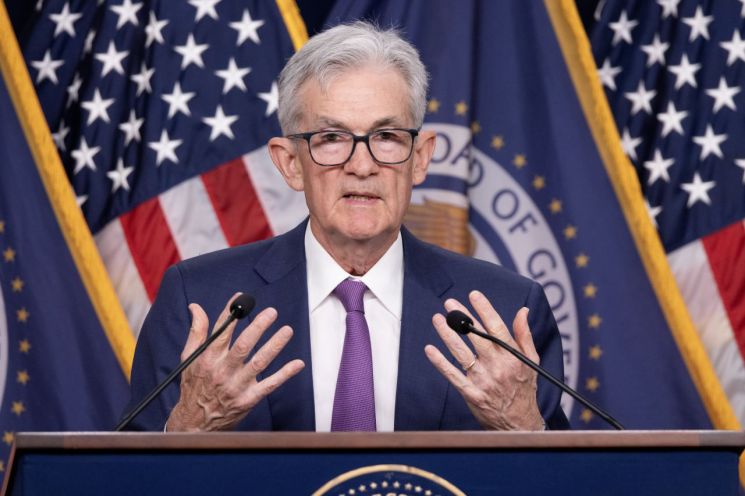
The timing of the U.S. benchmark interest rate cut is also a significant variable. Since the Korean economy is heavily influenced by the U.S., many expect that South Korea will cut rates only after the U.S. does. The direction of U.S. monetary policy remains uncertain, and with the interest rate gap between Korea and the U.S. reaching 2 percentage points, it is burdensome for South Korea to cut rates first.
The market is currently observing that the U.S. will cut its benchmark interest rate in September. According to the Chicago Mercantile Exchange (CME) FedWatch, the federal funds futures market sees a 64.9% chance that the U.S. Federal Reserve will cut rates in September. Initially, rate cuts were expected in the second quarter, but ongoing inflation concerns have pushed back the expected timing.
If the U.S. cuts rates in September, many experts expect the Bank of Korea to follow with rate cuts around October or November. The Woori Financial Research Institute predicted that considering the weakening expectations for early U.S. rate cuts, the better-than-expected 1st quarter growth of the Korean economy, and the burden of won depreciation, the Bank of Korea will cut its benchmark interest rate in the fourth quarter.
Joo Won, head of the Economic Research Department at Hyundai Research Institute, said, "Since our monetary policy is heavily influenced by the U.S., it is unlikely that the Bank of Korea will cut rates ahead of the U.S.," adding, "With the delay in the U.S. rate cut timing, it is highly likely that we will cut the benchmark interest rate around the fourth quarter."
© The Asia Business Daily(www.asiae.co.kr). All rights reserved.



















