Regularization of Future Public-Private Joint Meetings
"Coordination of Bio Policy, Regulation, and R&D Support"
New Opportunities for Domestic Bio Companies
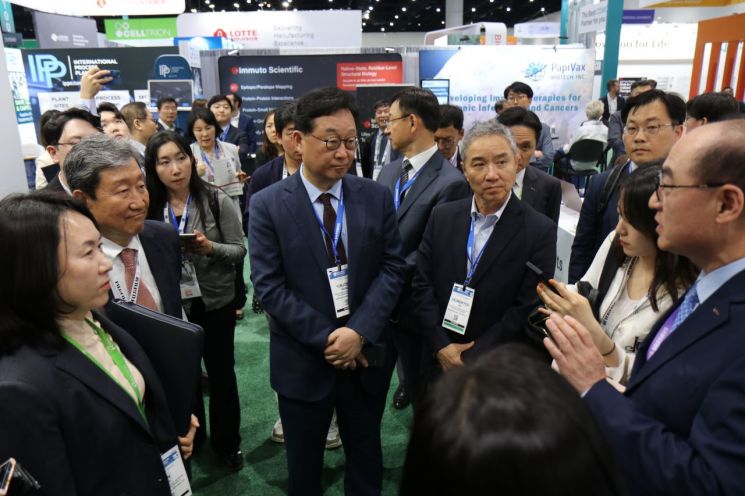 Wang Yoon-jong, the 3rd Deputy Director of the National Security Office, visited the Korean Pavilion at the BIO International Convention (BIO USA) held in San Diego, USA, on the 4th (local time) and received an explanation. [Image source=Yonhap News]
The 'Bio-Pharmaceutical Alliance' has been launched to establish a bio-pharmaceutical supply chain among South Korea, the United States, Japan, India, and the European Union (EU). Recognizing bio as a matter of security, efforts have been made to diversify bio supply chains to strengthen economic security. Notably, this consortium has expanded to include Japan, India, and the EU alongside South Korea and the United States, and plans to regularize joint public-private meetings in the future, offering new opportunities for domestic bio companies.
The Presidential Office announced on the 6th that South Korea, the United States, Japan, India, and the EU launched the five-nation joint public-private 'Bio-Pharmaceutical Alliance' and held an inaugural meeting on the 5th (local time) in San Diego, USA. The meeting was conducted in two sessions: a government session and a '1.5-track' session attended by both government and corporate representatives.
The Presidential Office explained, "The newly launched joint public-private Bio-Pharmaceutical Alliance was initiated based on a consensus between South Korea and the United States that cooperation among major countries is essential to stabilize supply chains, following the medicine shortages experienced during the COVID-19 pandemic. The alliance was agreed upon during the first South Korea-U.S. Core Emerging Technologies Dialogue in December last year, and the scope of participation has since expanded to include Japan, India, and the EU."
At this meeting, participating countries deeply agreed on the urgency of building a mutually trustworthy and sustainable bio-pharmaceutical supply chain to strengthen economic security. To this end, the governments and leading bio-pharmaceutical companies of the five countries will explore cooperation measures to diversify supply chains while closely coordinating each country's bio policies, regulations, research and development (R&D) support policies, and other means to prevent supply chain risks.
In the first meeting, government and corporate officials discussed the current vulnerabilities of the bio-pharmaceutical supply chain, advanced manufacturing technologies, and improvement plans utilizing R&D. They also brainstormed ways to remove institutional and technical barriers to promote supply chain diversification and cooperation measures to enhance the resilience of the bio-pharmaceutical supply chain.
Concentration of Active Pharmaceutical Ingredient Production in a Few Countries... Exploring Improvement Measures
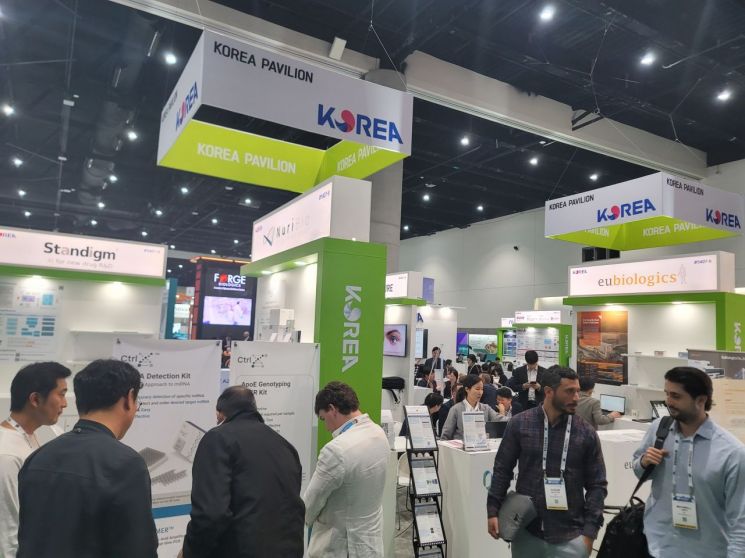 The Korea Pavilion set up at the '2024 BIO International Convention' (BIO USA), which opened on the 3rd in San Diego, USA. [Image source=Yonhap News]
Regarding the vulnerabilities of the bio-pharmaceutical supply chain, participating countries and companies agreed that the production of essential raw materials and intermediate active pharmaceutical ingredients (APIs) is concentrated in a few countries. They decided to jointly explore ways to diagnose and improve vulnerabilities through the establishment of a detailed pharmaceutical supply chain map.
Concerning the promotion of supply chain diversification, there was consensus that balancing each country's pharmaceutical approval systems can contribute to diversifying the pharmaceutical supply chain. Discussions were held on various institutional improvement measures that can ensure drug safety while strengthening supply chain stability.
The participating countries plan to regularize future joint public-private Bio-Pharmaceutical Alliance meetings to continuously seek ways to strengthen the bio-pharmaceutical supply chain, which is emerging as a core area of economic security.
In the government session, South Korea was represented by the Presidential Office, Ministry of Health and Welfare, Ministry of Science and ICT, Ministry of Trade, Industry and Energy, and Ministry of Food and Drug Safety; the United States by the White House, Department of State, Department of Health and Human Services, Department of Commerce, and Food and Drug Administration (FDA); Japan by the Cabinet Office, Ministry of Economy, Trade and Industry, and Ministry of Health, Labour and Welfare; India by the Department of Biotechnology, Ministry of Pharmaceuticals, and Medical Research Council; and the EU by the Directorate-General for Health and Food Safety’s Health Innovation Ecosystem and Health Emergency Preparedness and Response Authority (HERA), all participating as government representatives of their respective countries.
The 1.5-track session included representatives from the five governments as well as major companies from each country. In South Korea, Samsung Biologics, Celltrion, GC Green Cross, Chong Kun Dang Bio, and YS Life Sciences participated.
© The Asia Business Daily(www.asiae.co.kr). All rights reserved.



















