93 Military Deaths in 2022
'Military Discipline Training' Regulations Specified by Law, Not Followed On Site
Need for Pre-Education and Stronger Punishments
Recently, interest in military discipline training within units has increased following an incident in a unit in Inje, Gangwon Province, where a trainee collapsed and died while undergoing 'Eolcharyeo' (physical punishment). Experts pointed out that despite the establishment of legal regulations specifying the detailed contents of training to prevent excessive Eolcharyeo, these rules are still not being followed in the field.
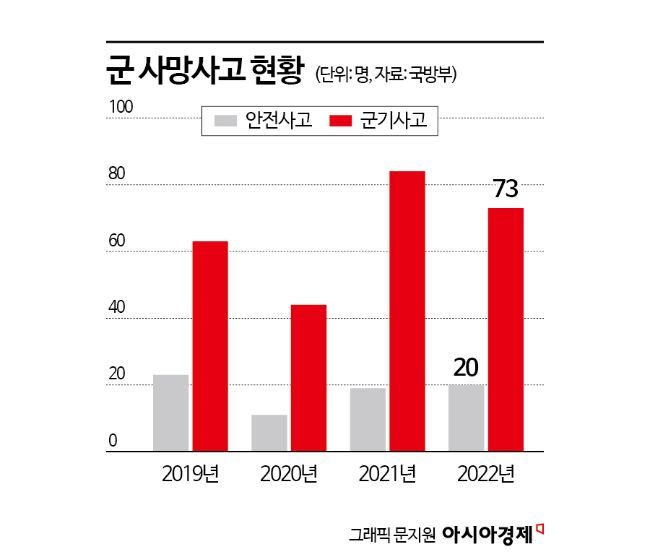
According to the Ministry of National Defense, fatal accidents in the military have consistently occurred over the past decade. The number of deaths, which was 117 in 2013, gradually decreased to 55 in 2020, but then steadily increased again to 93 in 2022.
In particular, the proportion of deaths caused by military discipline accidents was high. Fatal accidents in the military are broadly divided into military discipline accidents and safety accidents. Military discipline accidents refer to incidents caused by intentional or negligent violations of various laws such as the Military Criminal Act and the Act on the Status and Service of Military Personnel, including drowning, falls, and explosions. Safety accidents are those caused by unintentional unsafe human actions and unsafe physical conditions, including suicides. Considering that accidents due to personal illnesses or other unavoidable causes are not included in the statistics, the actual number of deaths is estimated to be much higher.
Military discipline training, which is cited as the cause of the recent incident, is considered a representative human rights violation factor among military personnel. Previously, the contents related to military discipline training were specified as administrative rules in each military regulation. However, in 2020, with the revision of the Act on the Status and Service of Military Personnel (Military Service Basic Act), provisions regarding military discipline education were included in the higher law, officially providing a legal basis for military discipline training. At this time, the term was changed from 'Eolcharyeo' to 'military discipline training.' Article 38-2 of the Military Service Basic Act states that "military discipline training may be conducted for active-duty soldiers to improve physical fitness or cultivate mental discipline."
Detailed provisions on military discipline training are outlined in the Enforcement Decree and the Army Barracks Life Regulations. According to these, daily military discipline training should be conducted within 2 hours, and if it exceeds 1 hour, a break must be provided. Additionally, running exercises should be limited to within 2 km once for privates and privates first class carrying individual gear, and within 1 km once for corporals and sergeants carrying individual or full gear.
Experts point out that these detailed provisions are difficult to follow in actual units. Not only do individual commanders often fail to fully understand the detailed contents of military discipline training, but due to the nature of the military, training intensity can always increase depending on the situation. In fact, the trainee who died in this incident was found to have been running 1.5 km and doing push-ups while carrying a full gear load of 20 to 25 kg, far exceeding the standards.
Attorney Son Kwang-ik of Dongin Law Firm, who served as the head of the disciplinary division at the Army Legal Office, explained, "Although the Personnel Staff Department delivers materials on military discipline training in the form of educational resources, there is no regular training for commanders. Moreover, since soldiers' conditions and physical strength vary, it is difficult to strictly implement military discipline training according to regulations in the field."
There are also concerns that soldiers have no place to raise issues even if they undergo military discipline training that violates regulations. Currently, complaints about irregularities within units are received through the 'Defense Help Call 1303.' When a complaint is received, the Inspection Department begins investigating the case, and if the misconduct is deemed serious, disciplinary action or referral to investigative agencies may follow through the Legal Affairs Department. Experts explain that unless the case involves sensitive issues such as sexual misconduct, most soldiers do not receive identity protection.
Attorney Song said, "Usually, sexual misconduct cases are investigated confidentially upon the victim's request, but general irregularities like military discipline training are not seriously considered for identity protection by the inspection department. Although the system is in place, many soldiers delay reporting or endure the situation due to fear of disadvantages, making it effectively a blind spot." He added, "Since there is a lack of proper awareness about correct military discipline training within units, preventive education should be strengthened, and strict punishment should be imposed for accidents that have already occurred to instill the understanding that everyone can be held accountable."
© The Asia Business Daily(www.asiae.co.kr). All rights reserved.


















