14 Members of the Democratic Party of Korea
Preparing to Propose the 'Korean Version of the IRA Act'
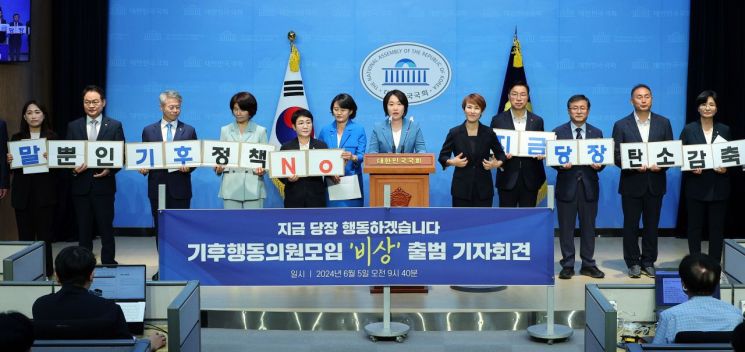 Democratic Party lawmaker Lee So-young is speaking at the launch press conference of the Climate Action Lawmakers' Group "Emergency" held at the National Assembly Communication Hall on the morning of the 5th. 2024.6.5 [Image source=Yonhap News]
Fourteen members of the National Assembly from the Democratic Party of Korea have formed a climate action parliamentary group called 'Bisang'. They set a goal to lead a social consensus on the end point of coal power generation during the 22nd National Assembly and to create a roadmap for breaking away from fossil fuels. Specifically, they announced plans to propose a Coal Phase-out Act next month, which is expected to spark controversy during future parliamentary discussions.
On the 5th, Democratic Party members Lee So-young, Park Ji-hye, Han Jeong-ae, Kim Seong-hwan, Kim Jeong-ho, Wi Seong-gon, Kim Won-i, Min Hyeong-bae, Heo Young, Park Jeong-hyun, Baek Seung-a, Yeom Tae-young, Lim Mi-ae, and Cha Ji-ho held a press conference at the National Assembly Communication Office to launch the climate action group 'Bisang'.
They proposed ▲ making the government properly calculate the carbon budget and establish reduction targets and policies based on it, ▲ quickly reaching a social consensus on the end point of coal power generation while creating a breakup roadmap for fossil fuels in general, including internal combustion engine vehicles and gas power generation, and ▲ drawing a new social and economic structure for the climate crisis era together with citizens, industry, and labor sectors.
The Democratic Party members participating in the Bisang group are currently preparing 40 legislative tasks related to climate and energy. They are expected to focus primarily on creating a roadmap for phasing out fossil fuels such as coal power generation.
Lee So-young (Gyeonggi Uiwang-si Gwacheon-si), the representative of the Bisang group, said at the press conference, "Most developed countries have completely frozen coal power generation by 2030, and some have already completed this transition," adding, "We plan to propose the Coal Phase-out Act, which includes procedures for abolishing coal power, compensation for early closures, and support for affected regions and workers, by July at the latest."
Park Ji-hye (Gyeonggi Uijeongbu-si Gap), the secretary of the Bisang group, is also preparing a Korean version of the Inflation Reduction Act (IRA). She explained that this bill contains provisions related to industrial structural changes that align with climate crisis responses.
The Democratic Party members also announced that they will revisit the High-level Radioactive Waste Special Act (High-level Waste Act), the Offshore Wind Power Special Act, and the Power Grid Special Act, which were not passed and discarded during the 21st National Assembly, in the 22nd National Assembly.
Kim Seong-hwan (Seoul Nowon-gu Eul) said, "The Power Grid Special Act was regrettably not passed in the 21st National Assembly due to its linkage with the passage of the Cha Sang-byeong Special Prosecutor Act," adding, "If it is a special act that eliminates the possibility of privatization, it is highly likely to pass in the 22nd National Assembly, and we are willing to process it very quickly."
Regarding the High-level Waste Act, Kim Seong-hwan explained, "Since nuclear waste from existing nuclear power plants must be managed, creating a permanent disposal site is inevitable," but added, "Within the scope of not increasing nuclear power plants, we plan to responsibly implement measures to handle high-level waste produced from existing plants."
Kim Won-i (Jeonnam Mokpo-si), who proposed the Offshore Wind Power Special Act in the 21st National Assembly, said, "The bill was not passed due to a lack of agreement on the roles of local governments and whether to include companies that had previously prepared offshore wind power," adding, "We plan to gather opinions from various lawmakers and reintroduce the bill in the 22nd National Assembly."
© The Asia Business Daily(www.asiae.co.kr). All rights reserved.
![Clutching a Stolen Dior Bag, Saying "I Hate Being Poor but Real"... The Grotesque Con of a "Human Knockoff" [Slate]](https://cwcontent.asiae.co.kr/asiaresize/183/2026021902243444107_1771435474.jpg)
















