Using Foreign Tourists' and Employees' Passports for Duty-Free Benefits
No Proper Punishment Even If Goods Are Not Exported Abroad
At around 3 p.m. on the 31st of last month, in the cosmetics store street of Myeongdong, Jung-gu, Seoul, employees were attracting foreign tourists by showing products in various languages such as English, Japanese, and Chinese. When a customer showed interest in the cosmetics displayed on the shelves, one employee began explaining the prices and products. In somewhat broken Korean, he said, "You can get a mask pack priced at 6,000 won per sheet for 5,700 won by applying the 'foreign tax-free' benefit."
When asked for more details about the 'tax-free' benefit, he explained that they could scan passports that tourists had forgotten or the passport of a Vietnamese employee to provide the discount. On that day, among 15 post-tax refund businesses selling cosmetics around Myeongdong and Dongdaemun History & Culture Park Station in Jung-gu, Seoul, and Hongdae Entrance Station in Mapo-gu, six were openly soliciting customers by offering tax-free benefits for foreigners.
 On May 3rd, during the '2024 Seoul Welcome Week' spring foreign guest welcoming event, foreigners are enjoying sightseeing and shopping in Myeongdong, Jung-gu, Seoul. Photo by Yongjun Cho jun21@
Post-tax refund businesses that openly induce tax evasion by using others' passports to give the appearance of discounts to domestic customers are proliferating rapidly. According to the Passport Act, using, transferring, or lending a passport under someone else's name is punishable by imprisonment of up to two years or a fine of up to 20 million won.
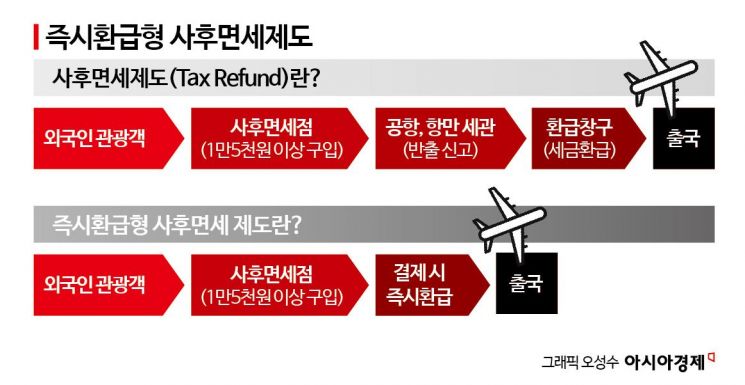
The 'tax-free' mentioned by some cosmetics store employees refers to the 'immediate refund type post-tax refund system.' Unlike the post-tax refund system where foreign tourists purchasing goods worth more than 15,000 won at duty-free shops get a refund of value-added tax and individual consumption tax at tax refund counters at airports or ports upon departure, the immediate refund type allows payment at the store with the value-added tax and individual consumption tax already deducted.
This system has the advantage of reducing inconvenience since foreigners do not need to visit tax refund counters before departure. According to the National Tax Service, the number of domestic post-tax refund businesses was counted at 19,934 as of last year.
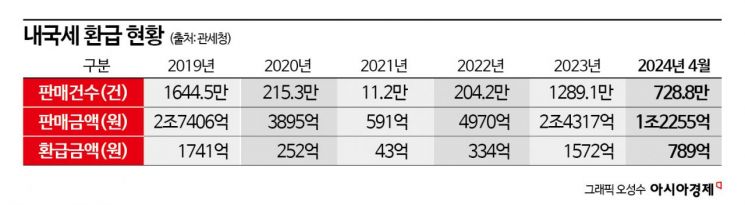
The government currently plans to expand the immediate refund system to enhance the convenience of foreign tourists. The sales amount of goods with domestic tax refunds was 2.7406 trillion won in 2019 during the COVID-19 pandemic, dropped to 389.5 billion won in 2020, 59.1 billion won in 2021, and 497 billion won in 2022, but rebounded significantly to 2.4317 trillion won in 2023. For this year, the amount recorded up to April alone was 1.2255 trillion won. The Korea Customs Service also plans to expand the scope of immediate refunds. The previous limit of a single transaction under 500,000 won and a total of 2.5 million won has been increased to a single transaction under 1 million won and a total of 5 million won.
However, as convenience for foreign tourists increases, there are also calls for tighter monitoring of illegal activities. According to the purpose of this system, foreign tourists must export duty-free goods purchased domestically abroad within three months. However, there is currently no legal basis to punish those who fail to do so. The only measure is to deny immediate refunds when foreigners who did not export goods within the period purchase items again in Korea. Since goods export confirmation can be done via kiosks or mobile devices, customs monitoring is relatively lenient.
Experts emphasize the need to raise awareness to eradicate illegal activities, even if thorough monitoring is difficult. Lee Jun-gyu, Professor Emeritus at Kyung Hee University Business School, said, "Less than 1% of companies undergo tax audits annually, but just the fact that audits happen makes them aware that 'they might be audited someday.' Similarly, if monitoring occurs once or twice a year, people will not commit illegal acts carelessly," he advised.
© The Asia Business Daily(www.asiae.co.kr). All rights reserved.



















