Government Withdraws Order Prohibiting Acceptance of Resident Doctors' Resignation Letters
High Possibility That Resignation Takes Effect After Acceptance
As the government announced the withdrawal of the order prohibiting the acceptance of resignation letters from medical residents, concerns have been raised about potential legal disputes regarding the timing of the resignation's effect and the amount of severance pay.
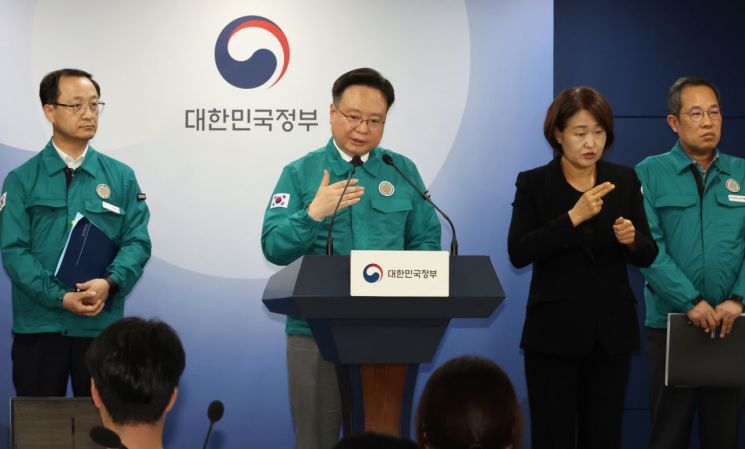 Minister of Health and Welfare Cho Kyoo-hong is answering questions from the press at a briefing on medical reform held at the Government Seoul Office in Jongno-gu on the 4th.
 [Image source=Yonhap News]
On the afternoon of the 4th, Cho Kyu-hong, Minister of Health and Welfare, stated at a 'Medical Reform Related Issues Briefing' held at the Government Seoul Office in Jongno-gu, Seoul, "We are withdrawing the order prohibiting hospital directors from accepting resignation letters and the orders imposed on residents to maintain medical services and commence work, effective today, so that residents can decide whether to return based on their individual intentions rather than collective action."
Hospitals plan to accept resignation letters following government guidelines. A representative from Seoul St. Mary's Hospital said, "We plan to accept resignation letters according to government guidelines regarding the return deadline and acceptance timing," adding, "If many residents resign, we will prepare by recruiting additional residents in the second half of the year." A representative from Severance Hospital also stated, "Since the government has allowed the acceptance of resignation letters, we are preparing to accept the resignation letters of residents who do not return."
The effect of resignation is likely to occur after the hospital accepts the resignation letter. Under civil law, a resignation letter automatically takes effect 30 days after submission, even if not accepted. However, since the government issued an order prohibiting acceptance of resignation letters, the resignation letters submitted by residents around February 20 have not yet taken effect.
Labor attorney Kim Kwang-hoon said, "In cases where the resignation takes effect only upon acceptance of the resignation letter, the effect occurs at the time of acceptance," adding, "Since the acceptance of resignation letters submitted around February 20 was delayed due to government orders, June is expected to be the effective date of resignation." However, he added, "Given the special circumstances, there is also a possibility of different handling."
Attorney Lee Dong-chan (The Friends Law Office) also explained, "If the hospital accepts the resignation letters in June, the resignation will take effect in June at the time of acceptance," and "Severance pay should be paid within 14 days after the resignation date."
However, some argue that the resignation effect might be based on actual work attendance. In this case, hospitals may need to immediately prepare severance pay. Attorney Jung I-won (Law Office Iwon) said, "If following the law strictly, since the residents did not work after submitting the resignation letter, the resignation could be considered effective around March 20, one month later," adding, "In this case, severance pay must be paid within 14 days of resignation, so hospitals should urgently prepare severance pay." He also added, "Given the special situation, even if payment is made after 14 days from the effective date in March, there should be no legal liability."
Therefore, for hospitals required to pay severance to residents, the payment timing is also expected to be after acceptance. Civil law stipulates that severance pay must be paid within 14 days of resignation. The amount of severance pay for residents is approximately 6 million KRW per year of continuous service. According to the Act on the Guarantee of Workers' Retirement Benefits, employers must pay severance pay equivalent to at least 30 days of average wages per year of continuous service to retiring employees. According to the 2022 Health and Medical Workforce Survey published by the Ministry of Health and Welfare, the average annual salaries of interns and residents are approximately 69 million KRW and 73 million KRW, respectively.
However, legal disputes may also arise over the amount of severance pay. Since residents whose contracts started in March submitted resignation letters around February 20 and thus have not completed the one-year threshold for severance pay, but the resignation effect occurs after March. Labor attorney Kim Kwang-hoon explained, "Unauthorized absence is not considered a break in employment. Since the period of employment is maintained, legal disputes may arise."
Attorney Lee Dong-chan said, "There could be claims based on the principle of no work, no pay, refusing to pay wages, or demands for wages since the resignation was accepted in June, indicating employment status," but added, "It depends on internal regulations and contracts, so it cannot be generalized."
It is also known that hospitals are confused about calculating severance pay based on the resignation effective date. A representative from a tertiary hospital in Seoul said, "Since the government's announcement was recent, we do not yet know when to consider the resignation effective date," adding, "We are waiting for further government guidelines."
Meanwhile, despite the government's policy, the number of residents considering returning is expected to be small. Park Dan, emergency medicine resident at Severance Hospital and acting chairperson of the Korean Intern and Resident Association, stated on his personal social media on the same day, "You must have prepared severance pay, right?" and added, "Nothing has changed. I will not return to the emergency room."
He also expressed his intention not to return through an internal messenger for residents the day before. Park said, "Like me, everyone originally came out prepared for their resignation letters to be accepted," adding, "I still vividly remember the feeling when I wrote the resignation letter. It was only postponed until now due to the order prohibiting acceptance of resignation letters." He continued, "It's okay if they arrest us. We have always been proud and confident at any moment. Let's make this a year without shame, looking up to the sky."
© The Asia Business Daily(www.asiae.co.kr). All rights reserved.

















