Minimum Wage Commission 2nd Meeting: Debate Over 'Workers' Actual Living Expenses'
Lee In-jae, the chairman of the Minimum Wage Commission responsible for deciding next year's minimum wage, stated on the 4th, "We will strive to determine next year's minimum wage through labor-management agreement rather than by vote."
At a press conference held at the Government Complex Sejong on the same day, Chairman Lee said, "Although the review schedule this year is tight due to the appointment of new public interest commissioners, we will do our best to conduct a thorough review as public interest is higher than ever."
Chairman Lee added, "Out of the 37 minimum wage decisions made so far, only 7 were decided by agreement," and said, "We will try to ensure that important decisions are made by agreement rather than by vote whenever possible."
He emphasized, "We will proceed as quickly and reasonably as possible to meet the legal review deadline of June 27, but while meeting the deadline is important, conducting in-depth discussions is also crucial," and added, "We will do our best to decide on a reasonable level of minimum wage that the public can accept."
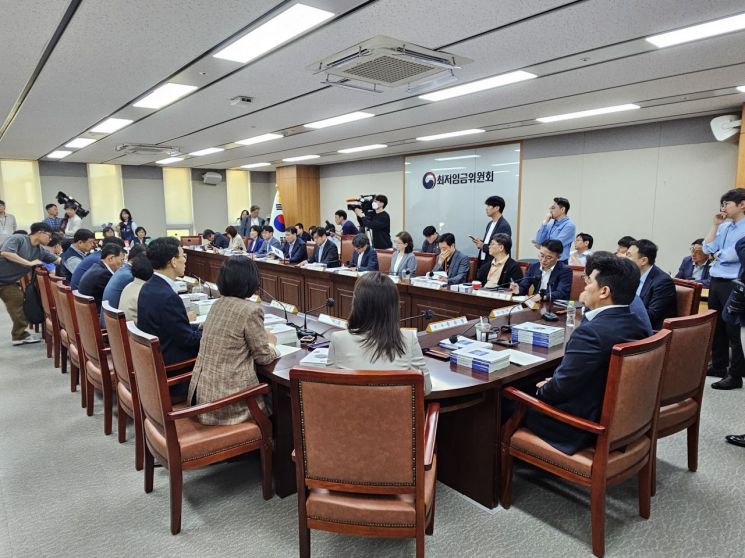
At the second plenary meeting on next year's minimum wage review held that morning, the management and labor sides expressed opposing views on key issues such as the actual living expenses of workers and the application of minimum wage to workers in special types of employment (teukso hyeongtae geunrosangsa, or teukgo).
In particular, the analysis of the living expenses of unmarried single workers reported by the Minimum Wage Commission's Living Expenses Expert Committee became the center of conflict. According to the analysis, the average monthly living expenses of unmarried workers living alone last year rose by 2% from the previous year to 2.46 million won. This means that a single person living alone without dependents needs at least 2.46 million won per month. This year's minimum wage is 9,860 won per hour, which translates to 2,060,740 won per month, 390,000 won less than the average actual living expenses.
Ryu Ki-jung, executive director of the Korea Employers Federation and a management-side commissioner, said in his opening remarks, "This includes high-income earners with monthly incomes of 7 to 8 million won, so it is not appropriate to use this for minimum wage deliberations," and pointed out, "It is reasonable to judge based on the living expenses of the minimum wage worker group, which is the policy target."
On the other hand, Ryu Ki-seop, secretary general of the Federation of Korean Trade Unions and a labor-side commissioner, emphasized, "Even the data published by the Minimum Wage Commission shows that the living expenses of unmarried single workers exceed 2.5 million won when considering inflation, but many workers support multiple household members, so the minimum wage must be significantly increased to a level that minimum wage worker households can live on."
Lee Mi-sun, vice chairperson of the Korean Confederation of Trade Unions, also said, "Urgent consideration is needed on how to solve the problem where unmarried single workers cannot even think about marriage or having children due to the minimum wage being lower than living expenses."
Furthermore, there were differences of opinion regarding the application of minimum wage to teukgo workers, which labor demanded in the previous meeting. Labor argues for discussing minimum wage for these workers to eliminate blind spots, but management maintains that they are not subject to the commission's review.
Executive Director Ryu said, "Teukgo and platform workers are not employees under the Labor Standards Act and therefore are not subject to minimum wage, so they cannot be discussed in the commission," and added, "In cases where subcontracted workers are recognized as employees on a case-by-case basis, discussion on separate minimum wage can be considered if necessity is recognized, but the recognition authority is not the commission but the government and courts."
Every year, during the minimum wage review process, there are disagreements between labor and management regarding the appropriateness of basic review data such as the actual living expenses of unmarried single workers. Criticism of the minimum wage decision-making method itself also continues. Regarding this, Chairman Lee said, "There have been continuous issues and supplementary discussions about the review data, but the current data is the best available produced by credible institutions," and added, "We will do our best with the existing data and make improvements if problems arise."
Regarding the decision-making method, he said, "Since I have not been in the chairman role for long, I will proceed smoothly within the current structure," and added, "Institutional improvements are matters to be discussed at a higher legislative and institutional level, not just within the Minimum Wage Commission."
© The Asia Business Daily(www.asiae.co.kr). All rights reserved.

















