25th Anniversary Conference of the National Finance Center
"Focus on Domestic Inflation Rather Than External Factors Like US Monetary Policy"
Need to Secure Fiscal Capacity to Prepare for Aging Population
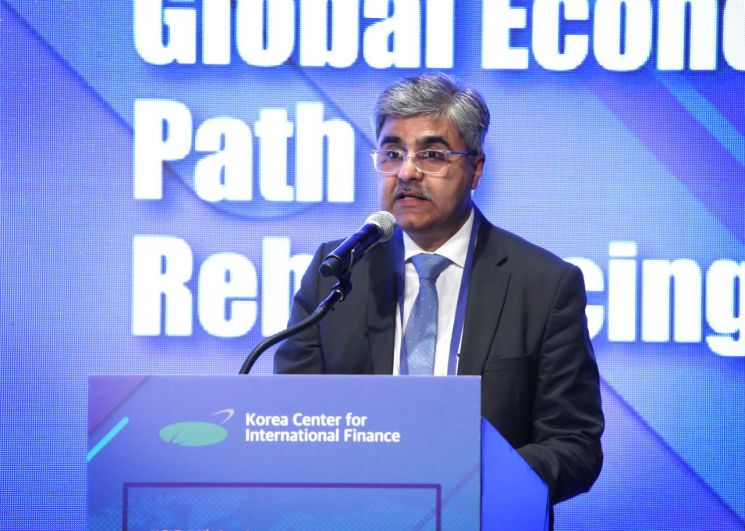
The Bank of Korea should focus on domestic inflation rather than external factors such as the U.S. Federal Reserve's (Fed) monetary policy when deciding its own monetary policy, according to a suggestion made. There was also a call to secure fiscal capacity in preparation for future aging.
Raoul Anand, head of the International Monetary Fund (IMF) Korea mission team, made these remarks on the morning of the 4th at the International Finance Center's 25th anniversary international conference held at the Plaza Hotel in Sogong-ro, Jung-gu, Seoul, under the theme "Challenges and Tasks of the Global Economy in the Era of Global Policy Transition."
Anand projected that the global economy will grow by 3.2% annually through next year, following last year. He said, "Consumer prices peaked in 2022 and are coming down, and the economic growth rate is steadily increasing," adding, "With stable but slow growth, the possibility of a recession has receded."
He assessed that inflationary pressures in Asian countries are relatively low. Anand stated, "Rapid monetary tightening and subsidy support policies have effectively controlled raw material price pressures," and "Compared to countries worldwide, inflationary pressure in Asia is at a low level." He added that service prices remain relatively high.
However, he noted that some countries, including Korea and Australia, maintained inflation rates above the central bank target level (2%) earlier this year, warranting caution. Anand said, "Korea faces many upside inflation risks such as geopolitical tensions and food prices," and suggested, "A balance is needed to allow inflation to converge to the target level without maintaining tightening for too long."
He continued, "Korea is a country with very strong resilience," and evaluated, "Monetary policy stance should be decided by focusing on internal conditions such as domestic inflation rather than external factors like the timing of the Fed's rate cuts."
He warned that an early shift in policy stance could be risky. Anand said, "Although inflation is converging to target levels in most countries, if policy stances change by country, capital flows could shift," adding, "In the current environment of a strong dollar and prolonged high U.S. interest rates, capital outflows could occur from Asian countries." He further emphasized, "Even if there is exchange rate volatility, central banks should focus on price stability."
There was also a suggestion to secure medium- to long-term fiscal capacity. Anand said, "If the need for fiscal spending increases sharply due to aging, questions about fiscal sustainability may arise," and assessed, "Pension reform and the introduction of fiscal rules will be necessary."
He stressed the need to prepare for structural changes such as aging, AI, and climate change in the future. Anand said, "While AI brings positive factors, there may also be negative factors such as job losses," and added, "Various social security systems should be introduced to address these negative factors."
He also said, "In aging countries, productivity is very important, so R&D investment is necessary," and added, "Furthermore, the dual structure of the labor market between regular and non-regular workers and the dual productivity structure between large and small and medium-sized enterprises must be overcome."
© The Asia Business Daily(www.asiae.co.kr). All rights reserved.
![Clutching a Stolen Dior Bag, Saying "I Hate Being Poor but Real"... The Grotesque Con of a "Human Knockoff" [Slate]](https://cwcontent.asiae.co.kr/asiaresize/183/2026021902243444107_1771435474.jpg)
















